Sorrow
Original title: Sorrow
kurzbeschreibung
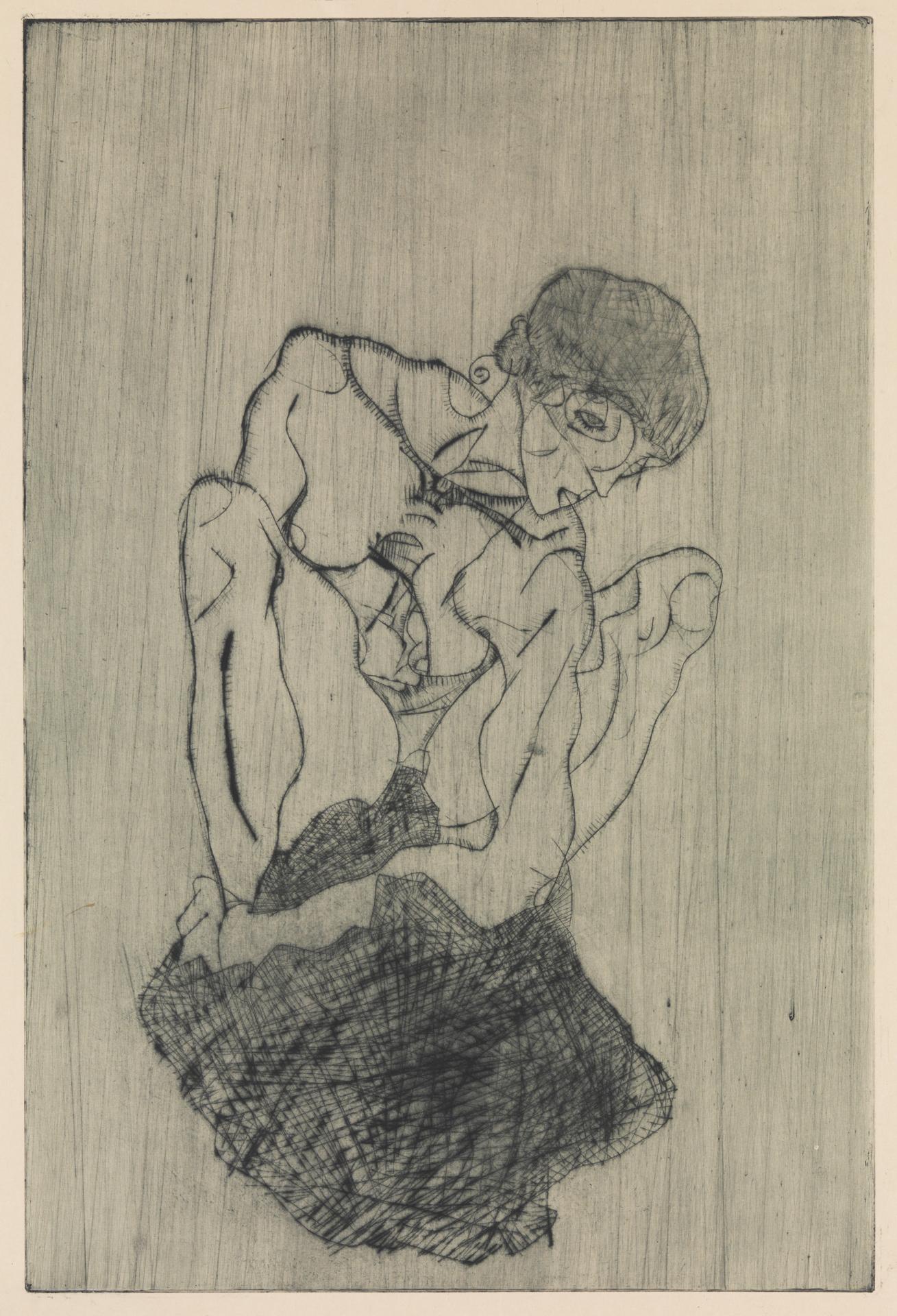
A seated figure, withdrawn into herself, dominates Egon Schiele's drypoint 'Trauer' from 1914. In this vertical sheet, the Expressionist concentrates his expressive line into a dense, emotionally charged portrait.
Description
A single seated person appears, head bowed low, gaze directed downward. Over shirt and trousers lies a close-meshed web of strokes that gives the surface an almost ornamental structure. The layout remains strictly centered, with no other figures or objects. Varying depth and density of lines create a monochrome gray scale; light falls evenly, without harsh shadows.
Context
The etching dates to 1914, a period of high productivity for Schiele immediately after his marriage to Edith Harms. At the same time, the First World War began, profoundly changing the artist's living and working conditions. Within a series of prints, he addressed existential themes such as loneliness and transience. He used the drypoint repeatedly in these years to test immediate graphic means of expression.
Impact
The bowed head and dense web of lines create an oppressed, inward-turned mood. The expressive stroke carries a direct emotional force that draws the viewer into the figure's despair. Through the monochrome, the sheet feels serious and entirely focused on the psychological.
Technique
Executed as a drypoint on paper, the lines are scratched directly into the copper plate. The print leaves the typical, slightly blurred burr lines that heighten the expressive quality. The paper measures 52.7 × 40 cm, the plate 47.9 × 32.1 cm.
AI-generated description text
Source: Metropolitan Museum of Art · Public Domain (CC0 1.0)