Irises
Original title: Irises
kurzbeschreibung
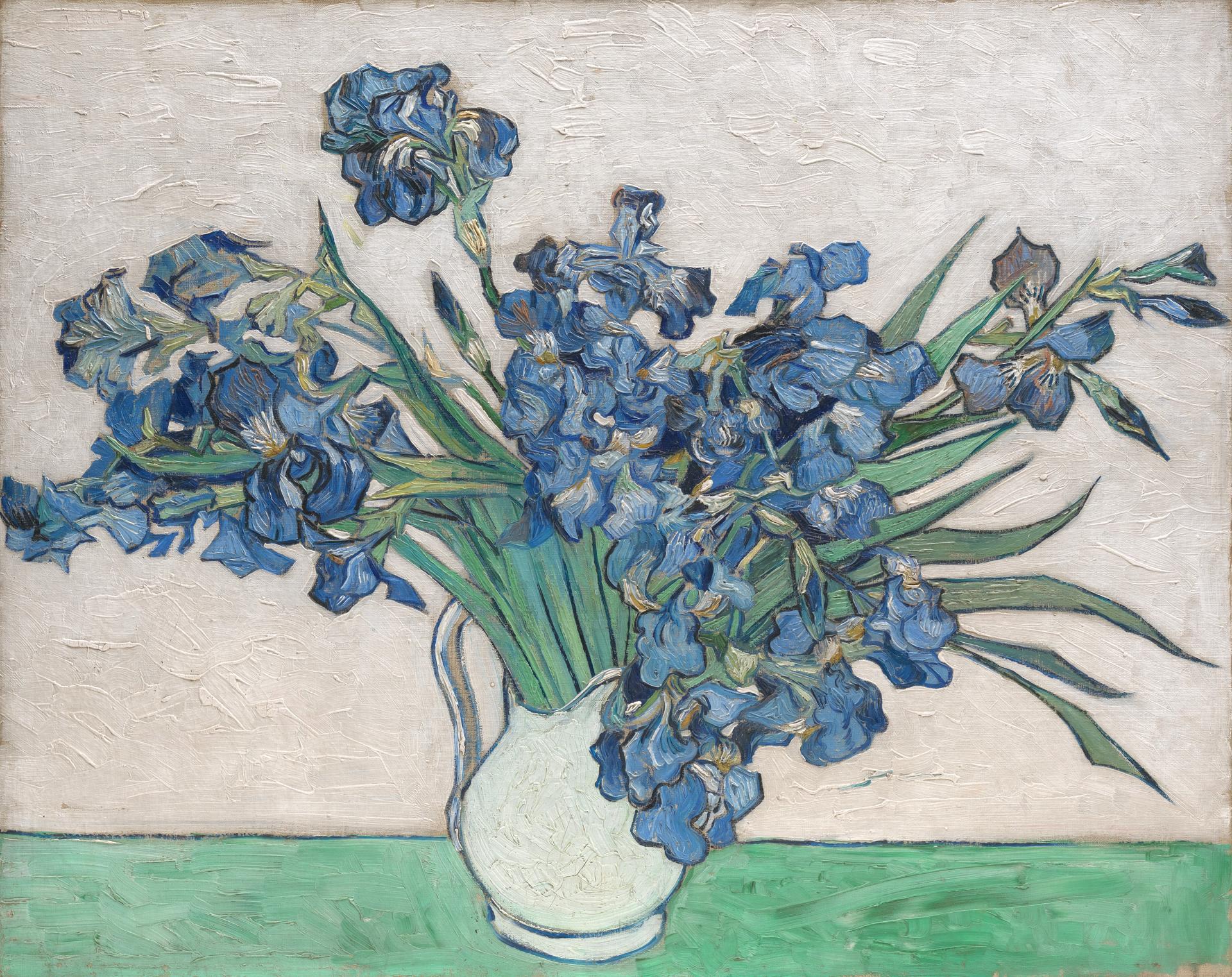
Vincent van Gogh painted the floral still life "Iris" in 1890. Oil on canvas, 73.7 x 92.1 cm. It shows iris blossoms in a white vase, their blue tones standing out against a light, cream-colored ground.
Description
A white, stylized vase forms the center, holding a dense cluster of irises. Their petals range from deep to bright blue, while the stems are yellow and cream. The green leaves vary in length and shape. A uniform light-cream background surrounds the flowers; a green strip at the bottom suggests the ground. Visible brushstrokes and the textured surface emphasize the structure of the blossoms and the vase.
Context
Painted in 1890, during the last year of Van Gogh's life, while he was staying at the Saint-Paul-de-Mausole asylum in Saint-Rémy-de-Provence. There he made several flower still lifes with plants from the asylum's garden. The picture's design reflects influences from Japanese woodblock prints, especially in the simplification of forms and the emphasis on flat areas. Van Gogh was working in a phase of intense production, shortly before his death in July 1890.
Impact
The luminous blues and the light background give the picture a fresh and lively appearance. The visible brushwork lends the scene a dynamic, almost expressive quality. Because only flowers, vase, and background are shown, a calm, concentrated mood arises.
Technique
Oil paint is applied in dense, visible brushstrokes on the canvas. This impasto method creates a relief-like surface that reflects light and mimics the texture of petals and leaves. The palette is limited to blue, green, and yellow tones, making the picture harmonious and clear.
AI-generated description text
Source: Metropolitan Museum of Art · Public Domain (CC0 1.0)