Rosa Bonheur
Original title: Rosa Bonheur
kurzbeschreibung
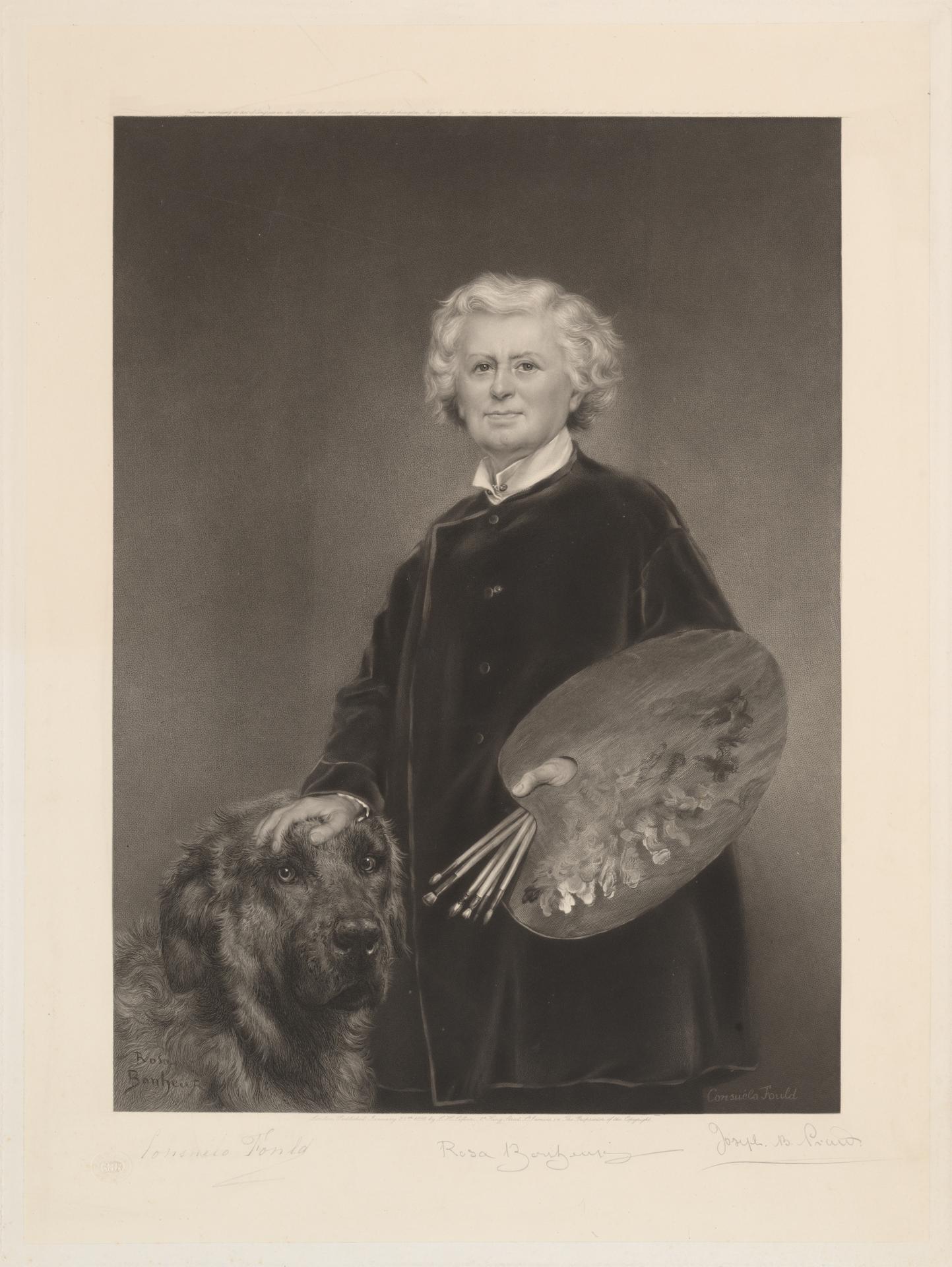
Joseph Bishop Pratt portrayed the celebrated animal painter Rosa Bonheur in 1896. The mixed-method mezzotint on chine collé is a proof before letters. Bonheur appears with her painting equipment and a dog at her side, a nod to her role as an artist and her closeness to animals.
Description
Over a white shirt she wears a black coat; her right hand holds a palette, her left a brush. A dog nestles against her and touches her face. The background stays plain and dark. The layout feels balanced, with the woman at its center and the dog shifted slightly to the left. Frontal light models the figures and picks out their contours, while the monochrome palette lets the delicate mezzotint lines come forward.
Context
Rosa Bonheur (1822–1899) was a French animal painter of international renown whose realistic pictures of animals were widely admired. The American artist Joseph Bishop Pratt made the portrait in 1896, when Bonheur was already over 70. Rendered as a mezzotint — a print technique common in the nineteenth century for reproductive portraits — the sheet presents the dog as a loyal companion, pointing to Bonheur's close bond with animals, which often lived in her studio.
Impact
The portrait feels intimate and dignified: Bonheur appears in familiar surroundings with her working tools. The calm, balanced arrangement and gentle lighting give the image a timeless elegance. Mezzotint produces a soft, velvety texture that brings out skin tones and fabrics in detail.
Technique
In this mixed-method mezzotint on chine collé, a thin sheet of Chinese paper is pasted onto a support paper. The mezzotint is made by roughening a copper plate and then smoothing selected areas, which allows fine gradations of tone. As a proof before letters, it shows the pure image without any added text and attests to Pratt's technical precision.
AI-generated description text
Source: Metropolitan Museum of Art · Public Domain (CC0 1.0)