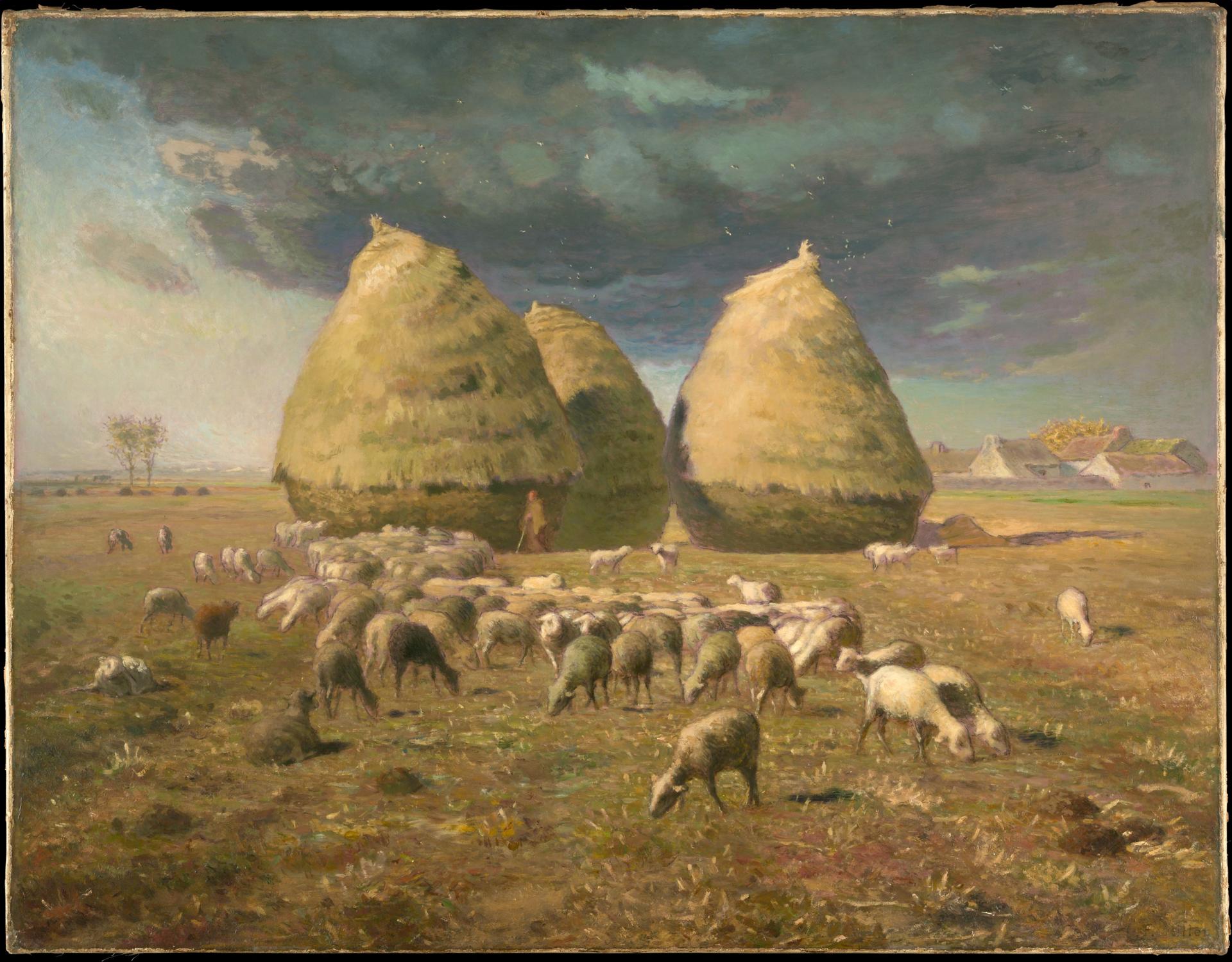
Haystacks: Autumn
Original title: Haystacks: Autumn
kurzbeschreibung
Around 1874, Jean-François Millet painted the oil work Heuhaufen: Herbst (Haystacks: Autumn), a rural view with stacked straw heaps, grazing sheep, and an overcast sky. It belongs to his late works, in which he placed country life at the center of his attention.
Description
Several straw bales step in a half-round across the middle of the picture and set the rhythm. In front of them, sheep graze on a meadow. Behind the heaps appear trees and a house with a dark roof; above lies a sky in blues and grays that suggests a misty day. Muted, natural colors prevail, and the animals as well as the bales are captured with great precision and realism.
Context
Millet was one of the leading masters of the Barbizon school, which had devoted itself to a realistic portrayal of peasant existence. This painting falls in his last years, when he increasingly took up landscapes and motifs from everyday rural life. It joins a series of haystack depictions made in the 1870s and inspired by the surroundings of Barbizon.
Impact
Calm and a hint of melancholy emanate from the picture; the muted tones and the cloudy sky contribute to this. The way the haystacks and sheep are arranged creates a harmonious, almost monumental pictorial structure that emphasizes the dignity of rural labor.
Technique
Millet worked with oil paint on canvas, which he applied in several layers to achieve soft transitions in the landscape. Especially in the foreground areas, the brushstroke is loose and pastose, while the sky is kept smoother—a means that supports the atmospheric effect.
AI-generated description text
Source: Metropolitan Museum of Art · Public Domain (CC0 1.0)