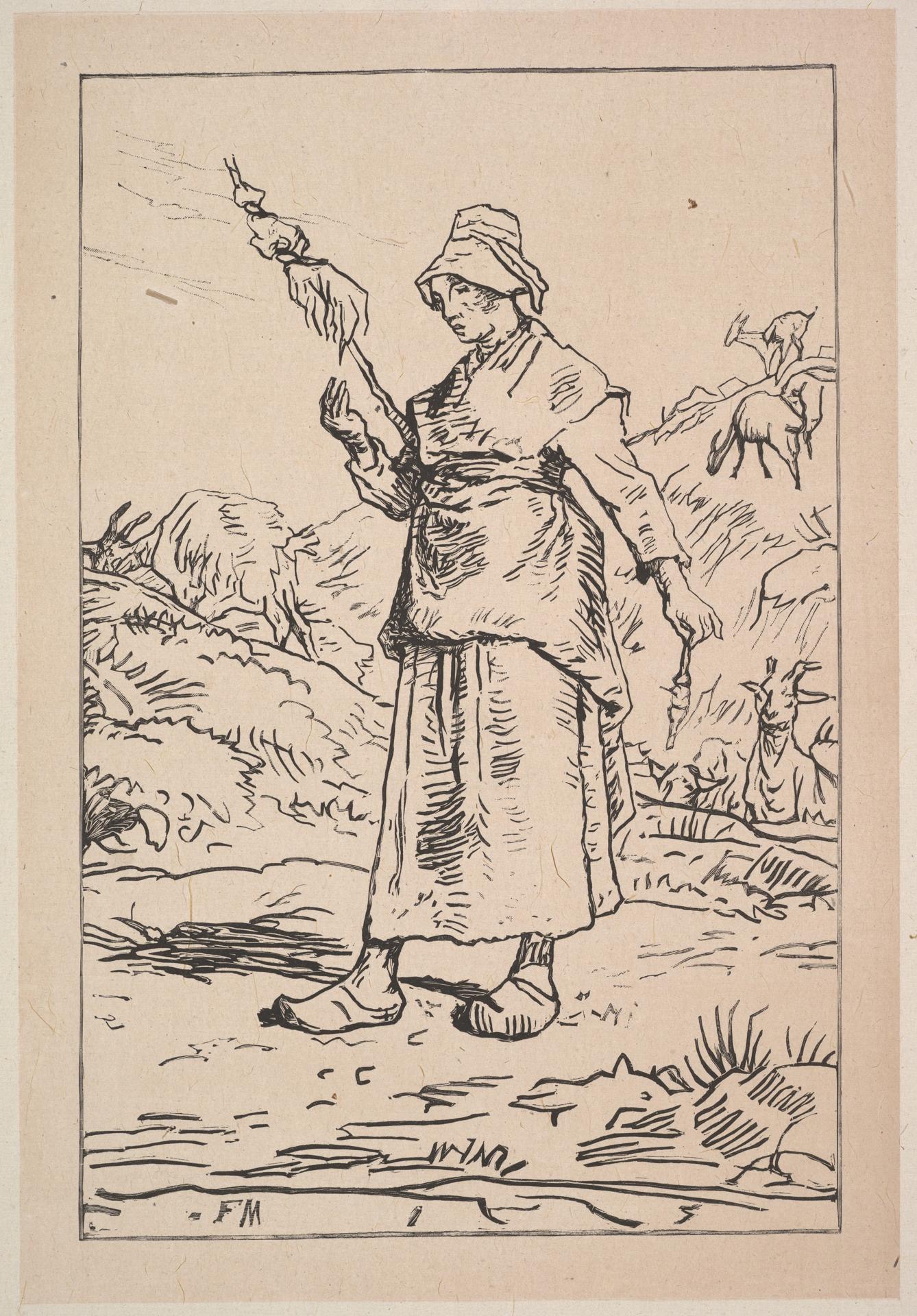
Spinner from the Auvergne
Original title: Spinner from the Auvergne
kurzbeschreibung
A spinner in traditional dress, wearing a hat and long jacket, holds a spindle and draws out yarn in this woodcut by Jean-François Millet, made between 1830 and 1899. Behind the upright woman, sheep graze on a hillside, reinforcing the rural character of the print.
Description
The woman stands upright, wholly absorbed in her work, spindle in hand as she pulls the thread. Her clothing includes a hat and a long, tightly fitted jacket. Several sheep graze on the slope behind her. Fine strokes and hatching shape the landscape; the image remains monochrome, with even light and no discernible shadowing.
Context
Millet, a French painter and printmaker of realism, became known above all for scenes of peasant labor. The Auvergne lies in central France and is considered a region with a strong rural tradition and livestock farming. The print probably falls into a period when Millet was deeply engaged with country life. Works of this kind helped raise appreciation for rural people in nineteenth-century art.
Impact
Calm and dignity emanate from the figure: the spinner's concentrated posture draws the eye first to her hands and the spindle, and only then to the sheep on the slope. Fine lines and even light give the sheet a clear, almost graphic effect. The rural setting feels idyllic yet remains realistically observed.
Technique
Millet worked here in woodcut: the image is cut into a woodblock and then printed on paper. The fine strokes and hatching reveal careful carving. The monochrome result is typical of this technique, which in the nineteenth century was used both for book illustrations and for individual prints.
AI-generated description text
Source: Metropolitan Museum of Art · Public Domain (CC0 1.0)