The Diggers (1830–99)
Original title: The Diggers
kurzbeschreibung
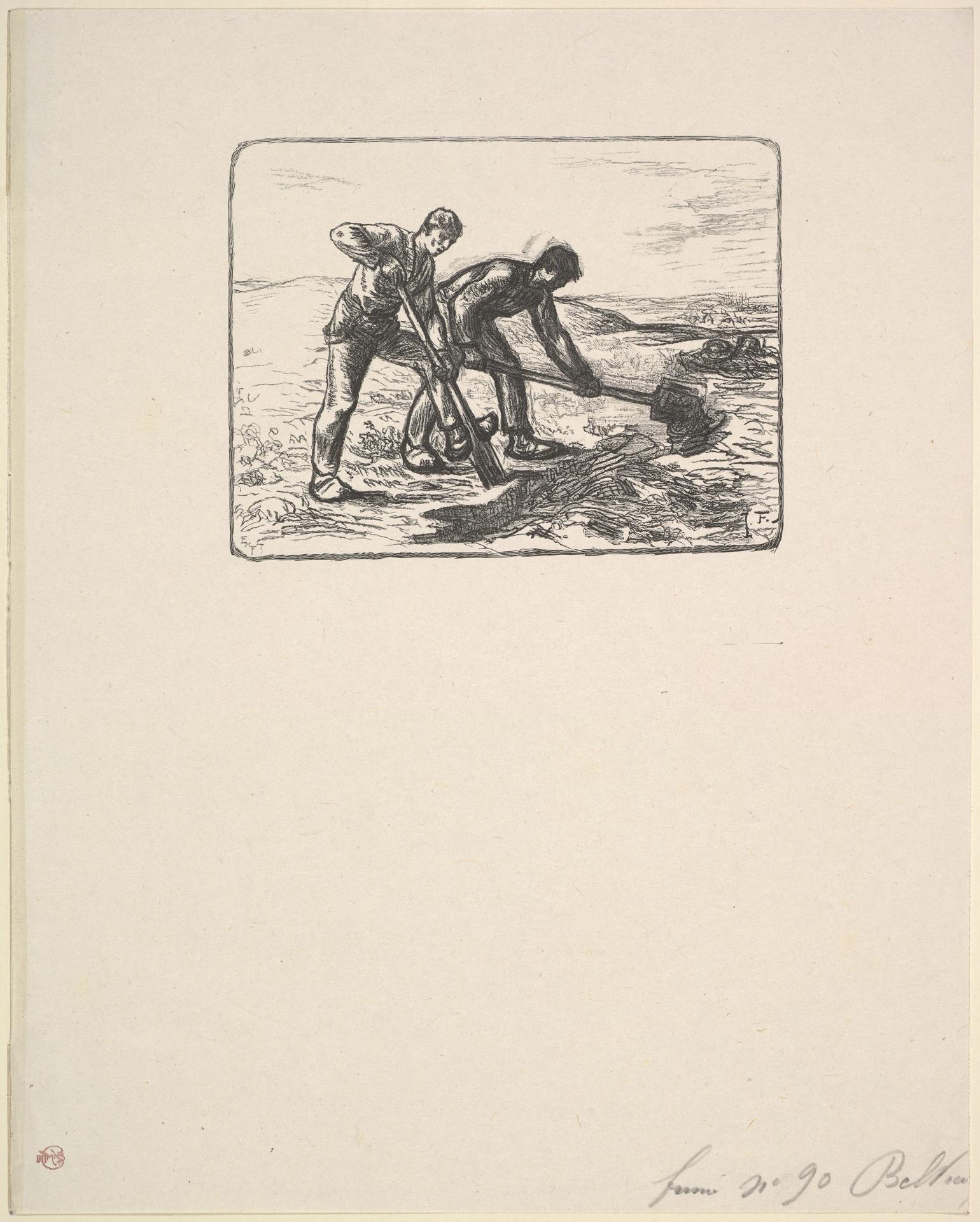
This woodcut by Jean-François Millet, titled Die Gräber, was made sometime between 1830 and 1899. Two men are shown digging up earth in a rural setting, and the print is executed in black and white.
Description
At the middle of the image, two men work with spades. Behind them stretches flat country with scattered shrubs and a sky carrying light clouds. Their clothing looks traditional and points to an earlier time. The layout stays easy to read: the workers in front, the landscape as a quiet close behind them. Light falls evenly, without strong shadows or harsh contrasts.
Context
Millet, a French painter and printmaker, became best known for his scenes of peasant labor. He belonged to the Barbizon school, which devoted itself to a realistic rendering of landscape and country life. During the years this sheet was made, he was studying the daily life of rural people closely. Works like this one often circulated as reproductions and so reached a wider audience.
Impact
A quiet, reflective mood comes off the print, carried by the plain arrangement and the men's old-fashioned dress. The realistic approach, with a faint nostalgic note, gives their labor something timeless and dignified. Because there is no color, the eye stays on forms and on the work itself, without distraction.
Technique
Millet chose the woodcut here, a relief process in which the image is cut away from a block of wood and then printed. The lines stand out clearly and evenly, as is usual for this technique. The print measures 10.7 × 14.1 cm, the sheet 30.6 × 24.3 cm.
AI-generated description text
Source: Metropolitan Museum of Art · Public Domain (CC0 1.0)