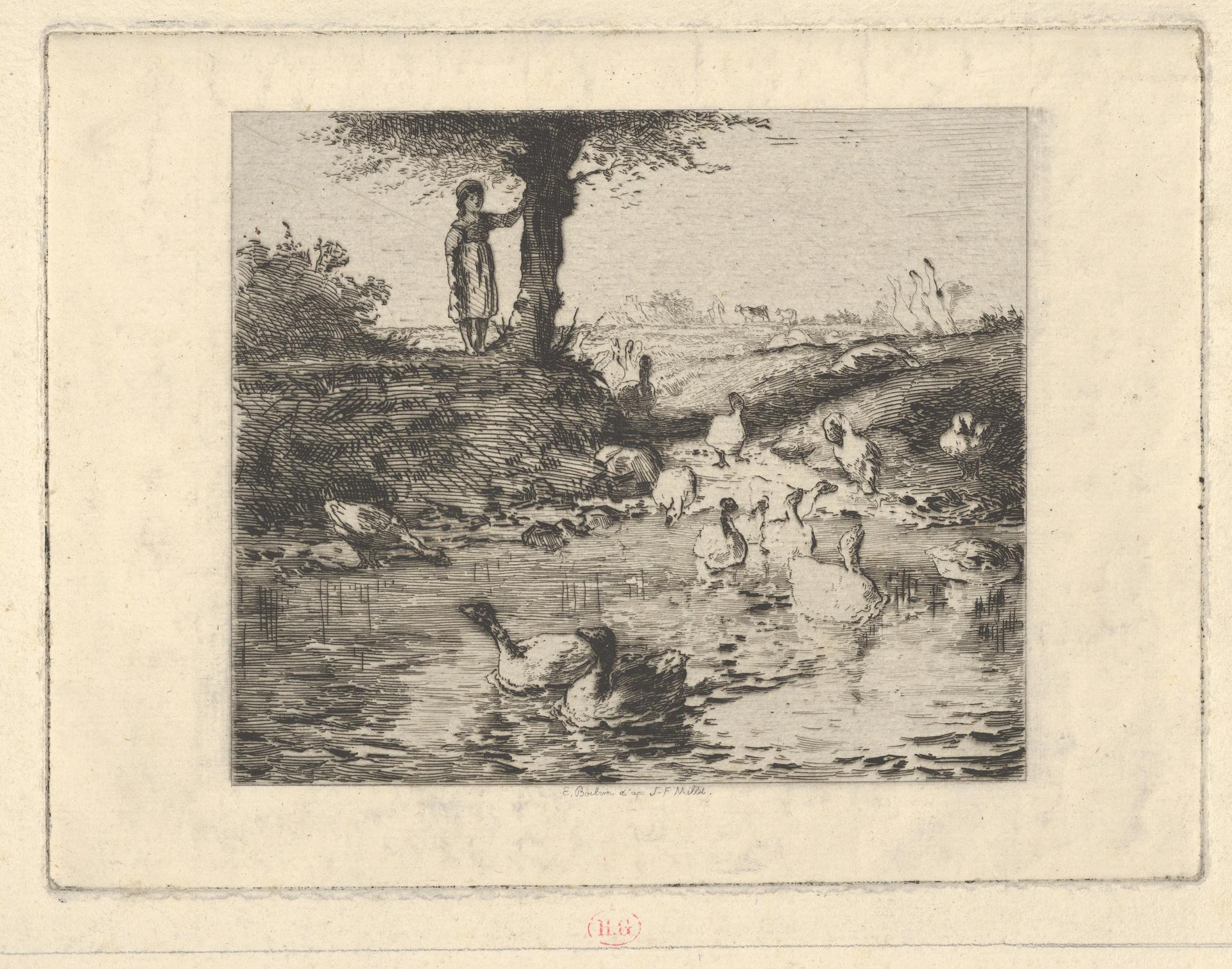
The Guardian of the Geese, after Millet
Original title: The Guardian of the Geese, after Millet
kurzbeschreibung
Emile Boilvin made this etching, Die Hüterin der Gänse, nach Millet, between 1888 and 1899. It shows a young woman standing under a tree, holding a bowl and calling a flock of ducks toward her. The print is an etching on paper; the sheet measures 21.4 by 29.8 cm, the plate 14 by 18.8 cm. The source was a work by Jean-François Millet.
Description
The layout is horizontal. In the foreground a female figure stands beneath a tree, bowl raised, her gaze on a group of ducks. These are scattered across foreground and background: some swim in the water, others stay on land. Behind opens a wide landscape with trees under a clear sky. The etching remains monochrome in grays and blacks; light falls evenly, with no strong shadows. Fine lines and hatching bring out textures and forms.
Context
Emile Boilvin (1845–1899), a French painter and printmaker, was known for his etchings after works by earlier masters. The source by Jean-François Millet (1814–1875) belongs to the circle of the Barbizon School, which depicted rural life realistically. Boilvin's etching is part of a series of reproductions that helped spread Millet's art in the late nineteenth century. The sheet is in the collection of the Metropolitan Museum of Art as public domain (CC0).
Impact
The etching radiates a calm, idyllic mood. The even distribution of light and the balanced arrangement of figure, animals, and landscape contribute to this. The realistic style, with impressionistic touches, feels lively without losing the graphic rigor of etching.
Technique
Etching involves incising a drawing into a metal plate—an intaglio process. Boilvin used fine lines and hatching to model the feathers, foliage, and ground with a sense of volume. The monochrome printing ink in grays and blacks is characteristic of this technique.
AI-generated description text
Source: Metropolitan Museum of Art · Public Domain (CC0 1.0)