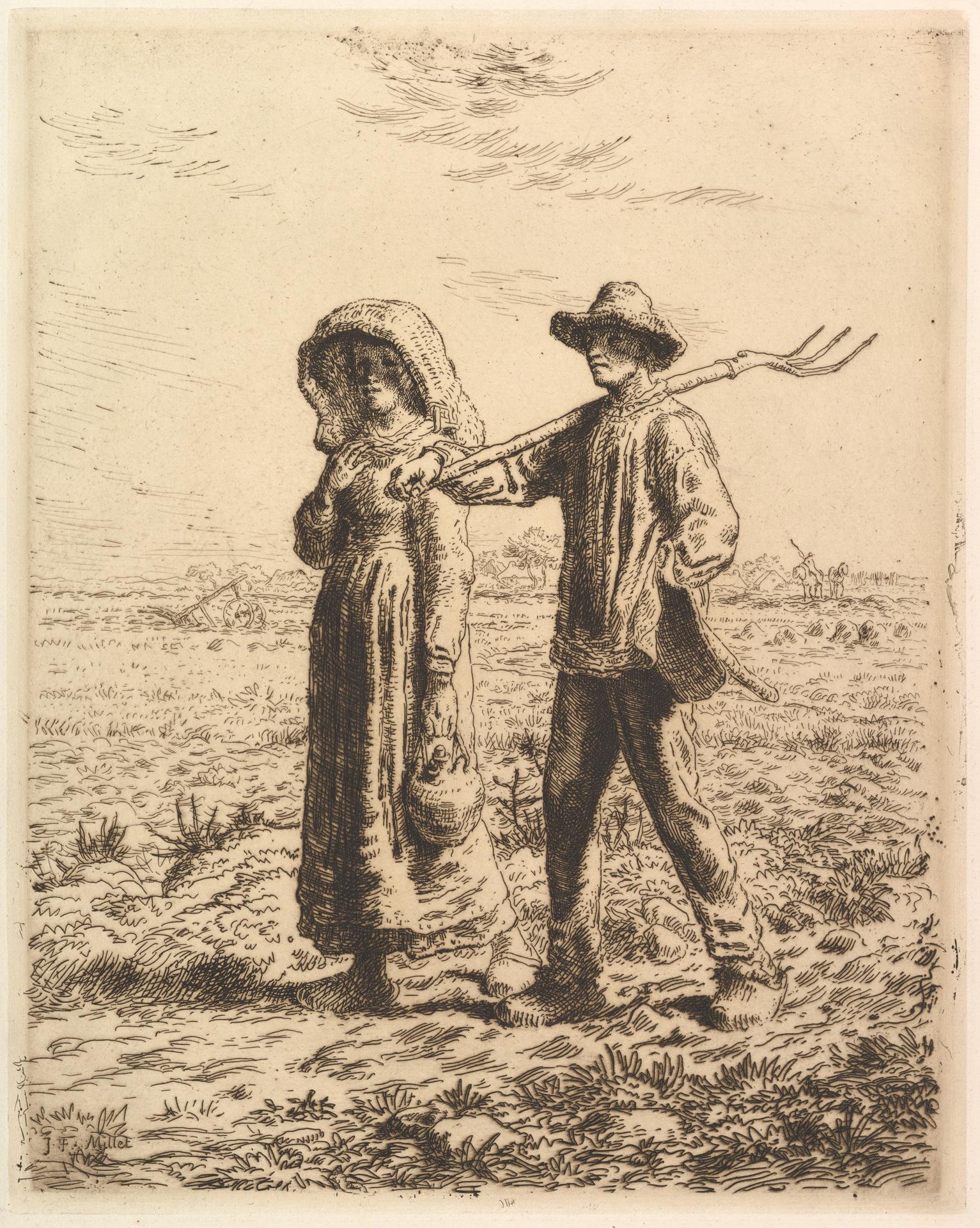
Peasants Going to Work (1863, Met-Objekt 4938)
Original title: Peasants Going to Work
kurzbeschreibung
Two peasants cross a field in this 1863 etching by Jean-François Millet. The impression, in brown ink on laid paper, is from the seventh and final state of the plate.
Description
A man in a hat leads the plow, while beside him walks a woman wearing an apron, a headscarf, and carrying a bag. Both draw close to the viewer and dominate the picture surface. Behind them, further fields and plows are suggested, under a lightly clouded sky. The arrangement runs horizontally, the light falls evenly and casts hardly any shadow. Brown in brown remains the tone of the entire sheet.
Context
In 1863 Millet was working intensively on the everyday life of rural people, and this motif belongs to those works in which he shows peasants at their daily labor. That the plate survives in seven states suggests a thorough, step-by-step working process.
Impact
From the first glance, a sense of calm emanates from the sheet, along with a quiet measure of dignity. Nothing is exaggerated, nothing dramatized: the even inking and the simple layout let the daily walk to work appear as a natural part of life. The viewer accompanies the two rather than watching them.
Technique
In etching, the drawing is bitten into a copper plate and then printed onto laid paper. The brown printing tone gives the impression a warm, earthy mood. The fact that the seventh state is reached here points to several revisions of the plate.
AI-generated description text
Source: Metropolitan Museum of Art · Public Domain (CC0 1.0)