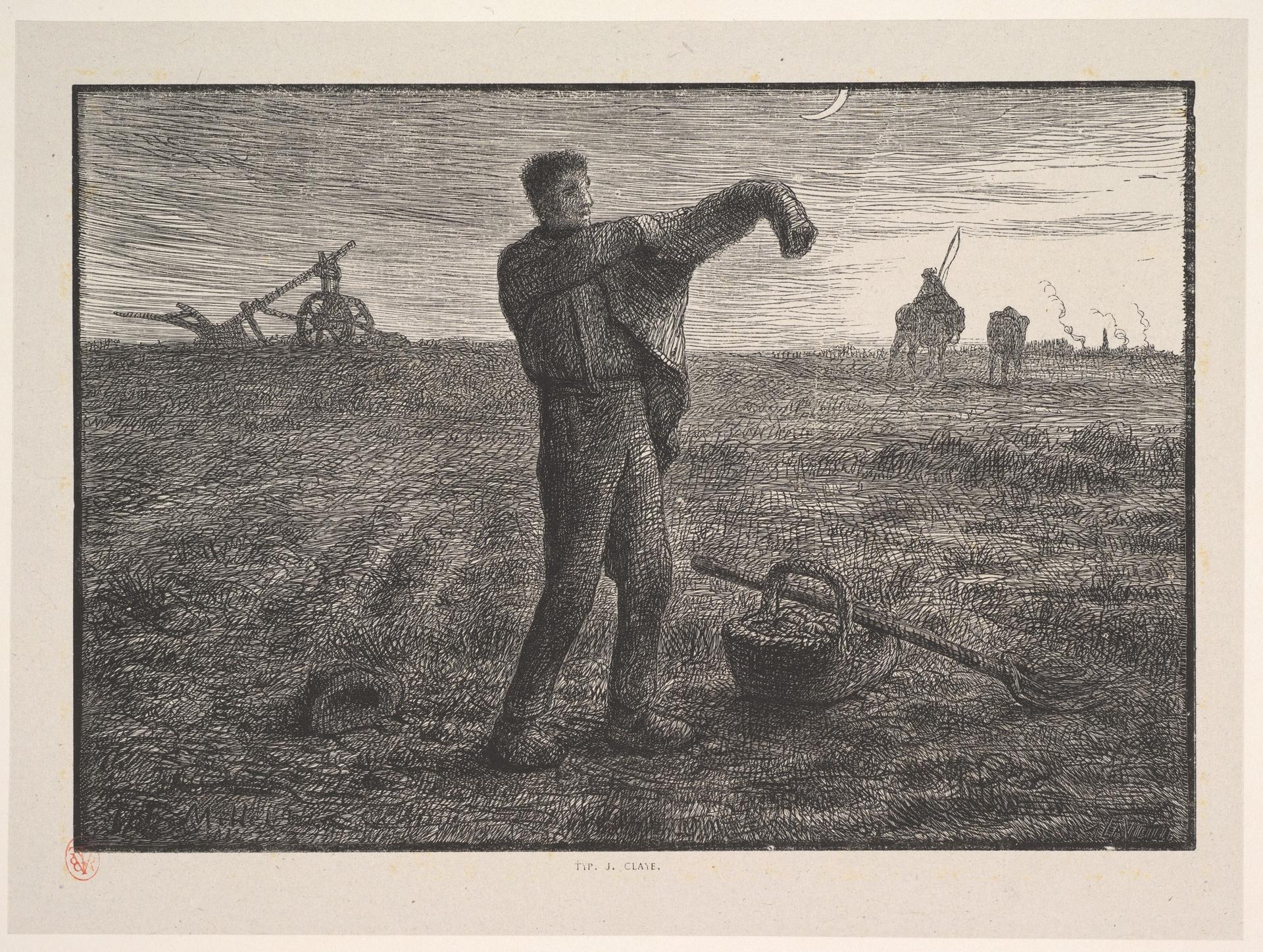
Evening, from "Four Times of the Day"
Original title: Evening, from "Four Times of the Day"
kurzbeschreibung
Evening belongs to Jean-François Millet's series The Four Times of the Day and was made between 1830 and 1875. Printed on chine collé, the sheet presents a man in a rural setting caught mid-gesture, with further figures and tools appearing behind him.
Description
A plainly dressed man stands at the front, one hand raised as if greeting someone or waiting for a reply. Beside him sit a basket and a long implement resembling a spade. Farther off, figures are scattered across an open stretch of farmland dotted with agricultural equipment. The setting sun lights the sky, and the monochrome grey palette yields soft shadows through the woodcut's cut marks. The layout runs horizontally, the main figure placed centrally while the secondary figures step back in stages.
Context
The Four Times of the Day series belongs to Millet's broader work on rural life and the labour of peasants. This print was pulled on chine collé, a method prized in the nineteenth century for fine impressions. The dating of 1830–75 spans Millet's entire active career, the years in which he worked at Barbizon and helped shape the artists' colony there.
Impact
Soft light and gentle shadow give the image a quiet evening mood that invites lingering. Ordinary country life comes across as dignified and poetic without being prettified.
Technique
Line and hatching carry the image: the wood engraving relies on grooves cut into the block, their depth and density grading the greys. Printing took place on chine collé, a thin, silk-like paper pasted onto a heavier support sheet. Delicate lines and subtle tonal steps arise from the varying direction of the cuts.
AI-generated description text
Source: Metropolitan Museum of Art · Public Domain (CC0 1.0)