The Raker
Original title: The Raker
kurzbeschreibung
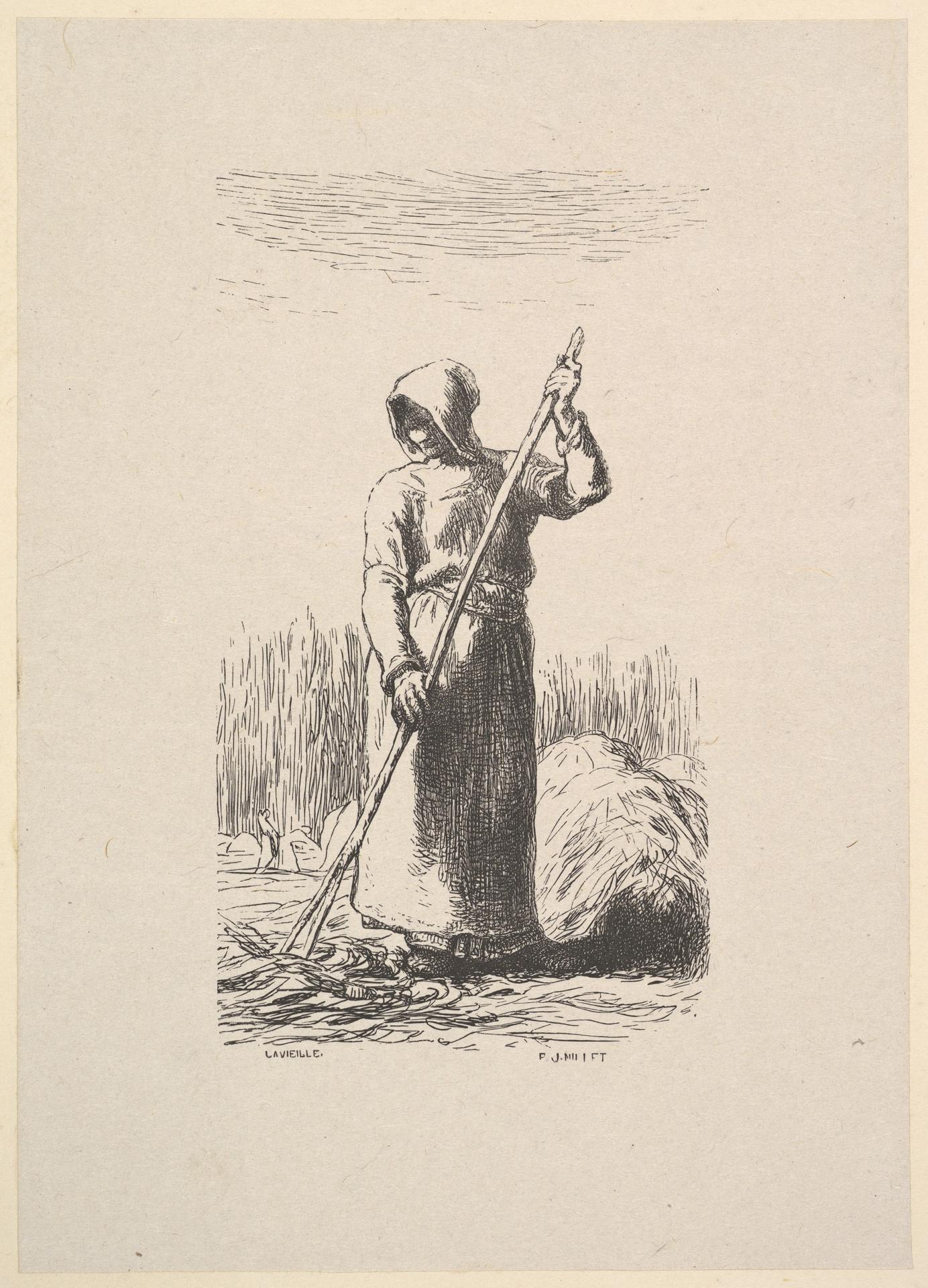
Jean-François Millet made this woodcut in 1853. It depicts a farm labourer with a rake, printed as a proof on chine collé. The subject belongs to Millet's series of scenes of rural work.
Description
A peasant in simple work clothes draws the rake across the ground; a hood or cloak covers the head so that no face is visible. Behind him stand a straw heap and low shrubs. The black and white of the woodcut and the even light define the image. The realistic gaze is fixed entirely on the labourer's task and his surroundings.
Context
The print was made during Millet's Barbizon years; he settled there from 1849. In the 1850s he turned increasingly to peasant labour and made it his main subject. Printmaking flourished in France at that time. That Millet placed rural people so centrally was unusual for his era.
Impact
The sparse layout lets the eye rest entirely on the peasant's activity. Because his face remains hidden, the figure feels general and typical. The calm, sober rendering conveys the dignity of rural work.
Technique
The woodcut was printed on chine collé, a demanding process using fine Japanese paper. Woodcut allowed fine lines and details with strong contrasts. As a proof, the sheet shows the state before the final revision of the block.
AI-generated description text
Source: Metropolitan Museum of Art · Public Domain (CC0 1.0)