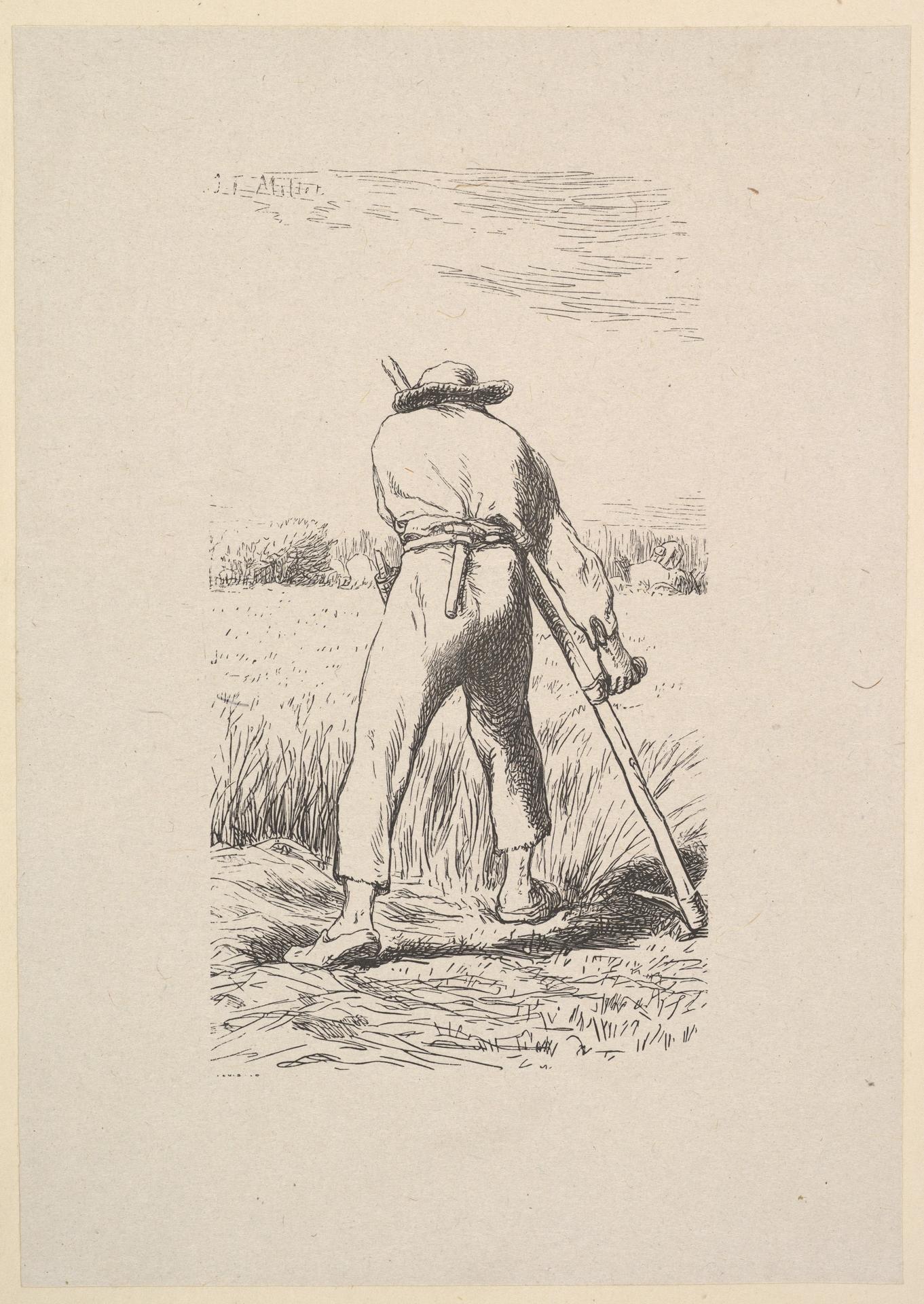
The Wheat Reaper
Original title: The Wheat Reaper
kurzbeschreibung
Dating from 1853, this woodcut by Jean-François Millet belongs to a series he made in the 1850s. The sheet, a monochrome print on chine collé, shows a man at work in the fields.
Description
A man is seen from behind, working in a field. He wears a wide cap, a jacket and trousers; in his right hand he holds a long, curved object that recalls a sickle or an axe, while his left hand grasps something that could be read as a tool or a bag. Tall grass or grain fills the field, and beyond it further fields stretch out under a flat, cloudless sky. The arrangement stays plain and directs the eye to the figure and his labour.
Context
Around 1853 Millet was devoting himself intensively to rural life and the work of peasants. This woodcut belongs to a series he produced for the art market in order to make his work accessible to a wider public. The field worker points to Millet's interest in the dignity of peasant labour, which also comes through in paintings such as The Sower (1850).
Impact
The spare, monochrome treatment gives the sheet a quiet, serious mood. Because the labourer is shown from behind, the viewer is drawn into the scene and takes in the work from the harvester's point of view.
Technique
The woodcut was printed on chine collé, in which thin Japan paper is pasted onto a support sheet. The block measures 13.5 by 7.5 centimetres, suggesting a small, detailed format. The present impression is a proof, which points to an early stage of pulling the print.
AI-generated description text
Source: Metropolitan Museum of Art · Public Domain (CC0 1.0)