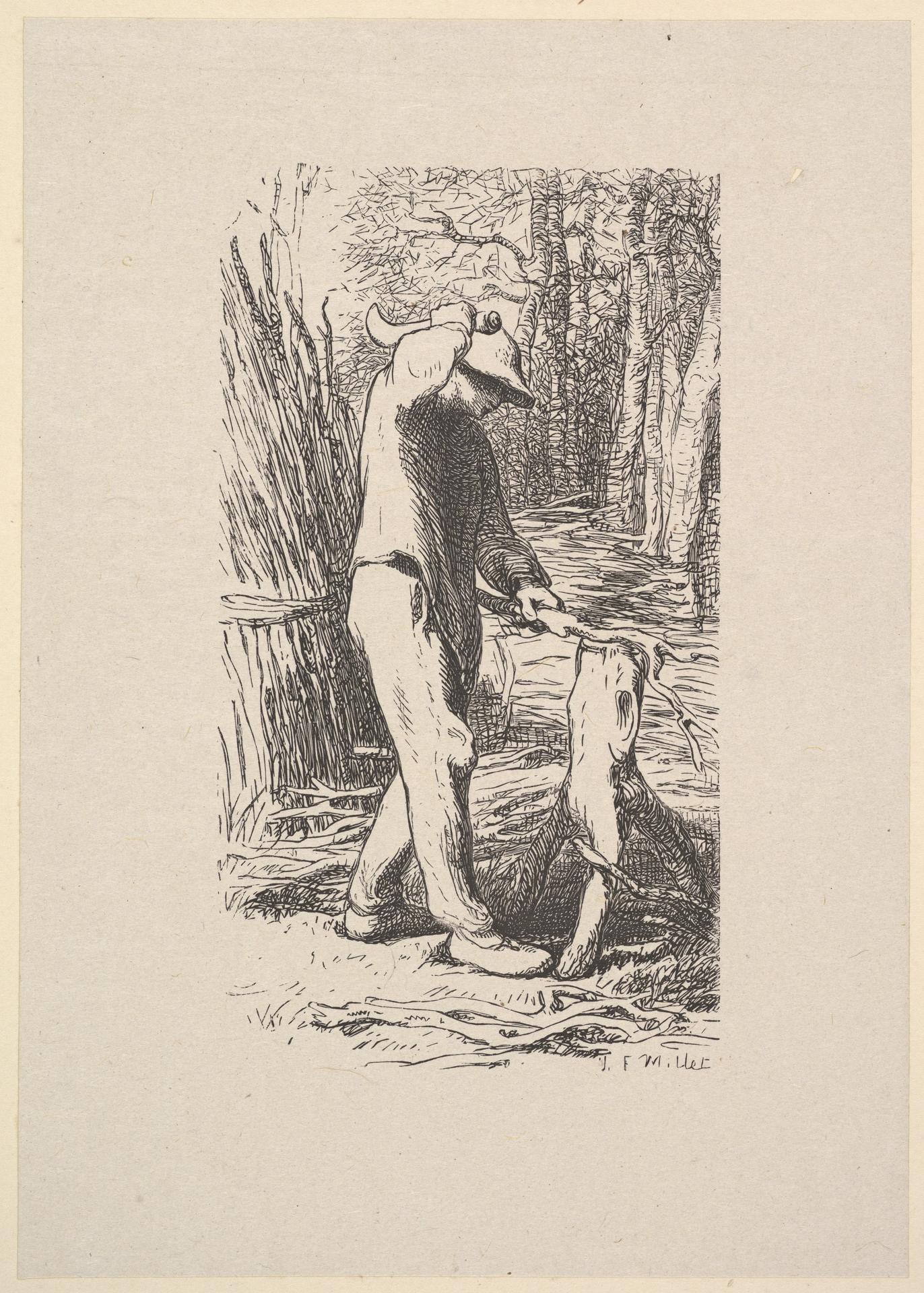
Woodcutter Making a Faggot
Original title: Woodcutter Making a Faggot
kurzbeschreibung
Where many pictures of forest labourers of the period dwell on the blow of the axe or the toppling trunk, Jean-François Millet's 1853 woodcut Holzfäller beim Bündeln von Reisig centres on gathering and tying. The proof on chine collé measures just 13.5 by 7.5 centimetres and follows a worker through an unspectacular but necessary task. Millet, best known for his scenes of rural work, was drawn here to the rhythm of everyday gestures.
Description
A woodcutter stands on a forest path, binding a bundle of brushwood; he wears protective trousers and a shirt, and a branch rests in his hand. Fallen limbs and leaves cover the ground, while further trees and branches close the space into a dense wood. Worked in black and white with very precise, thin strokes, the print conveys the grain of timber and the texture of foliage. The arrangement is plain and leads the eye to the man's task and his immediate surroundings.
Context
Jean-François Millet (1814–1875) was a French painter and printmaker, remembered above all for scenes of peasant life. He belongs to the Barbizon school, which devoted itself to realistic landscape and figure painting. The woodcut of 1853 falls in a period when Millet was engaging more closely with the lived reality of country people. Its small format suggests a study or a proof intended for a planned series or publication.
Impact
The sheet gives off a calm, concentrated mood that makes the hardship and persistence of rural work tangible. The dense, fine hatching draws the viewer into the wooded space. Altogether the work is unassuming yet insistent, characteristic of Millet's sympathetic view of working life.
Technique
Executed as a woodcut, the print was made on chine collé, that is, thin Japanese paper laid onto a support sheet. As a proof, the sheet reveals the fineness of the lines and the accuracy of detail cut into the block. The black-and-white treatment stresses the graphic quality and the careful carving.
AI-generated description text
Source: Metropolitan Museum of Art · Public Domain (CC0 1.0)