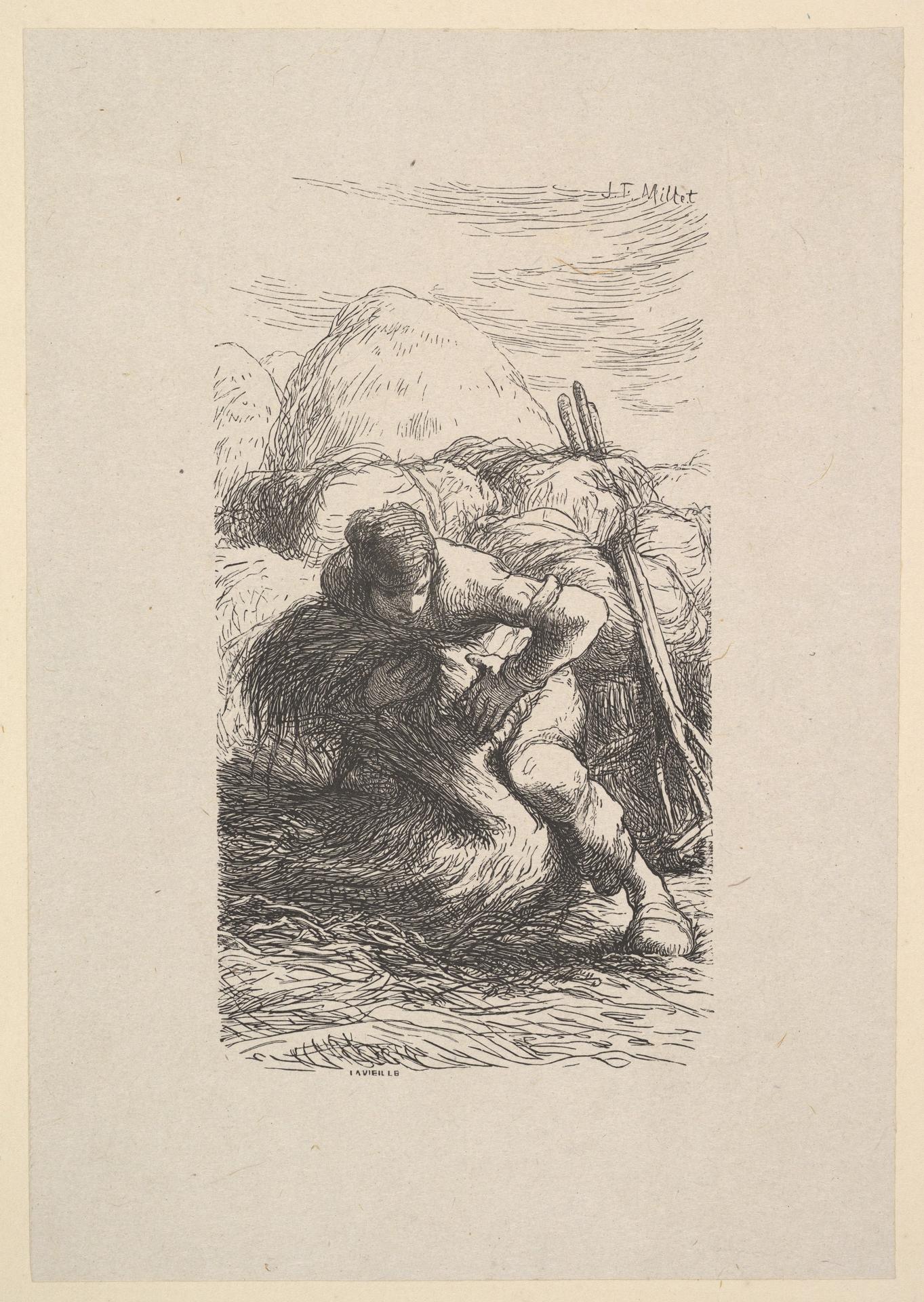
The Sheaf Binder
Original title: The Sheaf Binder
kurzbeschreibung
A figure bends over a sheaf of grain — this motif of field work was captured by Jean-François Millet in 1853 as a woodcut. Black on chine collé, without color, entirely focused on the movement and posture of the figure.
Description
A person kneels on the ground, holding a bundle of ears or grain in their hands, dressed in simple work clothes; their posture seems collected and thoughtful. Behind them, mountains or hills are only hinted at, placing the sheet in a rural setting. The linework is dense and constantly varies in width, making the surfaces of each element tangible. Light is distributed evenly across the view, with no harsh contrasts or distinct shadows.
Context
The woodcut was made in 1853, during a phase in which Millet was deeply engaged with the everyday life of rural people. It belongs to the same circle as his later paintings, such as 'The Gleaners' of 1857, and demonstrates his sustained interest in field work as a subject. The present sheet is a proof print, valued as an independent work of art. Millet's sober view of rural people was unusual for its time and had a lasting influence on nineteenth-century genre painting.
Impact
The sheet feels concentrated and quiet because the main figure dominates the pictorial space and everything else recedes. The carefully placed lines of varying strength create a richly articulated surface that invites close looking. From the person's thoughtful posture arises a calm, almost meditative mood.
Technique
The sheet was printed as a woodcut on chine collé, in which a thin Japanese paper is adhered to a stronger support. Black and white define the image, with lines that vary in strength — a characteristic of woodcut. The proof print reveals how precisely the linework operates and how finely tonal values are graduated through the printing process.
AI-generated description text
Source: Metropolitan Museum of Art · Public Domain (CC0 1.0)