Sheepshearing
Original title: Sheepshearing
kurzbeschreibung
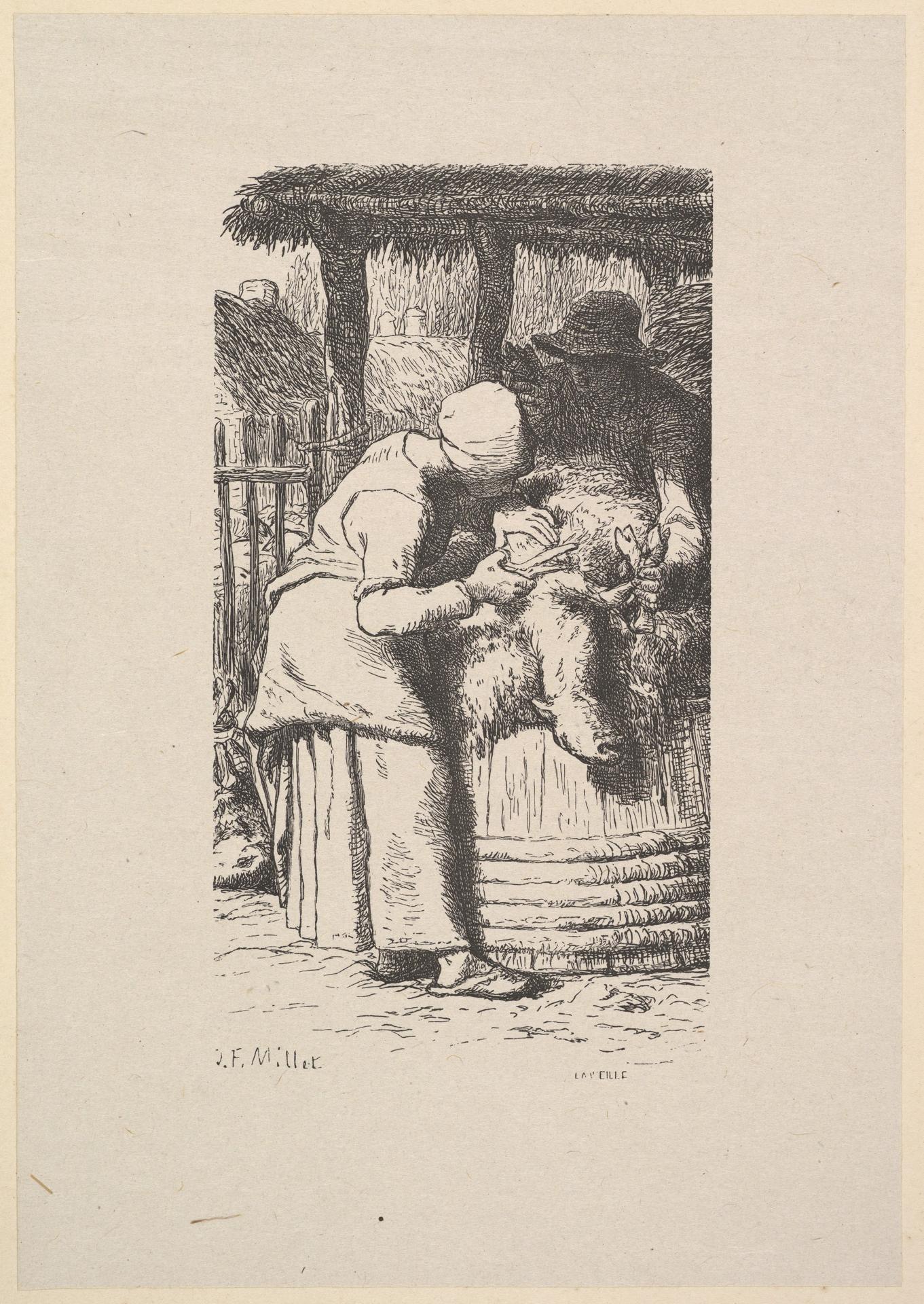
Two people shear a sheep in this rural scene, which Jean-François Millet captured as a wood engraving in 1853. The print is a wood engraving on chine collé and belongs to a proof edition.
Description
In the foreground stands the sheep, being worked on by a figure wearing a cap and jacket. Beside them, a second figure in traditional dress and a hat assists with the same animal. Behind, a simple barn structure with a thatched roof opens up. The image remains monochrome; clear, precise lines and a realistic approach define the picture.
Context
In 1853, when this print was made, Millet turned increasingly to rural life and the labor of peasants. He belonged to the Barbizon school, which focused on nature and simple country life. The motif was printed using wood engraving, a technique widely used in nineteenth-century printmaking.
Impact
Calm and concentration of rural work emanate from the print, carried by precise lines and a realistic touch. Because the coloring remains monochrome, figures and surroundings stand out clearly in their details, without distraction.
Technique
For the wood engraving on chine collé, the motif was cut into a woodblock and printed onto thin Japanese paper. Sharp lines and fine details, as this technique demands, characterize the result—a process that requires high precision.
AI-generated description text
Source: Metropolitan Museum of Art · Public Domain (CC0 1.0)