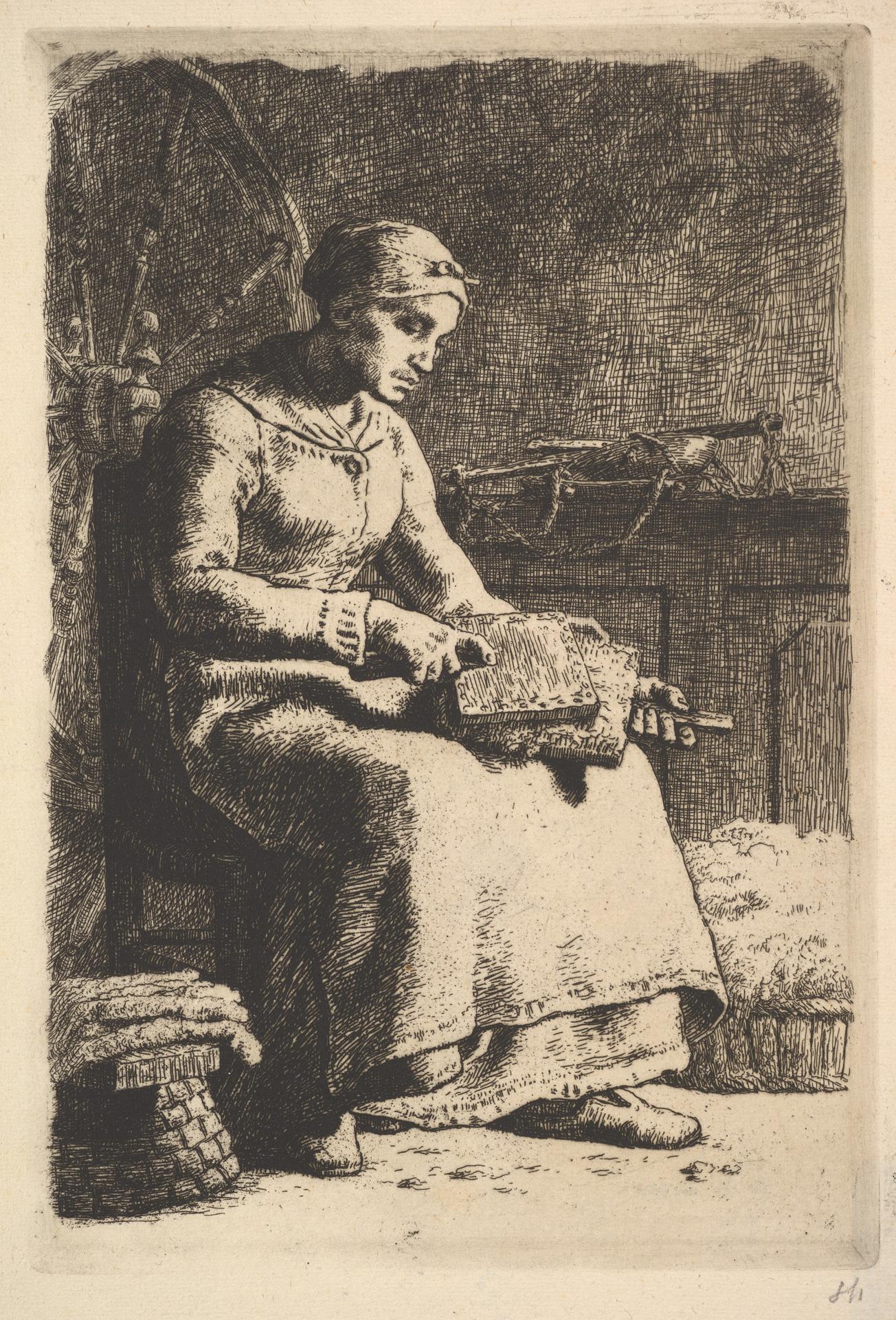
The Wool Carder (ca. 1855–56, Met-Objekt 4911)
Original title: The Wool Carder
kurzbeschreibung
Where many pictures of labour from the same years turn the worker into a hero or a bit of local colour, Jean-François Millet's etching The Wool Carder (ca. 1855–56) does neither. He gives us a woman absorbed in her work with the wool comb, and the print stays close to ordinary reality, drawing the eye to her quiet concentration.
Description
She sits on a plain chair, a tool for working wool held in her hands. Her lowered head shows how completely she has given herself over to the task. She wears a simple dress and a head covering. A window with a wooden frame lets muted light into the room. A basket with a bundle beside it completes the arrangement, which is given over entirely to the figure and what she is doing.
Context
Millet made the work in the mid-nineteenth century, when he was studying peasant life and rural labour in depth. That the print survives as a single sheet points to a small edition or to something of a trial piece. Millet belonged to the Barbizon school, which put simple country life at the centre of its art.
Impact
A calm, serious mood comes off the sheet, reinforced by the soft light and the concentrated layout. The woman's absorbed posture lends the scene a quiet dignity and invites reflection on work in the countryside.
Technique
Etching is an intaglio process in which the drawing is bitten into a copper plate. Fine, detailed lines shape Millet's graphic handling. The print exists in only one state, which suggests a direct and unchanged transfer from the plate.
AI-generated description text
Source: Metropolitan Museum of Art · Public Domain (CC0 1.0)