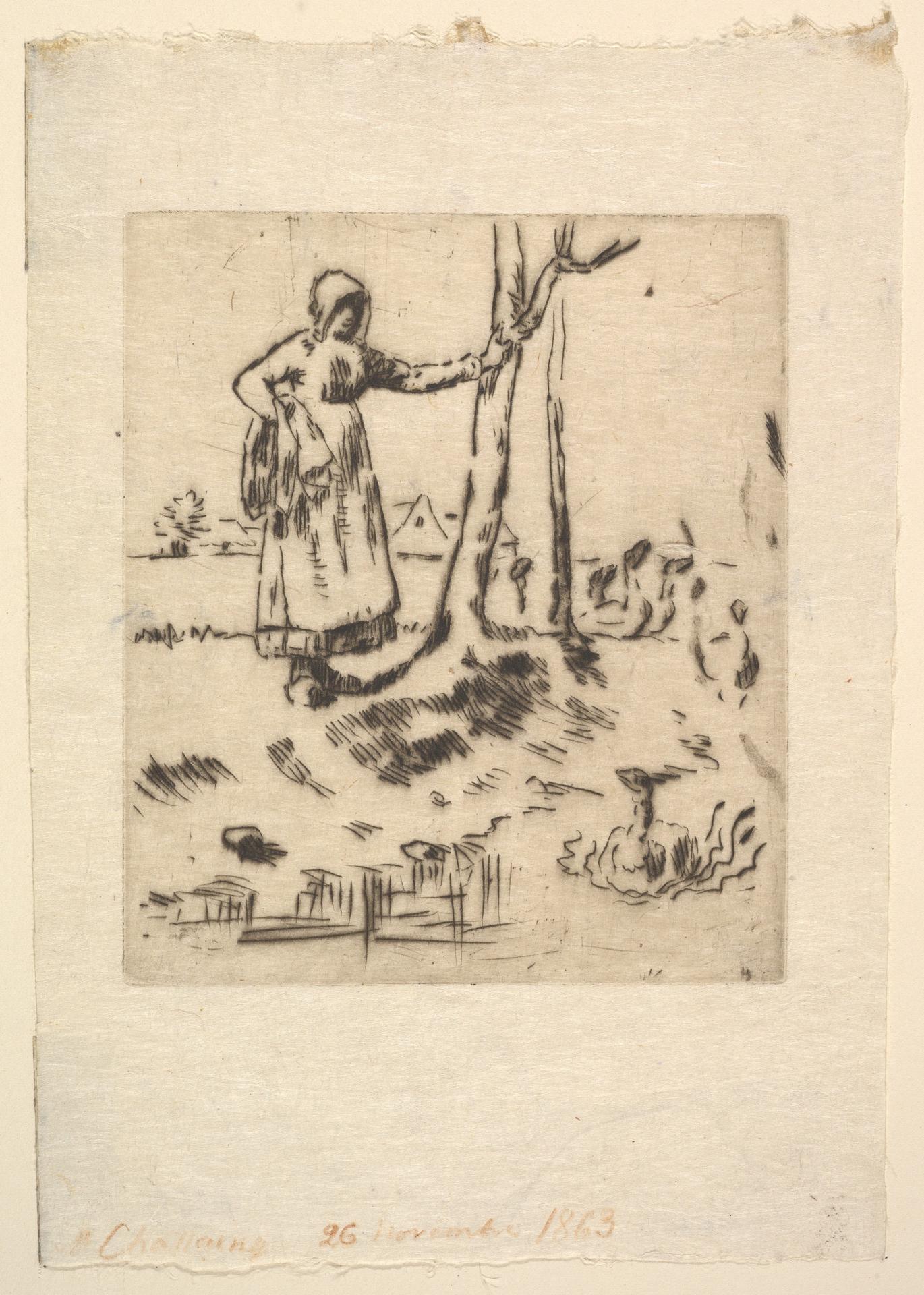
The Goose Girl
Original title: The Goose Girl
kurzbeschreibung
Leaning against a tree, a young woman in rural dress holds a twig in her hand. Jean-François Millet captured this motif as an etching; the dating spans 1830 to 1875. The print belongs to his many portrayals of peasant life in nineteenth-century France.
Description
A woman, her back against a tree trunk, holds a twig or stick. Her clothing suggests a peasant or farm worker. Behind her, trees, shrubs, and buildings hint at a rural setting. Black and white dominate the image, with even light that avoids harsh shadows. The etched lines trace the figure's contours and render the textures of the surroundings.
Context
Millet (1814–1875), a French painter and printmaker, devoted himself mainly to peasants and rural laborers. He belonged to the Barbizon school, which made country life its subject. During the period this etching was made, he was deeply engaged with everyday peasant life. The print reflects the growing appreciation of ordinary rural people that gained importance in nineteenth-century art.
Impact
A sense of calm emanates from the woman's relaxed posture against the tree. The simple layout and delicate lines create an intimate, almost poetic mood. Viewers are invited to linger quietly and observe rural life.
Technique
A drypoint on thin wove paper. Lines drawn with the drypoint needle stand out slightly, giving the print its distinctive softness. The plate measures 14.2 x 12.1 cm, the sheet 22.5 x 15.5 cm; this results in a small, richly differentiated format.
AI-generated description text
Source: Metropolitan Museum of Art · Public Domain (CC0 1.0)