Peasant Pushing A Wheelbarrow
Original title: Peasant Pushing A Wheelbarrow
kurzbeschreibung
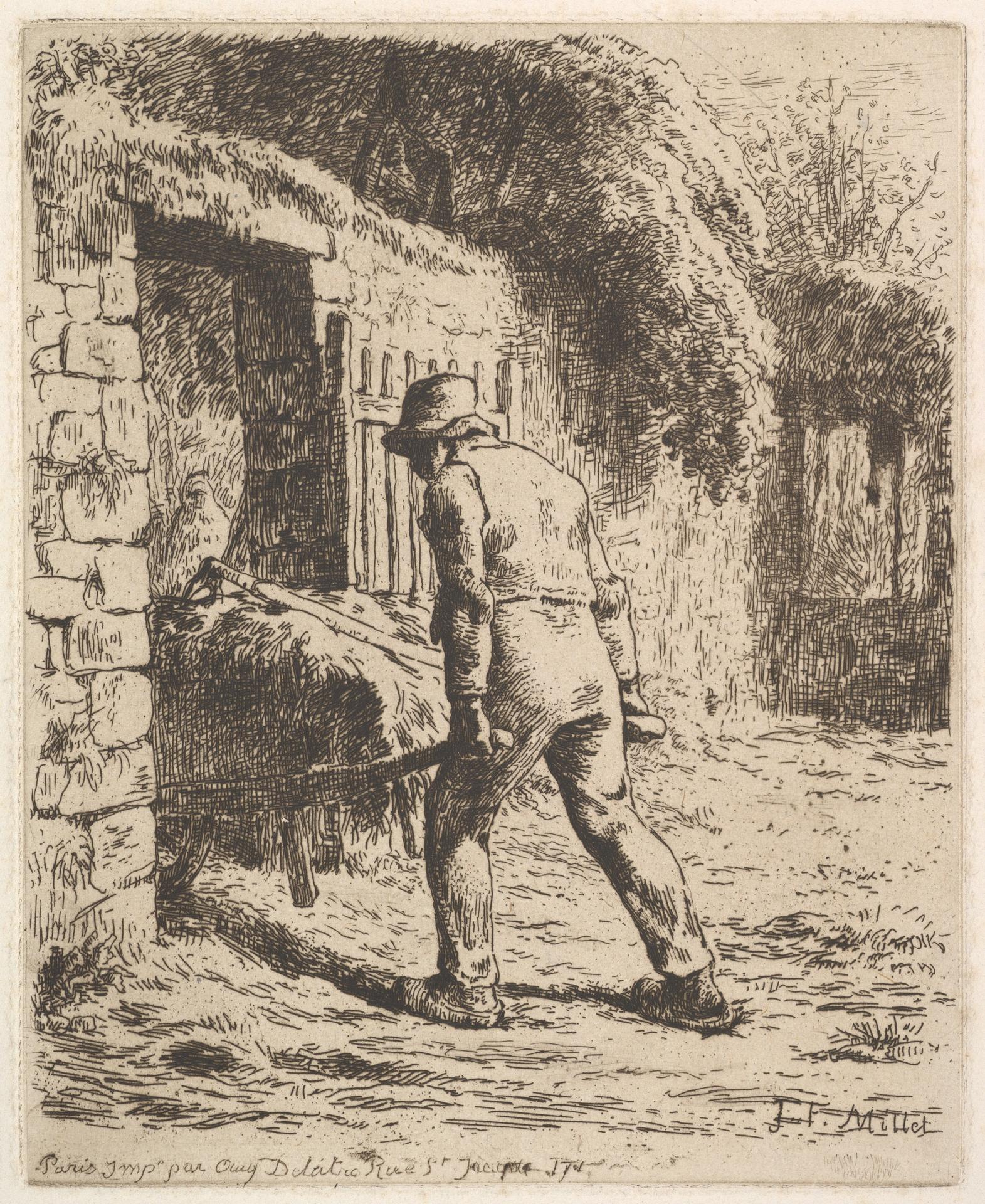
In 1855 Jean-François Millet etched a peasant walking forward with a wheelbarrow full of earth or sand, seen from behind. The print is in brown-black ink on chine collé and is the first of four states.
Description
A man in a hat, jacket and trousers pushes a barrow loaded with earth or sand, his back turned to us. His path leads past a stone building; beyond it appear trees and another stone structure. Grey tones dominate, produced by the ink and the printing process. Diffuse light settles over the scene, giving it a quiet air. The layout stays plain and directs the eye entirely to the man's labour.
Context
Millet made this in 1855, when he was deeply engaged with the life of rural people. He belonged to the Barbizon school and was known for his realistic portrayals of farm workers. This sheet is among his graphic works, in which he often took up everyday scenes of country life. That it is the first state shows he continued to revise the composition before the later states were made.
Impact
The spare arrangement and calm light make the print restrained yet insistent. Because the peasant is shown from behind, his physical work and the quiet dignity of rural life come to the fore. The monochrome tonality supports the serious, matter-of-fact mood of the piece.
Technique
The etching was printed in brown-black ink on chine collé. In this process a thin sheet of Japanese paper is glued to a sturdier support so that fine details are preserved. This is the first of four states, meaning the plate had not yet been further reworked.
AI-generated description text
Source: Metropolitan Museum of Art · Public Domain (CC0 1.0)