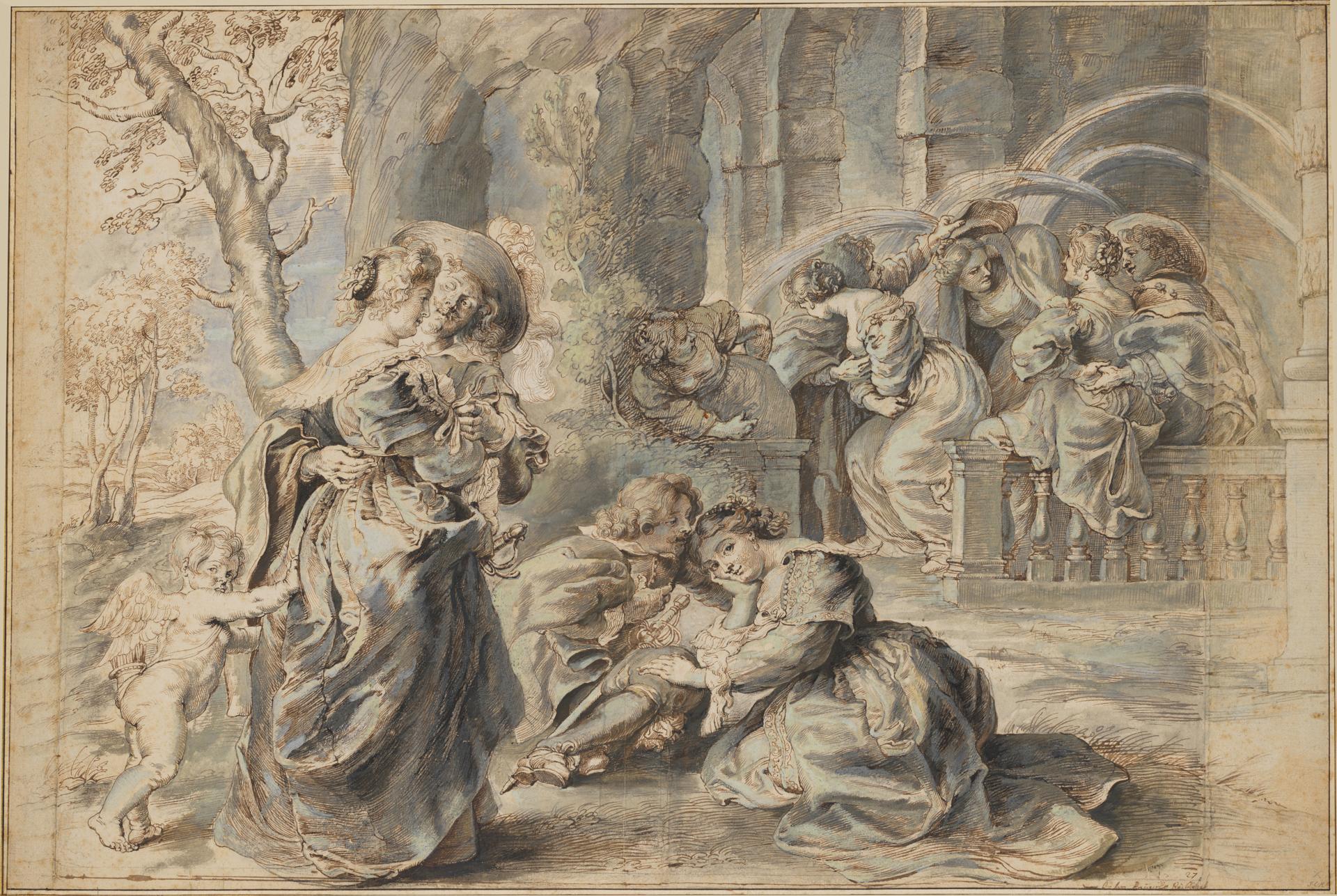
The Garden of Love (left portion)
Original title: The Garden of Love (left portion)
kurzbeschreibung
Drawn around 1633–35 by Peter Paul Rubens, this sheet captures a scene in a palace-like garden. It is executed in pen and brown ink, with brush and gray-green wash over traces of black chalk, heightened with indigo, green, yellow, and white. Likely a preparatory study for the painting of the same name.
Description
A woman in a long, elegant gown stands at the front, supported by a small winged angel. Beside her, another woman lies on the ground, also in splendid attire, appearing injured or exhausted. Several figures populate an arcade in the background, some conversing, others observing. Trees and plants frame the action, suggesting an idyllic garden. Gray tones dominate, with accents of green and brown; the light feels soft.
Context
In his final years, Rubens turned increasingly to mythological and allegorical subjects. The Garden of Love was a popular motif in Flemish art, presenting courtly love and sensuality. This sheet was probably made as a design for a larger painting that Rubens executed for a private patron. The use of precious pigments such as indigo points to careful execution.
Impact
The lively layout and soft lighting create an intimate, almost dreamlike mood. Delicate lines and colored accents give the sheet particular vivacity. Between the animated group in the foreground and the calm scene in the background, a tension-filled balance emerges.
Technique
Rubens combined pen and brown ink with brush and gray-green wash to achieve both precise contours and soft shading. Over a preliminary drawing in black chalk, he applied colored highlights of indigo, green, yellow, and white, giving the sheet a painterly quality. Strips added later at the sides indicate that the format was expanded afterward.
AI-generated description text
Source: Metropolitan Museum of Art · Public Domain (CC0 1.0)