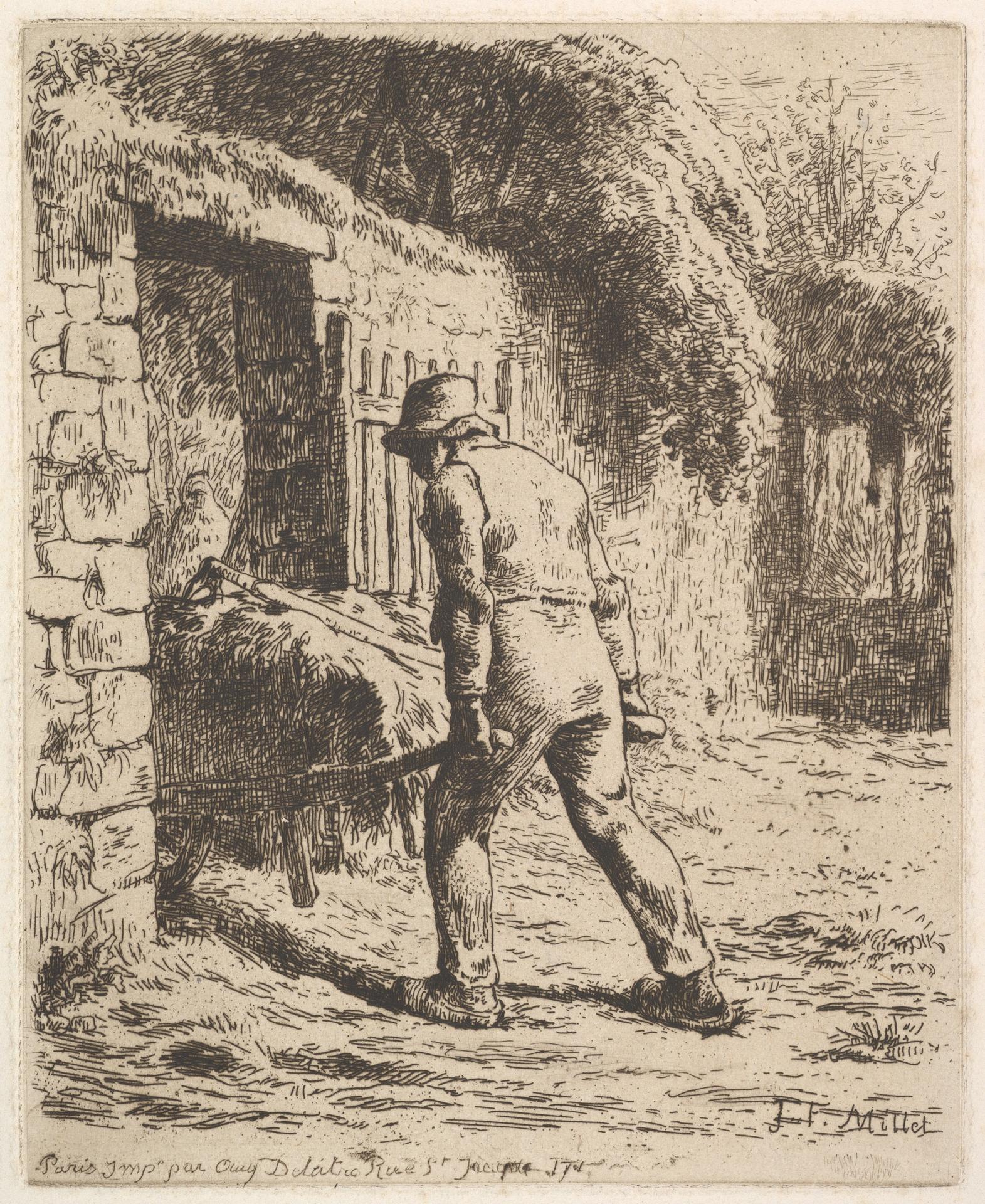
Peasant Pushing a Wheelbarrow
Original title: Peasant Pushing a Wheelbarrow
kurzbeschreibung
A peasant pushes a wheelbarrow: Jean-François Millet captured this motif in an etching in 1855. Printed in brown and black ink, the work exists in four states; this is the second. We see a farm laborer pulling a wooden cart with an animal inside across a yard.
Description
A peasant, dressed in an apron and hat, pulls a wooden cart on which an animal sits. Behind him rises an old stone wall, its gate opening onto a dark interior. The rural setting feels plain and rustic. Clear and straightforward is the layout, which places the peasant with the cart at the center.
Context
Millet, a leading master of the Barbizon school, devoted himself to depicting French rural life. This etching was made in 1855, during a period when he was deeply engaged with peasant labor. The peasant with the wheelbarrow recurs several times in his oeuvre. The print belongs to a series of graphic works that attest to Millet's sympathy for everyday peasant life.
Impact
The varying gray tones of the print evoke a calm, serious mood. Even light without harsh shadows underscores the simplicity of the subject. Textures of wall, cart, and clothing are realistically captured, giving the image a tactile quality.
Technique
An etching, printed in brown and black ink on paper. The plate measures 16.5 × 13.3 cm, the sheet 42.3 × 34 cm. The second of four states is evidenced by the artist's careful reworking of the plate.
AI-generated description text
Source: Metropolitan Museum of Art · Public Domain (CC0 1.0)