The Gleaners (ca. 1855–56)
Original title: The Gleaners
kurzbeschreibung
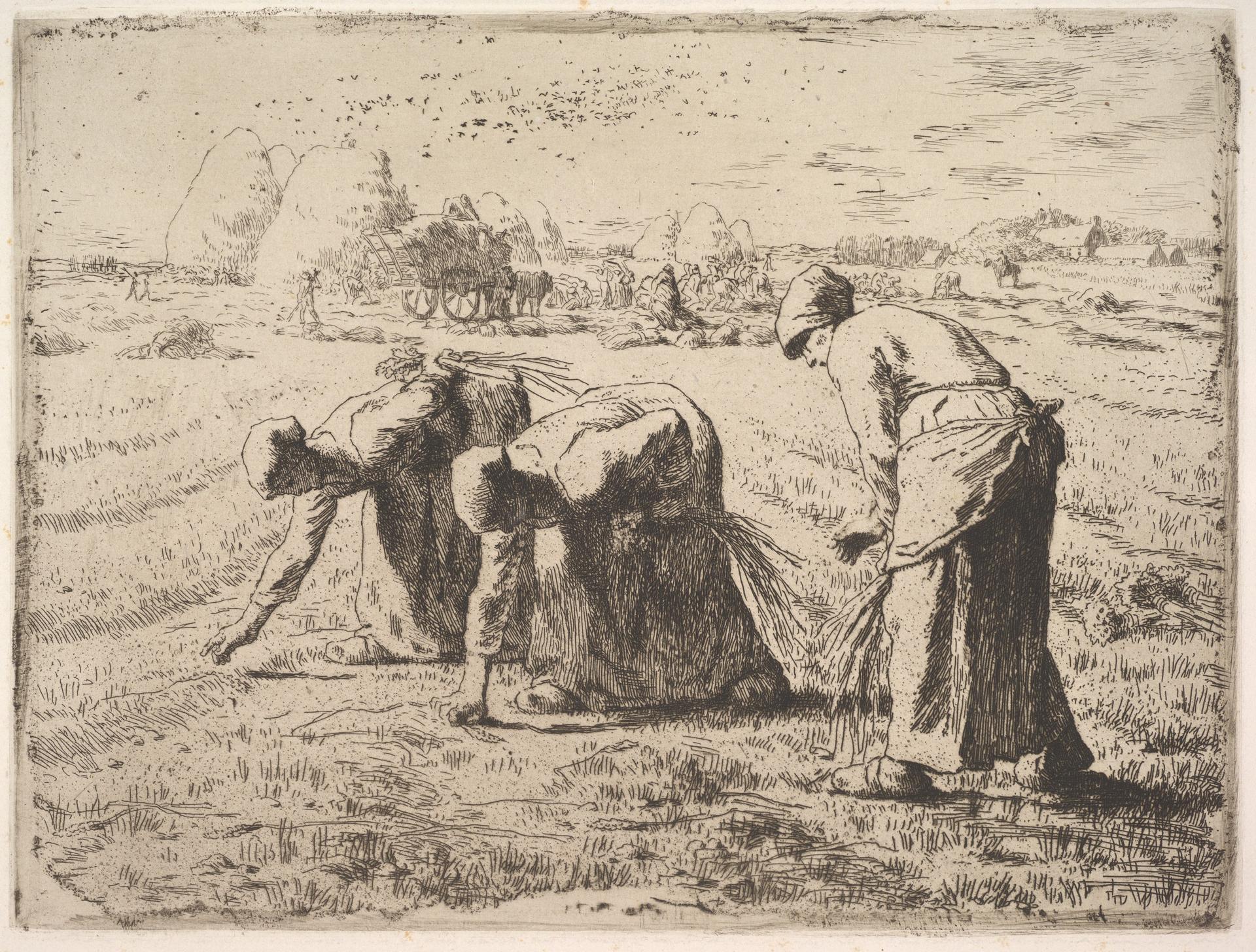
Jean-François Millet's etching The Gleaners, made around 1855–56, presents three peasant women gathering stray ears of grain in a field. The print is an etching on chine collé and represents the first of two states.
Description
Your eye is drawn first to the three women: two kneel to pick up ears of grain, while the third stands upright beside them. Behind this group, other figures and a horse-drawn cart can be made out. Gentle hills rise in the distance, and a flock of birds flies across them. The sky in this monochrome etching is clouded, and the light falls evenly across the surface, with no harsh shadows.
Context
Millet first treated the gleaners theme in a painting of 1857, which was received controversially at the Paris Salon. The etching was made shortly before that as a graphic version of the subject. Millet belonged to the Barbizon School and focused his work on peasant labor. This harvest scene conveys a sense of social conditions in rural nineteenth-century France.
Impact
The calm, almost symmetrical arrangement of the figures gives the scene a dignified, nearly monumental quality. Because light falls evenly across the sheet and the lines remain clear, the simplicity and seriousness of the work stand out plainly.
Technique
For this etching, the drawing was bitten into a metal plate. The print was then made on chine collé—a thin Japanese paper mounted on a support sheet. The process allows for fine, precise lines and an even progression of tonal values.
AI-generated description text
Source: Metropolitan Museum of Art · Public Domain (CC0 1.0)