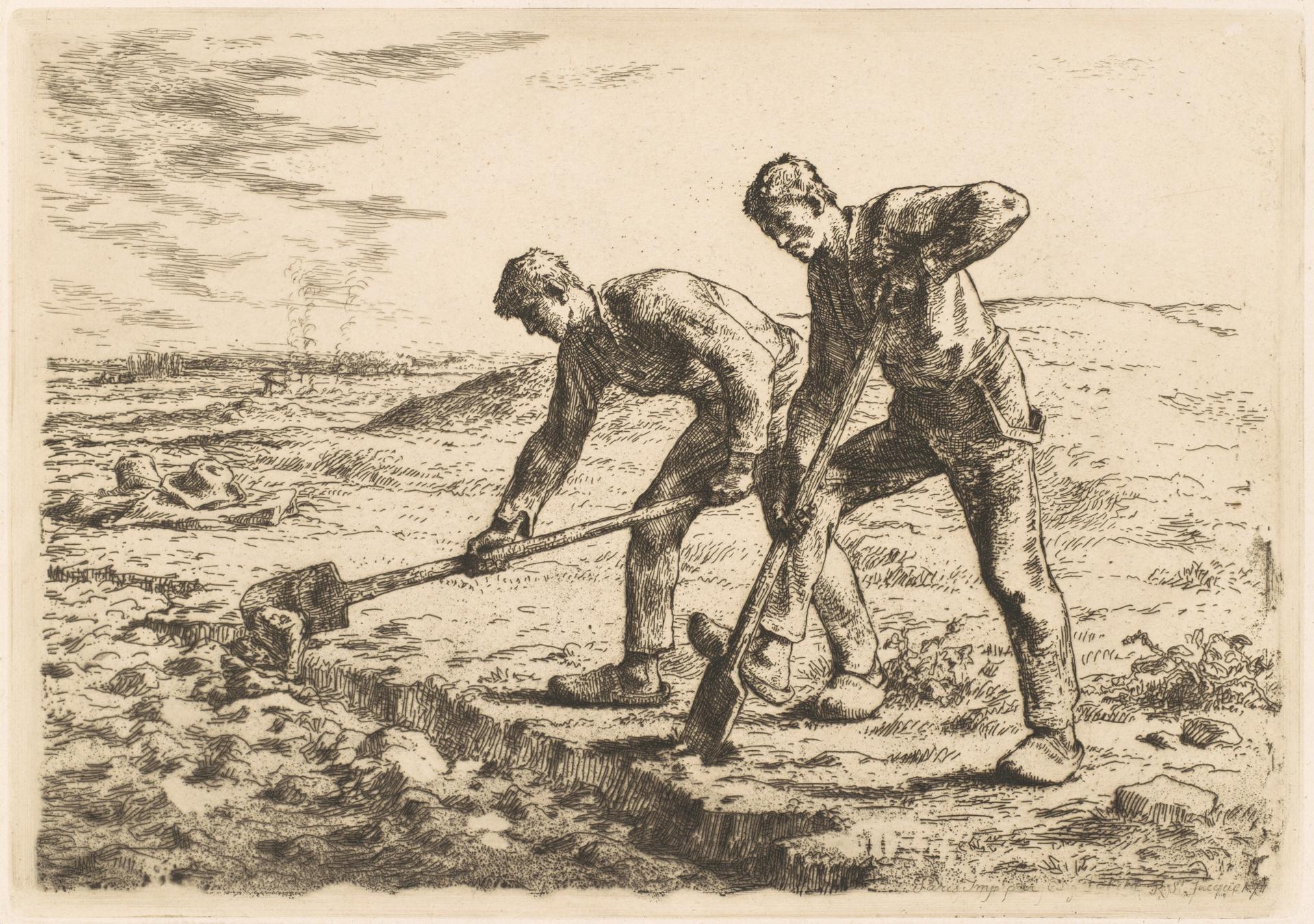
The Diggers (ca. 1855)
Original title: The Diggers
kurzbeschreibung
Two farm laborers dig up soil with their spades, set within a wide rural landscape—a motif Jean-François Millet captured in an etching around 1855. Four printed states exist from the plate; this sheet is the fourth and final one.
Description
In the foreground, two men turn over earth or sand with spades. Both wear simple shirts and trousers, their expressions serious and fixed on their work. Behind them stretches an open landscape with scattered trees under a cloudy sky. The arrangement runs horizontally, and the sheet remains entirely in black and white. Light falls evenly across the surface, with no harsh contrasts.
Context
Around 1855, Millet turned increasingly to the lives of rural people. Within the Barbizon school, he placed ordinary scenes of labor at the center of his work. Etching served him as a printmaking medium through which he could reach a wider audience beyond his better-known paintings.
Impact
The print conveys a calm, dignified stillness inherent in the work. Even light and a plain layout draw the eye to the two concentrated figures and their activity. The many individual lines give the print a precise, true-to-life feel.
Technique
For the etching, the drawing was incised into a metal plate and then bitten with acid. It was printed on paper, and the plate measures 23.7 × 33.7 cm. The fourth of the four printed states represents the final version of the plate.
AI-generated description text
Source: Metropolitan Museum of Art · Public Domain (CC0 1.0)