The Gleaners (1834–75)
Original title: The Gleaners
kurzbeschreibung
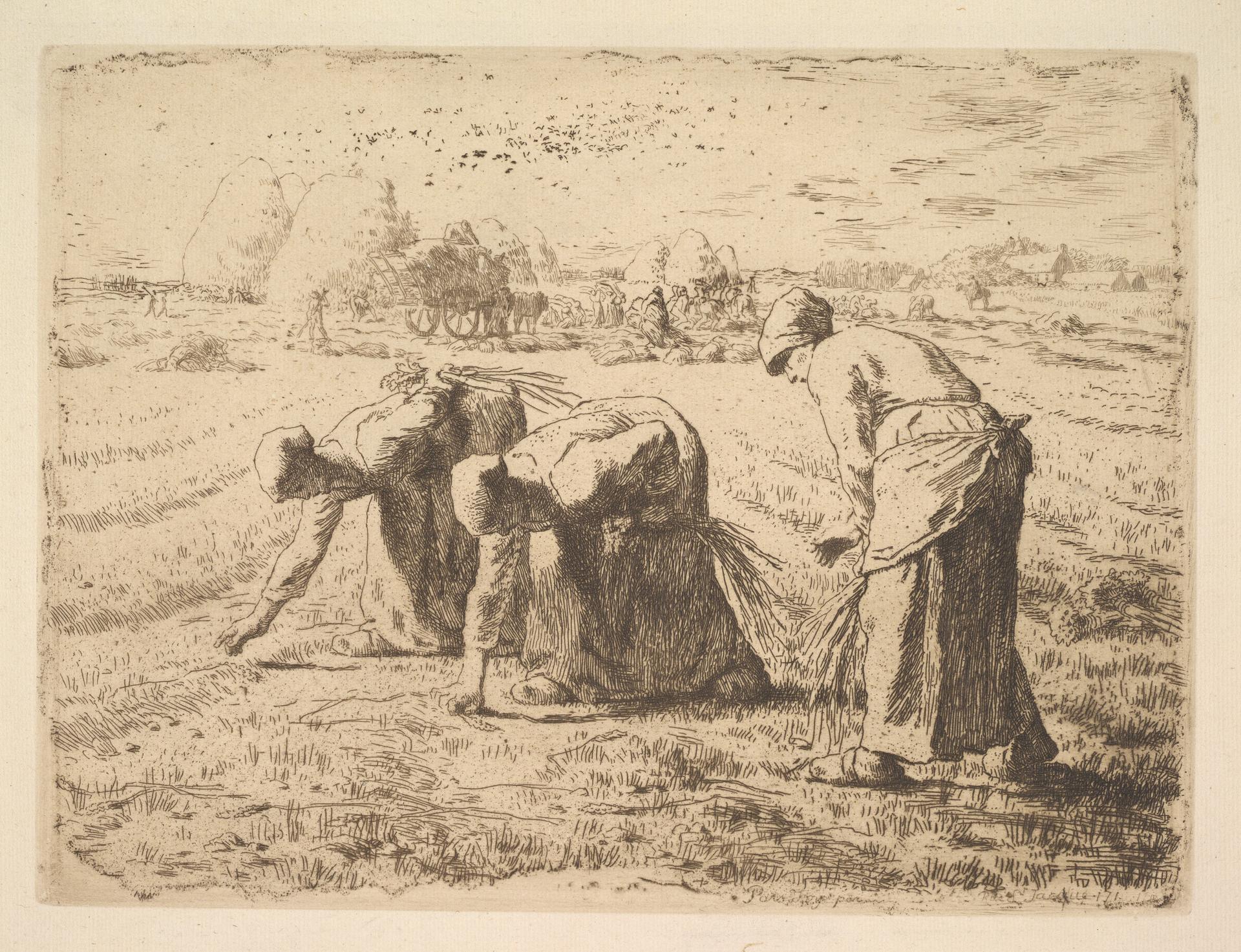
Unlike many harvest scenes of its day, Jean-François Millet's etching 'The Gleaners' puts the laborious aftermath of the harvest front and center. Made between 1834 and 1875, the print shows three peasant women gathering stray ears of grain from a field. It was printed in brown and black ink on laid paper and is the second state of two.
Description
In the foreground, two women bend over the field, picking up ears of grain, while a third kneels farther back. Their clothing is plain and rural. Beyond them opens a wide landscape with gentle hills and trees on the horizon, where other figures and a cart can be made out. The light falls evenly, without strong shadows; the line weight varies, creating texture and depth.
Context
Millet painted 'Des glaneuses' in 1857, and the etching grew out of that same milieu. The motif of gleaners was widespread in the nineteenth century and stood for the work of rural people. Millet belonged to the Barbizon school and devoted his work to peasant life.
Impact
The scene feels calm and dignified without glossing over the labor. Through its monochrome palette and finely graded linework, the print takes on a timeless, almost graphic quality that draws the eye to the figures.
Technique
As an etching, the image was printed in brown and black ink on laid paper. The plate measures 18.9 x 25.4 cm, the sheet 24.4 x 30.5 cm. Line etching allows for fine lines and shading, which the print on the textured paper further enlivens.
AI-generated description text
Source: Metropolitan Museum of Art · Public Domain (CC0 1.0)