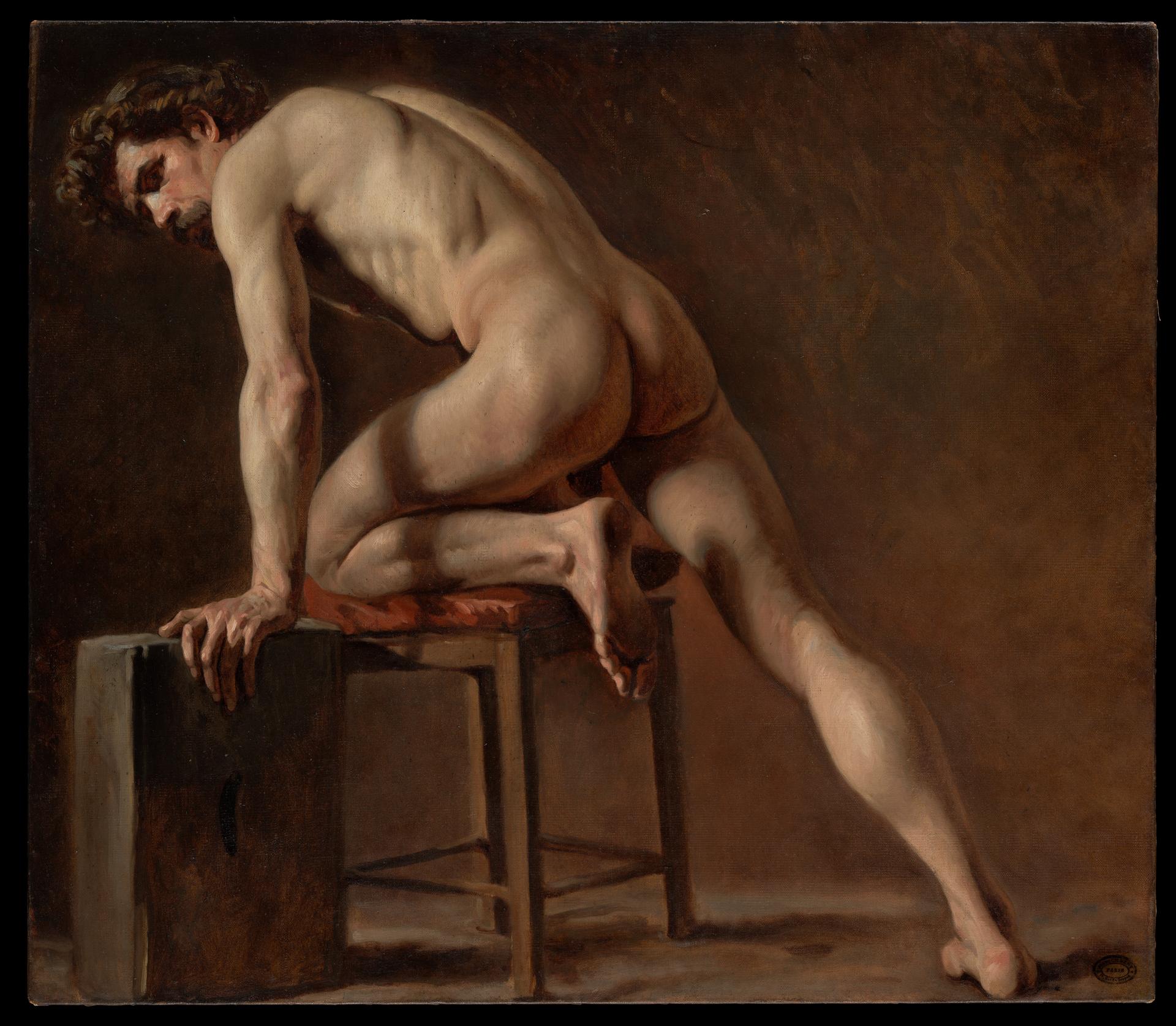
Study of a Nude Man
Original title: Study of a Nude Man
kurzbeschreibung
Unlike many contemporary nude studies, Gustave Courbet's 'Study of a Naked Man' from the early 1840s relies on direct, unspectacular observation of the body: a male model sits in a hunched pose on a wooden stool. The oil on canvas measures 73.7 × 84.1 cm and counts among the early evidence of Courbet's realist approach and his engagement with the human form.
Description
A powerfully built, muscular man with short curly hair sits on a simple wooden stool. His torso has slumped forward, his head is lowered, and his figure leans slightly to the right. Both arms hang down, the right hand resting on the stool, the left hanging free. A dark, indeterminate background surrounds the figure, dominated by brown and gray tones. Soft light picks out the contours and musculature of the model.
Context
Courbet painted this work in the early 1840s while in Paris, working from models at the Académie Suisse and in the Louvre. It belongs to a series of early studies in which he engaged with academic nude painting while developing his own realist approach. Such exercises were common for artists of the time to train anatomy and the effects of light.
Impact
The subdued palette and the model's pensive pose give the image a serious, inward-looking mood. Realistic rendering and soft light create a presence that is both sensual and matter-of-fact, directing the viewer's gaze to the essential: the naked body.
Technique
The painting is executed in oil on canvas, with Courbet using muted earth tones. The dark background and targeted lighting demonstrate his handling of light and shadow as formative means. The brushwork remains realistic and detailed, as is characteristic of 19th-century painting.
AI-generated description text
Source: Metropolitan Museum of Art · Public Domain (CC0 1.0)