River and Rocks
Original title: River and Rocks
kurzbeschreibung
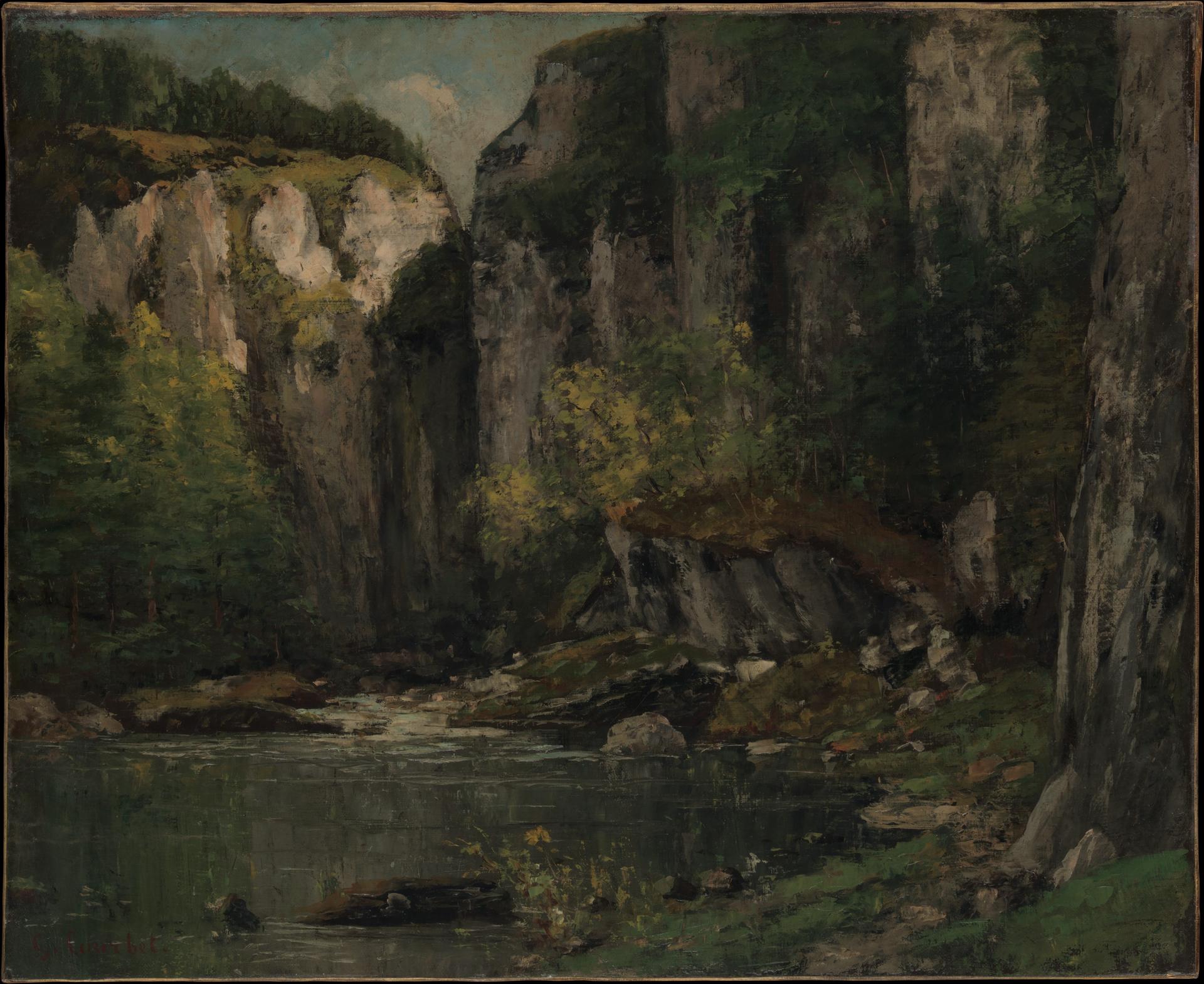
Gustave Courbet painted Fluss und Felsen (River and Rocks) between 1873 and 1877 in oil on canvas. The work presents a quiet river landscape bordered by high cliffs and dense greenery. It belongs to Courbet's realist phase, capturing nature with close observation and a thick, atmospheric presence.
Description
A calm river winds through a narrow gorge flanked by steep, towering rock walls. These cliffs are partly covered with green growth; on the right, large boulders in the water are overgrown with trees and bushes. Deeper into the picture, more rocks and trees stack up, strengthening the sense of space. Diffused light suggests an overcast sky or early morning. The palette stays muted and natural, dominated by greens and browns.
Context
Courbet made this painting in his final years, which he spent in Swiss exile after being convicted for his role in the Paris Commune. There he devoted himself mainly to landscapes and animal paintings, often depicting the wild nature around Lake Geneva. As a leading Realist, he rejected idealization and portrayed unvarnished reality. The work dates from a time when he was moving away from Impressionism and pursuing his own naturalist path.
Impact
The calm rendering of river and rocks has an immediately soothing effect; the eye follows the watercourse into the depth of the gorge. Muted colors and soft light create a mood of stillness and seclusion that invites lingering. Without loud effects, the painting unfolds a simple presence and a convincing rendering of natural light.
Technique
Oil on canvas forms the base; with fine brushstrokes and glazed application of color, Courbet shaped the landscape. Earth tones and greens were applied in several layers to gain depth and texture. The brushwork remains loose but controlled—a hallmark of his late landscape painting.
AI-generated description text
Source: Metropolitan Museum of Art · Public Domain (CC0 1.0)