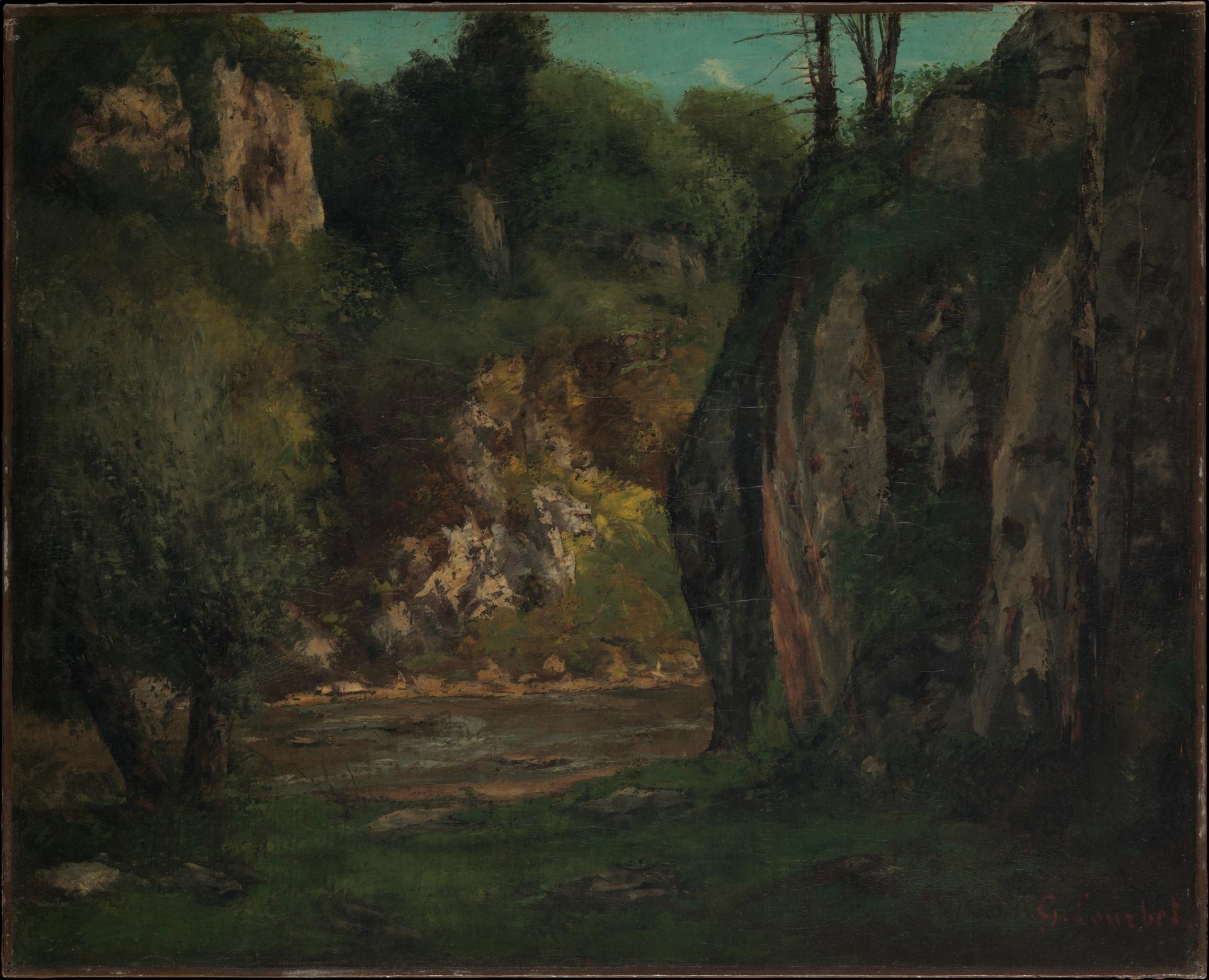
The Hidden Brook
Original title: The Hidden Brook
kurzbeschreibung
A stream that vanishes beneath a moss-covered rock face is the subject of this landscape painting by Gustave Courbet, made around 1873 to 1877. Oil on canvas, it presents a dense, untouched woodland with no human or animal figures. Courbet, a leading figure of Realism, recorded the scene without any idealization.
Description
From the middle of the picture the water runs off to the left and disappears under a rock wall covered in moss. Trees and shrubs in various shades of green line both banks. Toward the back, trees and rocks thicken into a solid mass of forest, and above it a turquoise sky opens up. Muted, natural colors and clearly visible brushstrokes give definition to rock and tree structure.
Context
The painting dates from Courbet's final years, which he spent in Swiss exile from 1873. At that time he devoted himself mainly to landscape painting, often with motifs from the Jura and the area around Ornans. Courbet was known for a Realism that deliberately set itself against Romantic idealization. The exact location of the painting is not recorded, but the motif fits coherently into his late work.
Impact
Calm and an almost idyllic mood emanate from this view and invite lingering. Hidden details such as the mossy rock and the light on the water bring nature close to the viewer. Because no people appear, the landscape feels untouched and timeless.
Technique
Courbet worked in oil on canvas, applying the paint thickly as was typical of his late years. The visible brushstrokes shape the surfaces of rocks and tree trunks and give the picture something tangible. Muted colors and a loose touch support the spontaneous, naturalistic impression.
AI-generated description text
Source: Metropolitan Museum of Art · Public Domain (CC0 1.0)