Les Demoiselles de village
Original title: Les Demoiselles de village
kurzbeschreibung
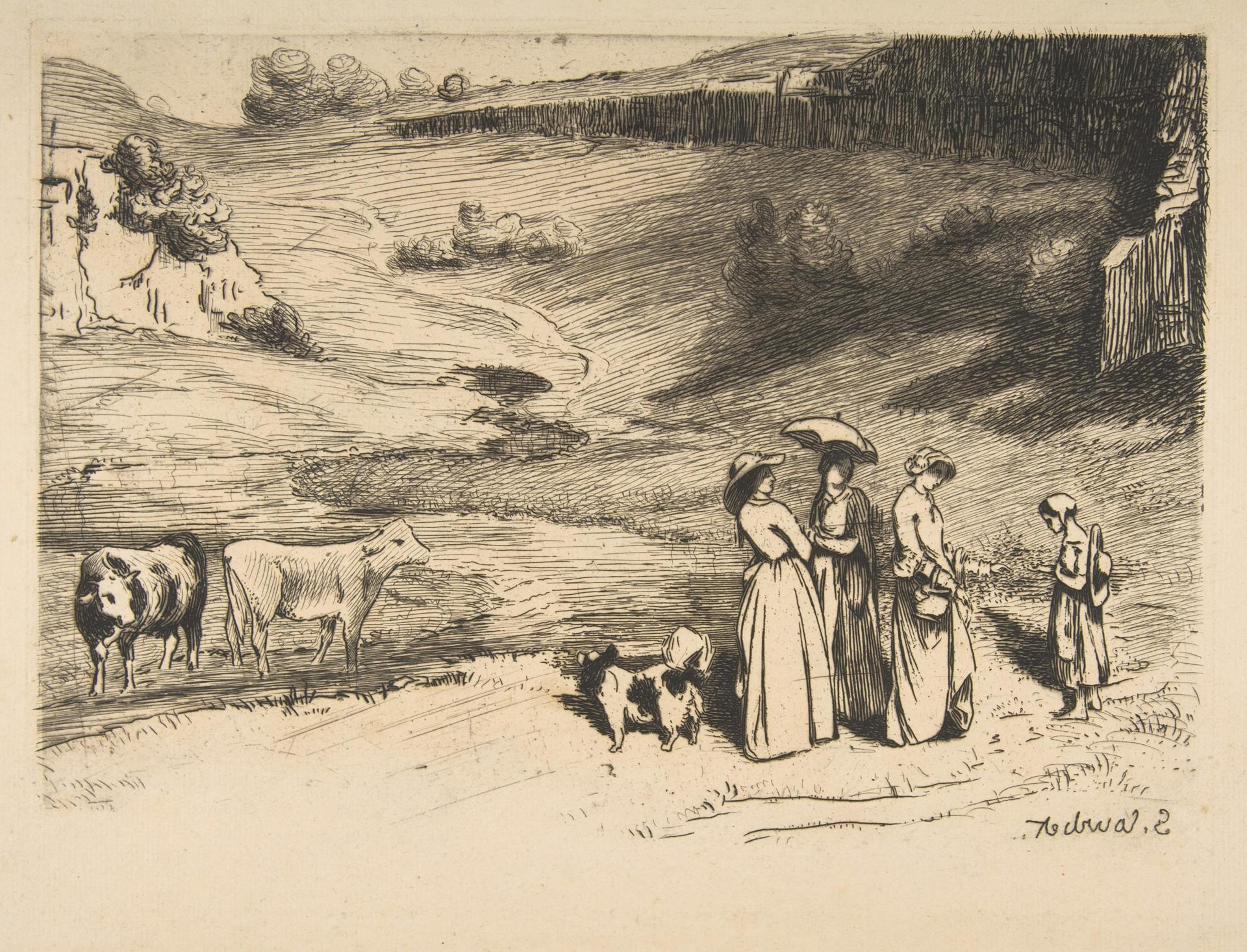
Félix Bracquemond made this etching, Les Demoiselles de village, in 1867, presenting a group of women in a rural setting. The drypoint impression is the third of three states and is regarded as a typical example of nineteenth-century realist landscape and genre work.
Description
Several women stand on a dirt path amid rolling country and trees. Two of them hold a parasol, and another carries flowers in her hands. Two cows and a dog enliven the rural foreground. Rendered in black and white, figures and objects are drawn out through graded lines and shading. The horizontal arrangement stresses the openness of the land, while light and shadow arise from the etched stroke of the needle.
Context
The etching dates from 1867, a time when Bracquemond was engaging closely with country life and nature. The motif of village girls with animals draws on a long pictorial tradition widespread in French art of the nineteenth century. The artist was known for his virtuoso etching technique and for his part in renewing printmaking in France. In this phase he moved away from pure reproduction and developed independent artistic compositions.
Impact
A calm, idyllic mood radiates from the print, carried by balanced layout and delicate linework. Human figures and animals in natural surroundings come together into a harmonious, timeless atmosphere. The viewer is invited to contemplate rural life at leisure.
Technique
The etching, an etched print on paper, survives in the third of three states. The plate measures 22.2 × 31.7 cm, the sheet 28.4 × 36.6 cm. This method allows fine lines and shading that record the textures of landscape and figures precisely.
AI-generated description text
Source: Metropolitan Museum of Art · Public Domain (CC0 1.0)