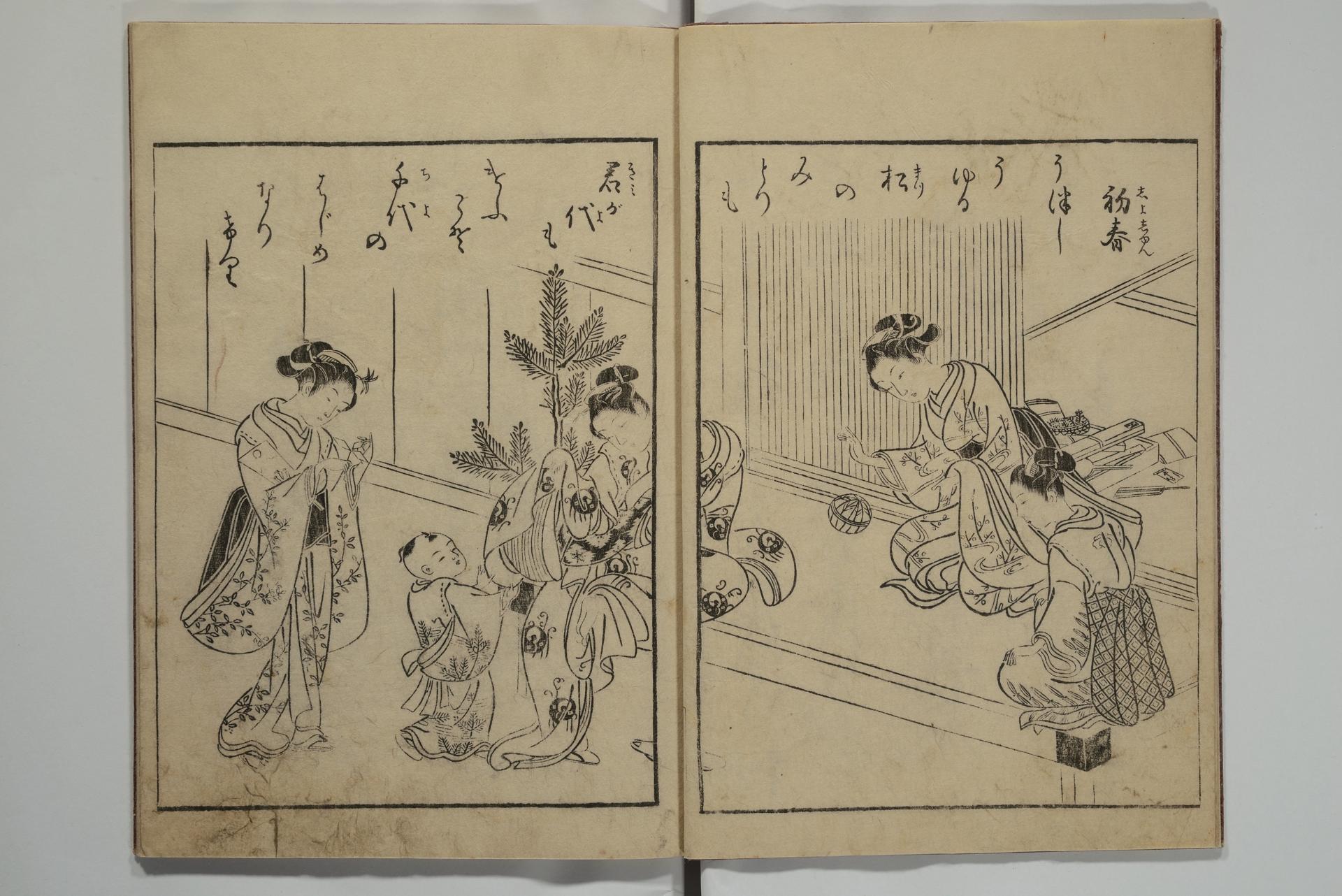
Picture Book of the Eternal Pines (Ehon chiyo no matsu) (ca. 1767, Met-Objekt 4839)
Original title: Picture Book of the Eternal Pines (Ehon chiyo no matsu) 絵本千代の松
kurzbeschreibung
Unlike many comparable ukiyo-e prints, this three-part set of woodblock-printed books from around 1767 by Suzuki Harunobu presents scenes of everyday life with women and children in traditional Japanese dress. The prints, ink on paper, are typical of eighteenth-century ukiyo-e but stand out through their specific compilation.
Description
On the left, a woman in traditional Japanese clothing stands upright and looks at a boy kneeling by a pine tree, attaching something to it; the meticulously drawn tree occupies a large part of the image. On the right, another woman sits on the ground holding something in her hands, while behind her vertical stripes suggest a curtain or wall. Both pages bear Chinese characters that give the title and possibly a description of the scene. The pages are old, show signs of weathering, and the coloring is uniform and dark.
Context
Suzuki Harunobu is counted among the major Japanese woodblock artists and is known for his delicate, colorful prints. The 'Ehon chiyo no matsu' was created in the late Edo period, when illustrated books (ehon) were widespread in Japan. Women and children in everyday life were a common subject of ukiyo-e, and Harunobu contributed to the development of multicolor printing (nishiki-e). This work belongs to an artistic output aimed at a broad urban audience.
Impact
The scene feels calm and introspective, with clear lines that precisely capture figures and nature. The dark ink coloring lends the scenes a timeless and serious atmosphere, transporting the viewer to the world of the eighteenth century. Humans and nature appear in a harmonious, contemplative mood.
Technique
Three woodblock-printed books, printed with ink on paper, make up the work. Woodblock printing allowed for the reproduction of fine lines and details, though the coloring here is limited to ink. The pages are bound in traditional Japanese style and show the typical signs of wear of old books.
AI-generated description text
Source: Metropolitan Museum of Art · Public Domain (CC0 1.0)