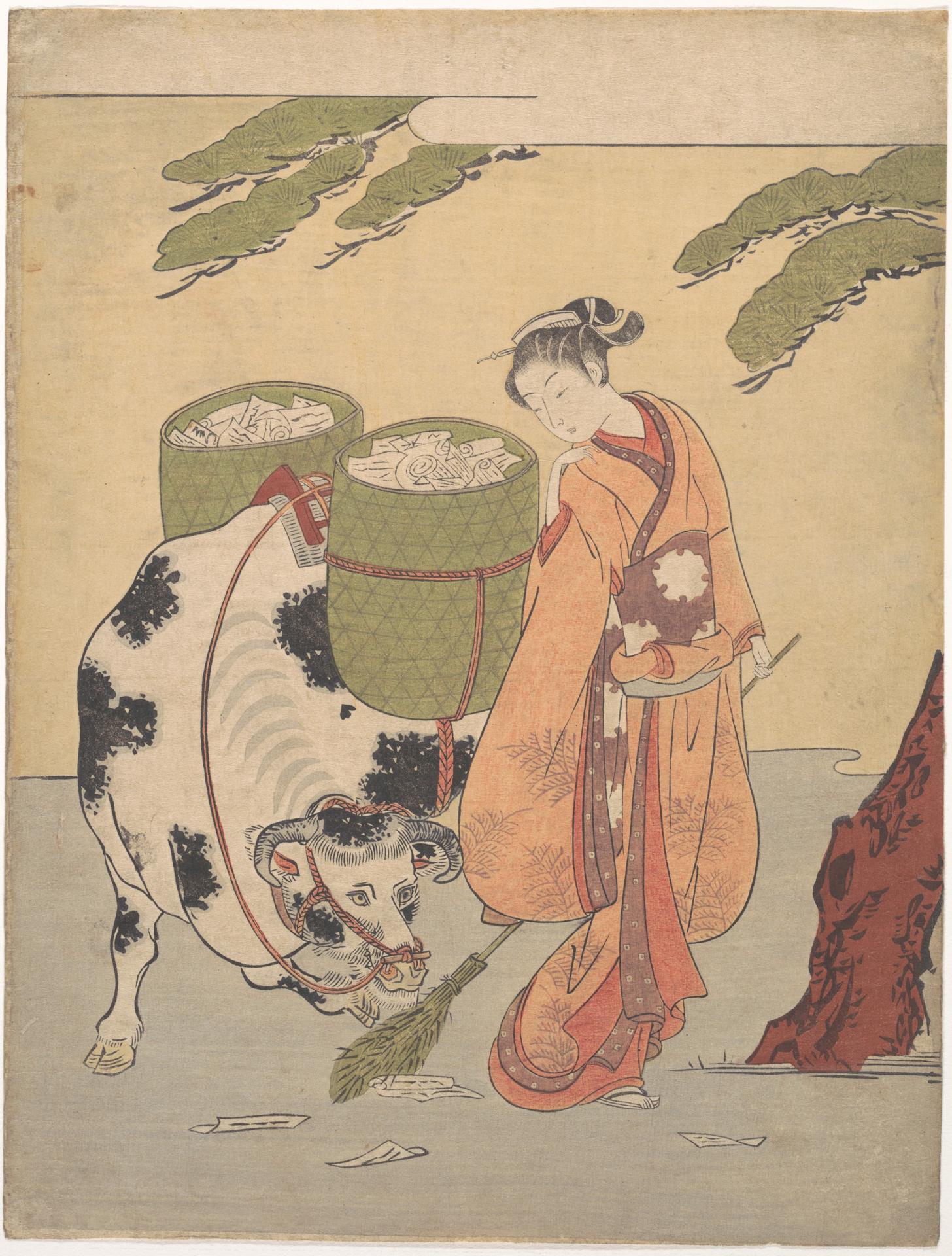
A Woman Sweeping up Her Love Letters
Original title: A Woman Sweeping up Her Love Letters
kurzbeschreibung
Suzuki Harunobu's colour woodblock print 'A Woman Sweeping Up Her Love Letters', made between 1725 and 1770, draws the eye to a woman in traditional dress. She sweeps the floor with a broom while holding a book in her hand. The sheet belongs to ukiyo-e and pairs an everyday action with emotional depth.
Description
To the woman's right stands a large animal with a black-and-white pattern that recalls a donkey. She leans slightly forward; her right hand guides the broom across the grey floor, her left holds a book. Two green barrels filled with paper frame the arrangement. At the right edge a red carpet adds an accent, while tree branches in the background suggest a landscape. The kimono-like garment appears in muted tones.
Context
Harunobu is regarded as a pioneer of multicolour woodblock printing (nishiki-e), which established itself in Edo in the 1760s. The link between love letters and the woman's melancholy points to the period's interest in emotional worlds and private moments. The appearance of a donkey is unusual and could reflect Western influence or an allegorical intent. Such prints were produced in series and aimed at a broad urban public.
Impact
From the first glance a calm, thoughtful mood emanates; the muted palette and the woman's quiet gesture contribute to it. The animal and the green barrels cause a slight irritation that invites lingering. Thus an atmosphere of quiet melancholy and poetic everydayness arises.
Technique
Ink and colours on paper were used for the print, with Harunobu employing the multicolour process: each colour required its own woodblock. Clear contours and flat tones define the result; the precise registration of the individual blocks was crucial.
AI-generated description text
Source: Metropolitan Museum of Art · Public Domain (CC0 1.0)