Courtesan and Shinzō
Original title: Courtesan and Shinzō
kurzbeschreibung
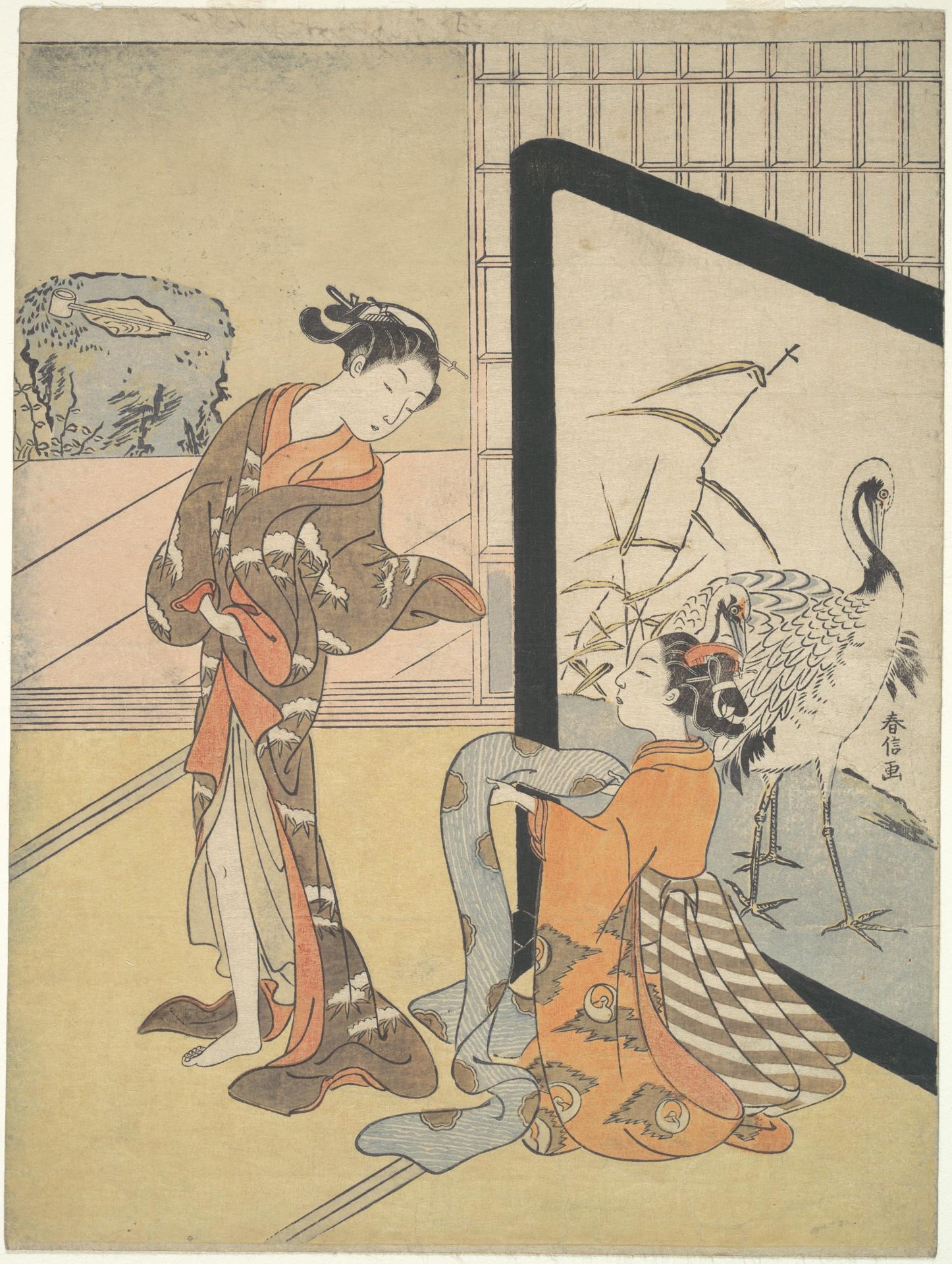
This colour woodblock print by Suzuki Harunobu (1725–1770) presents two women in an interior. The standing figure on the left wears a kimono patterned with flowers and leaves, while the seated woman on the right is dressed in a similarly patterned garment. The sheet is printed in ink and colour on paper and measures 28.6 x 21.6 cm.
Description
On the left, a woman in a floral kimono stands with her gaze lowered, her posture reflective. To the right, a second woman sits, also in a patterned kimono, looking left with a calm demeanour. A grid-patterned window opens onto a landscape with bamboo and a crane. The palette is mostly pastel with accents of orange and brown; clear, detailed lines define the image. Even lighting suggests an indoor setting.
Context
Suzuki Harunobu ranks among the leading masters of Japanese colour woodblock printing (nishiki-e) and was active in Edo (present-day Tokyo) in the mid-18th century. As a pioneer of multicolour printing, which emerged around 1765, he decisively shaped the technique. He often depicted scenes from the urban pleasure quarters, including courtesans and their attendants (shinzō). The artist's dates limit the creation of this print to the period between 1725 and 1770.
Impact
Pastel tones and the quiet poses of the figures give the image a still, contemplative mood. Fine lines and the richly detailed kimono patterns create a decorative yet intimate atmosphere. The view through the window onto bamboo and crane adds a poetic note and lifts the scene above the everyday.
Technique
The work was printed as a woodblock print with ink and colour on paper. Harunobu used the multicolour printing process, in which each colour requires its own woodblock. Precise contours and flat areas of colour are characteristic of the nishiki-e technique of the late 18th century.
AI-generated description text
Source: Metropolitan Museum of Art · Public Domain (CC0 1.0)