Shirai Gompachi
Original title: Shirai Gompachi
kurzbeschreibung
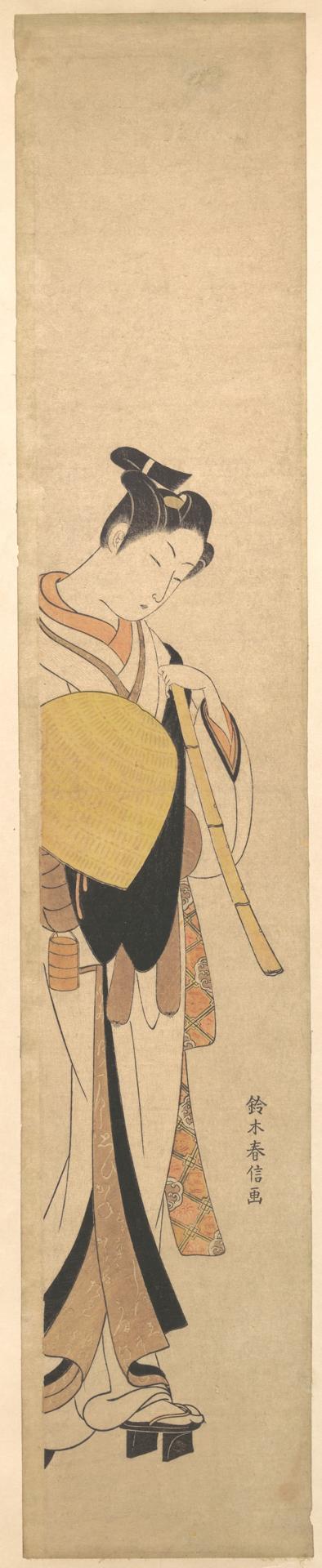
Suzuki Harunobu made this print, Shirai Gompachi, probably in 1770. It is a Japanese woodblock print in ink and color on paper. A woman in traditional dress leans downward, a staff in her hand. The tall, narrow hashirae measures 28 1/8 by 5 inches.
Description
A woman in a kimono with a striking pattern bends forward, holding a bamboo staff or similar implement. A sash gathers her traditional hairstyle. Her posture and the position of her arms suggest she is picking something up or getting ready. Nothing distracts in the plain, detail-free ground. Muted browns, beige, orange and blue set the palette. Characters at the lower right point to the artist or the title.
Context
Harunobu ranks among the major ukiyo-e artists of the eighteenth century and is regarded as a pioneer of nishiki-e, the multicolored woodblock print. This sheet dates from around 1770, in the late Edo period, a culturally lively phase in Japan. Hashirae, narrow vertical formats, served as decoration for pillars in Japanese houses. Whether Shirai Gompachi is a historical person or a literary figure cannot be established with certainty.
Impact
The tall, slender format brings the elegance of the figure's line to the fore. Restrained colors and a spare ground produce a quiet, collected mood. The woman's pose feels graceful and everyday at once, a trait characteristic of Harunobu's portrayals of women.
Technique
The design was cut into a wooden block and then printed with color onto paper. Ink and color on paper match standard practice in Japanese color woodblock printing. Precise lines and finely graded colors attest to the high craft of the execution.
AI-generated description text
Source: Metropolitan Museum of Art · Public Domain (CC0 1.0)