Beauty and Holiness
Original title: Beauty and Holiness
kurzbeschreibung
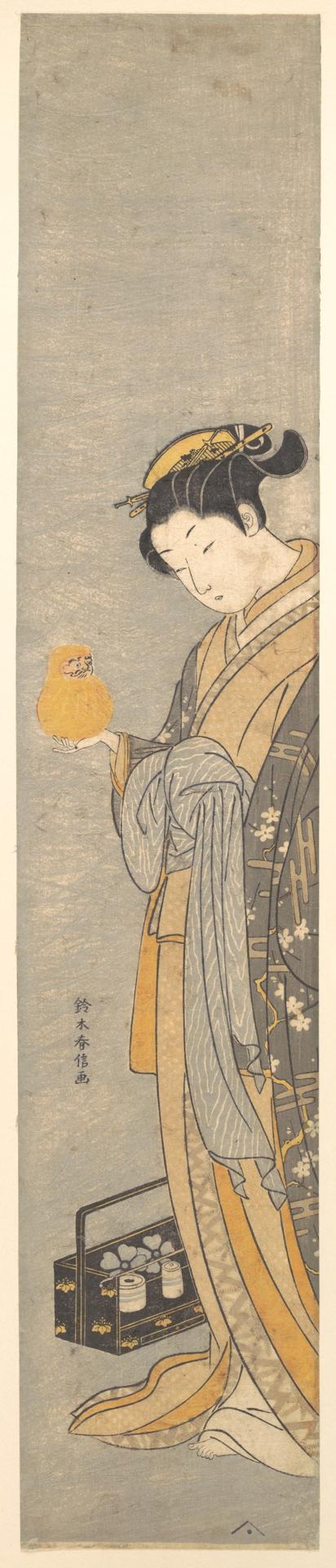
This tall, narrow print by Suzuki Harunobu, probably made in 1770, presents a woman in Japanese dress holding a yellow object, with a basket of implements standing beside her. The unusually slim hashirae format draws out the figure's slender bearing. The title joins beauty with holiness, giving an everyday subject a spiritual overtone.
Description
Her kimono is patterned with blossoms and leaves; the hair is piled high and held by a yellow band. A yellow object rests in her hand, and next to her stands a basket containing a bottle and other things. Flowers and branches belong to the fabric's design. Grey, blue, yellow and white set the palette, and the light falls evenly, with no hard shadows. Crisp outlines and flat colour areas define the style common to Edo-period prints.
Context
Harunobu is regarded as a pioneer of the multicolour woodblock print, nishiki-e, in Japan. This sheet belongs to the late Edo period, an age of cultural flowering and urban pleasure culture. Hashirae formats like this often served to decorate narrow rooms. Everyday grace meets religious resonance here, as the title already suggests.
Impact
The tall, narrow shape directs attention to the woman's graceful posture and the delicate patterns of her kimono. Quiet colours and clear lines convey a still elegance. Because the title brings beauty and holiness together, it lends the everyday motif a spiritual dimension.
Technique
For printing with ink and colour on paper, the lines and colour areas are cut into woodblocks and printed one after another. The multicolour process, nishiki-e, allowed fine gradations and patterns. At 25 x 5 inches the sheet corresponds to the narrow hashirae format, intended for wall pillars or columns.
AI-generated description text
Source: Metropolitan Museum of Art · Public Domain (CC0 1.0)