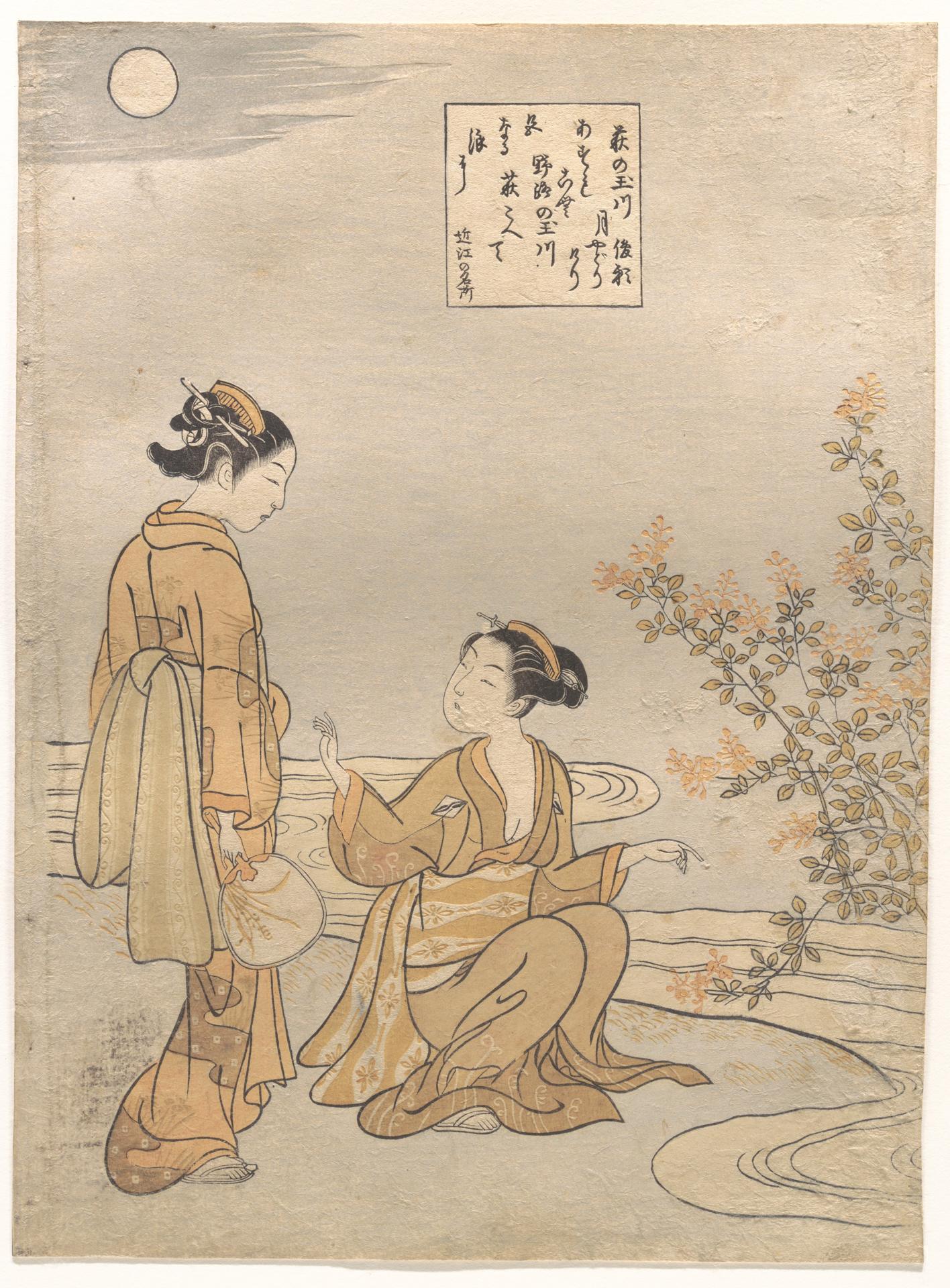
Hagi no Tamagawa
Original title: Hagi no Tamagawa
kurzbeschreibung
Two women in kimono stand at a riverbank: a colour woodblock print by Suzuki Harunobu from the second half of the eighteenth century, made in ink and colour on paper.
Description
The woman on the left stands upright and turns her gaze toward her companion, who kneels at the water's edge holding something in her hand. Both kimonos are patterned with flowers, and both women wear traditional head coverings. A text panel with Japanese characters sits at the upper left, and the moon hangs in the sky. Flowers and branches grow at the right side of the image. Earth tones dominate the palette, set off by accents of gold and brown.
Context
Harunobu ranks among the foremost masters of ukiyo-e and made his name with multicoloured woodblock prints, known as nishiki-e. 'Hagi no Tamagawa' refers to one of the six celebrated Tamagawa rivers, a subject taken up often in Japanese art. Many of his prints show women in everyday or poetic moments, frequently with allusions to classical literature.
Impact
The layout feels calm and well balanced; the figures settle harmoniously into the landscape. Muted colours and the gentle moonlight give rise to a quiet, reflective mood.
Technique
Ink and colour on paper, executed as a woodblock print. A separate woodblock was used for each colour, producing a multicoloured impression. Finely drawn lines and delicate tones characterise Harunobu's working method.
AI-generated description text
Source: Metropolitan Museum of Art · Public Domain (CC0 1.0)