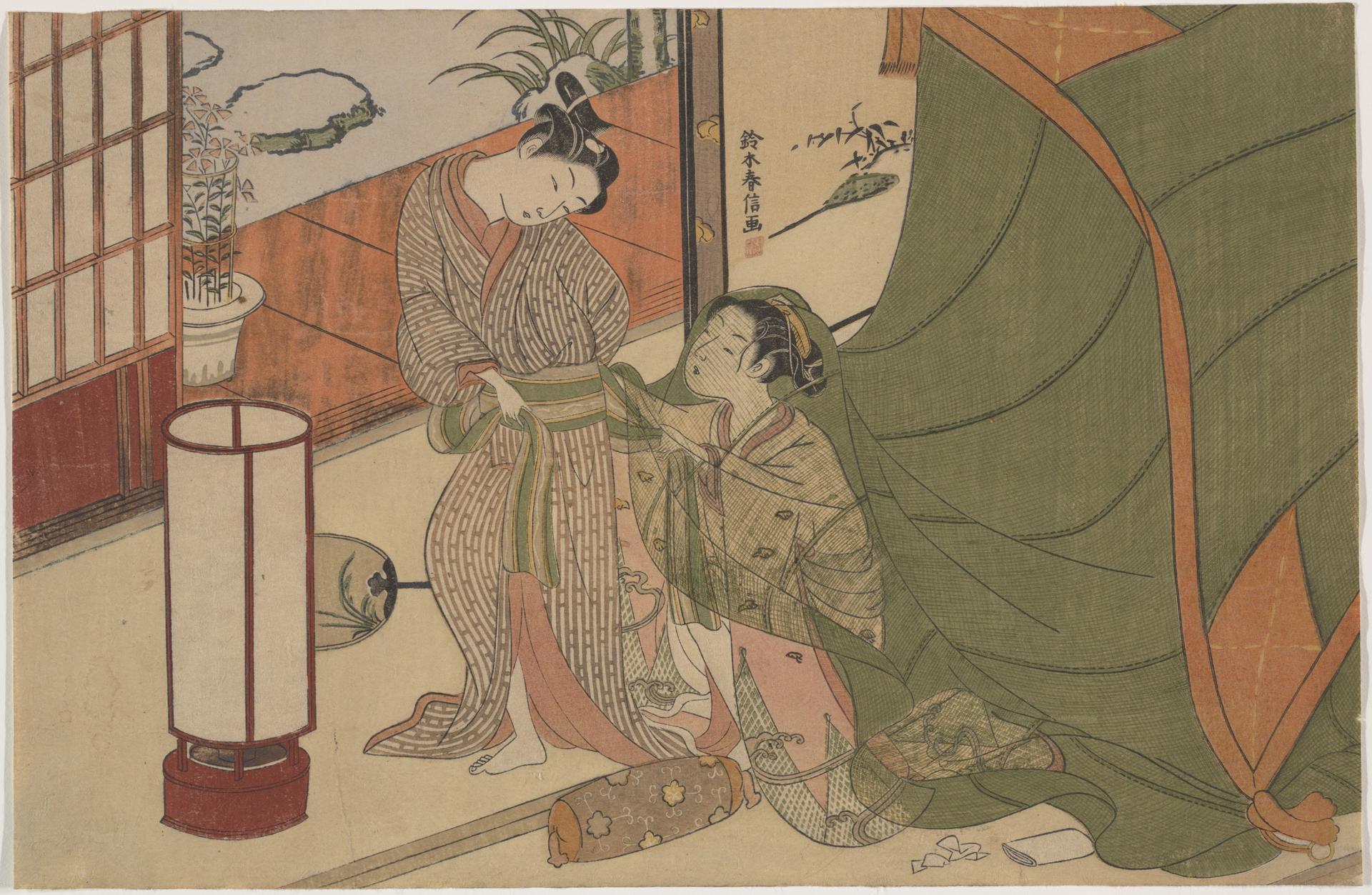
Parting of Lovers: The Morning After (ca. 1765–70, Met-Objekt 4805)
Original title: Parting of Lovers: The Morning After
kurzbeschreibung
Suzuki Harunobu made "Parting of Lovers: The Morning After" around 1765–70 as a Japanese woodblock print. It takes the form of a narrow pillar print (hashira-e) in ink and color on paper. Two women in an interior appear in a familiar scene of morning parting.
Description
Two women in traditional kimonos animate an interior. One kneels on the floor, helping the other, who lies on the ground and seems to be dressing. The kimonos differ in color and pattern. A wooden wall, a potted plant and a wood-framed window form the rear area; a lantern stand occupies the foreground. Earth tones dominate the palette, with accents of green and pink. Light entering from outside bathes the scene in warm daylight.
Context
Suzuki Harunobu ranks among the major Japanese woodblock artists of the Edo period and helped develop full-color printing (nishiki-e). The pillar-print format served to decorate interiors, often placed in alcoves or on pillars. Lovers parting in the morning was a widespread motif in eighteenth-century ukiyo-e. Harunobu's activity falls in the 1760s, a phase of cultural flourishing in Edo, today's Tokyo.
Impact
A quiet, intimate mood emanates from the print, carried by warm light and a calm arrangement. Delicate colors and clear lines give the scene an elegant, fragile note. The tall, narrow format of the pillar print brings the two figures and their relationship to each other into focus.
Technique
Cut into woodblocks and printed with ink and colors on paper, the sheet reveals Harunobu's characteristic touch: fine lines and patterns. It survives as a pillar print (hashira-e), a tall, narrow format intended for mounting on pillars or posts. Several printing passes laid the colors onto the paper one after another.
AI-generated description text
Source: Metropolitan Museum of Art · Public Domain (CC0 1.0)