Atalanta and Meleager (ca. 1616)
Original title: Atalanta and Meleager
kurzbeschreibung
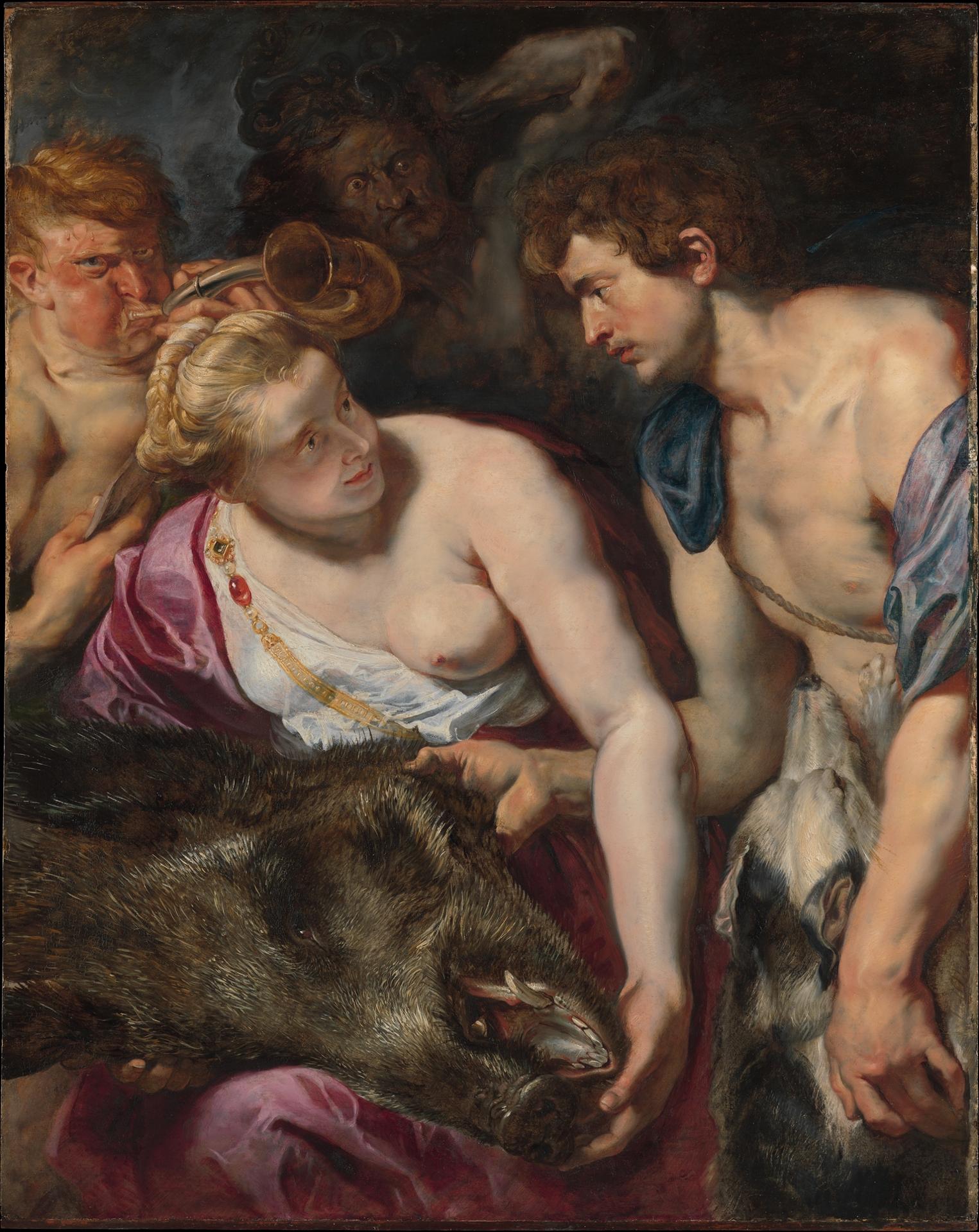
Peter Paul Rubens painted "Atalanta and Meleager" around 1616. The picture presents the Calydonian boar hunt, with the slain boar's head being handed over to the huntress Atalanta. The work is executed in oil on wood.
Description
In the foreground, a blonde woman in a red robe holds the head of a wild boar. Beside her stands a brown-haired man, a blue cloth draped over his shoulders, holding an animal skin. On the left, another man blows a horn. A third figure in the background, partly in shadow, looks on. Bright light falls on the main figure and the boar's head, drawing the eye strongly.
Context
The painting comes from Rubens's Antwerp workshop, one of the leading artistic centers of the 17th century. Rubens often created mythological and biblical scenes for nobility and wealthy patricians. The Calydonian hunt was a common Baroque motif, representing bravery and virtue.
Impact
The strong contrast between light and dark creates a dramatic, tense atmosphere. Because the woman and the boar's head are the focal point, attention is directed to the central event. Dark tones give the whole a serious, solemn character.
Technique
Oil paint on a wooden panel allowed for detailed, fine execution. Through chiaroscuro—the strong contrast of light and shadow—the figures stand out in a sculptural way. Fur, fabric, and skin are rendered with great precision.
AI-generated description text
Source: Metropolitan Museum of Art · Public Domain (CC0 1.0)