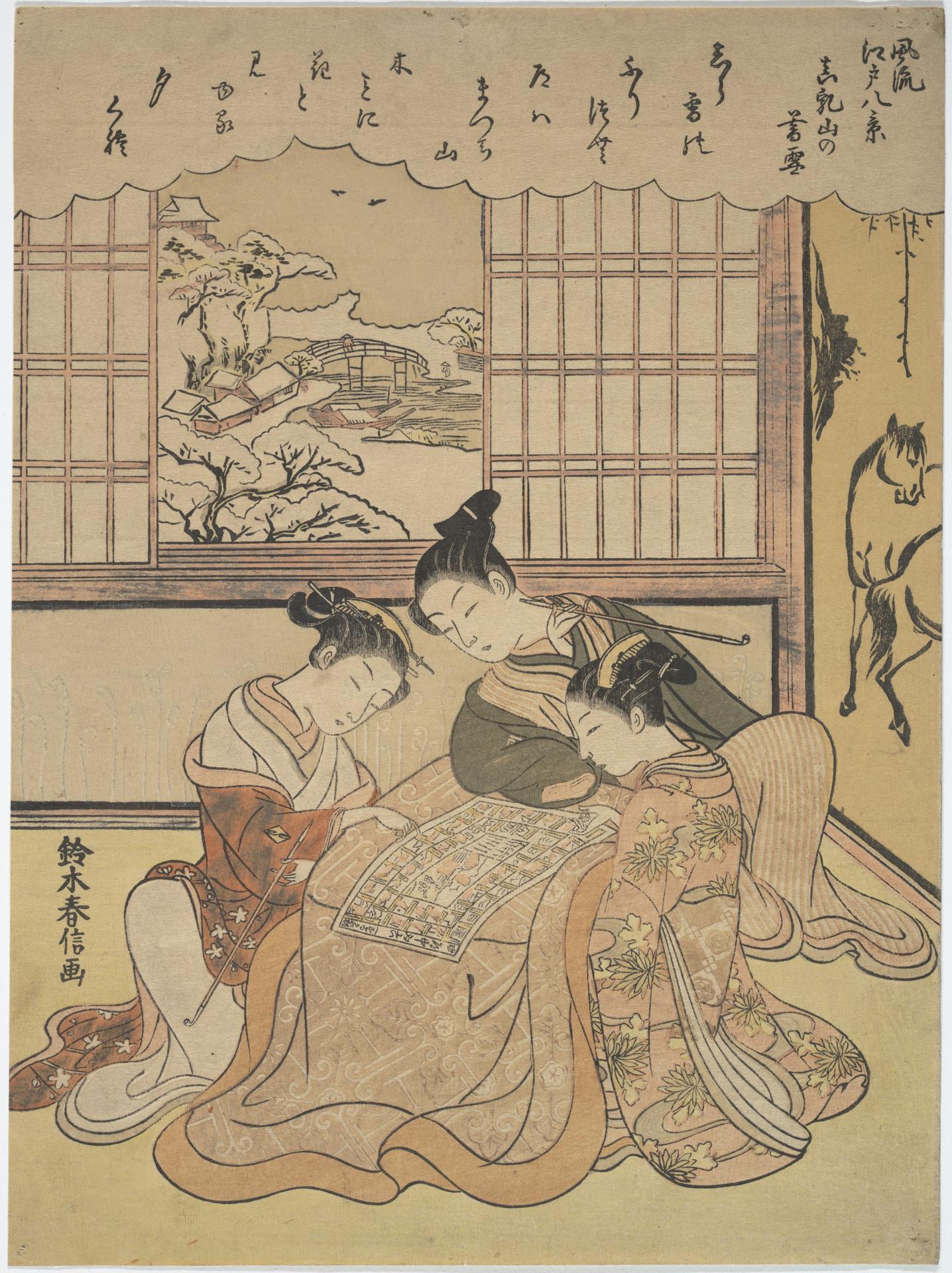
Evening Snow on Matsuchi Hill, from the series Eight Fashionable Views of Edo (Furyu Edo hakkei)
Original title: Evening Snow on Matsuchi Hilll, from the series Eight Fashionable Views of Edo (Furyu Edo hakkei)
kurzbeschreibung
Three women sit close together on a patterned cloth spread across the floor, looking through a window toward the snow-covered Matsuchi Hill. In this colour woodblock print of about 1765–70, Suzuki Harunobu sets a domestic scene against a wintry view outdoors.
Description
Three women in long robes of richly falling folds have settled on a large, decorated cloth that covers the floor. A window behind them opens onto a snowy landscape with bare trees. Above the window opening runs an inscription panel with characters; to its left appears a small horse motif. Earth tones dominate, with red and blue as accents, while the light falls warm and muted from outside. The layout feels balanced: the figures hold the foreground, the window forms the still point.
Context
Harunobu's series Furyu Edo hakkei takes aim at the famous Eight Views of Omi, relocating their subjects to contemporary Edo, present-day Tokyo. The artist helped pioneer full-colour printing (nishiki-e), which emerged around 1765 and transformed woodblock art. The print dates from the late Edo period, when urban culture and fashion flourished in the capital. Scenes of women at leisure suited an urban audience that prized such subjects as fashionable (furyu).
Impact
Warm light and earthy tones gather into a quiet, familiar mood. The contrast between the snug interior and the cold of the snowy landscape outside creates a poetic tension. Clear organisation and balanced arrangement give the print an almost meditative calm.
Technique
The print was made as a woodblock with ink and colour on paper in the medium chu-ban format. For full-colour printing, a separate woodblock was used for each colour. Precise linework and delicate gradations of colour testify to the high craft standards of the printing workshops of the day.
AI-generated description text
Source: Metropolitan Museum of Art · Public Domain (CC0 1.0)