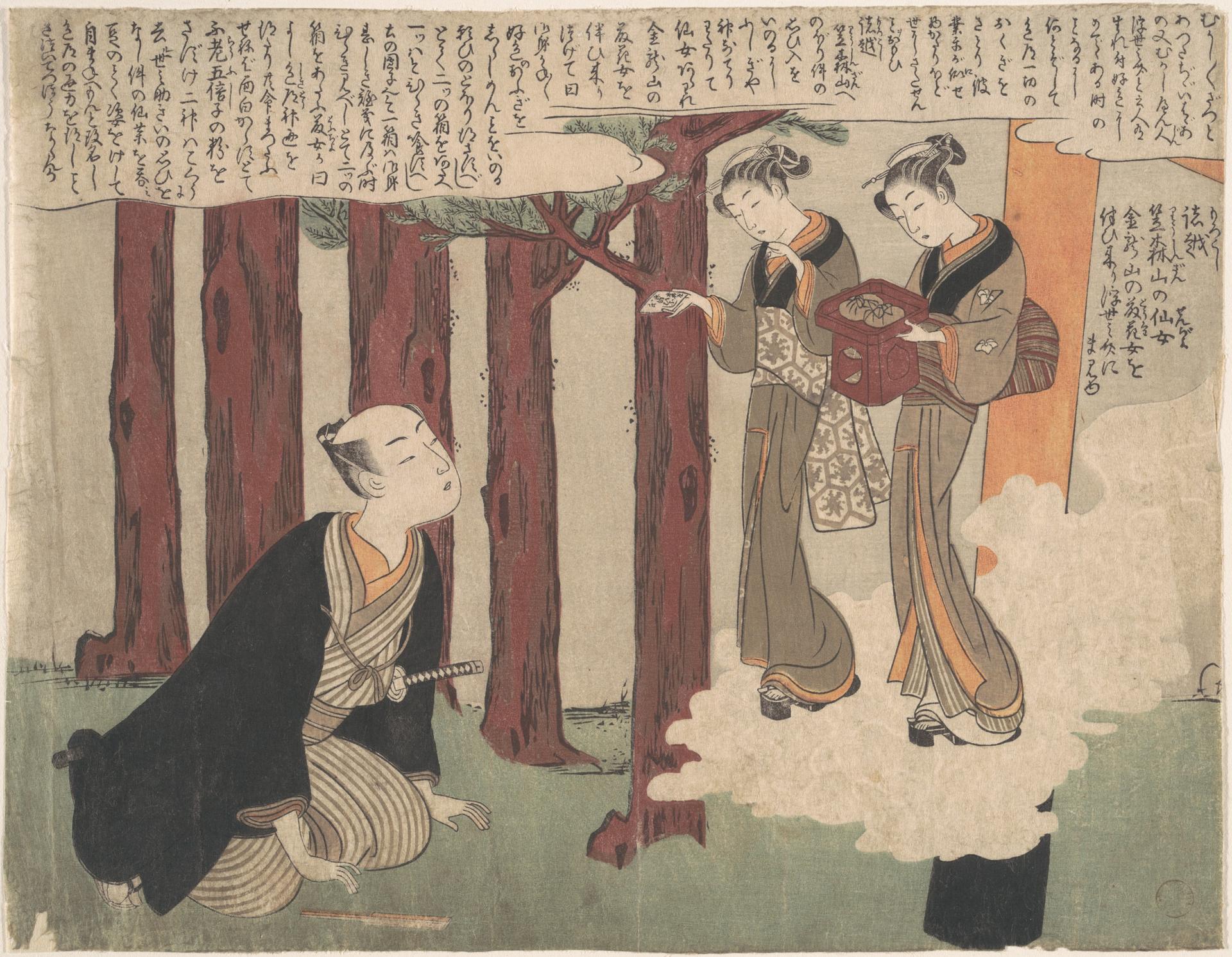
First Leaf of the Shunga; The Delightful Love Adventures of Maneyemon
Original title: First Leaf of the Shunga; The Delightful Love Adventures of Maneyemon
kurzbeschreibung
A woman holds a small box while a man kneels before her; this pair opens the shunga series that Suzuki Harunobu issued around 1769. The first sheet of The Amorous Adventures of Maneyemon sets the two figures against a landscape of trees and drifting clouds. Harunobu produced the print as a colour woodblock, using ink and colour on paper.
Description
Crouched on the ground, a man in traditional dress faces a standing woman whose hand closes around a small box. Trees and passing clouds frame the pair and form the landscape backdrop. Earth tones dominate the palette, broken by red and orange accents. Foreground and background are clearly separated and arranged almost symmetrically. The tones stay muted, the light falls evenly — an appearance typical of woodblock prints from that era.
Context
Harunobu ranks among the most important Japanese woodblock masters of the eighteenth century; he played a key role in developing full-colour printing (nishiki-e). Shunga literally means 'spring pictures' — erotic prints that circulated widely in the Edo period and were kept in the collections of respected citizens. This sheet belongs to a series recounting the love adventures of Maneyemon, a figure partly invented and partly handed down. Such series were highly popular with collectors and often bound into albums.
Impact
The layout is calm and nearly symmetrical, and the muted earth tones reinforce that impression — for an erotic subject, the print feels unexpectedly restrained. Set within nature, the encounter takes on a poetic, almost idyllic tone that appeals to the aesthetic eye rather than to curiosity. Clean contours and carefully graded colours reveal Harunobu's craftsmanship and the elegance of Japanese colour woodblock printing.
Technique
The medium is woodblock: ink and pigments were printed onto paper. Harunobu helped pioneer multi-colour printing, in which each colour requires its own woodblock — this allowed fine gradations and lively colour effects. At roughly 20.3 x 26 cm, the sheet matches the standard chuban format common for such intimate prints.
AI-generated description text
Source: Metropolitan Museum of Art · Public Domain (CC0 1.0)