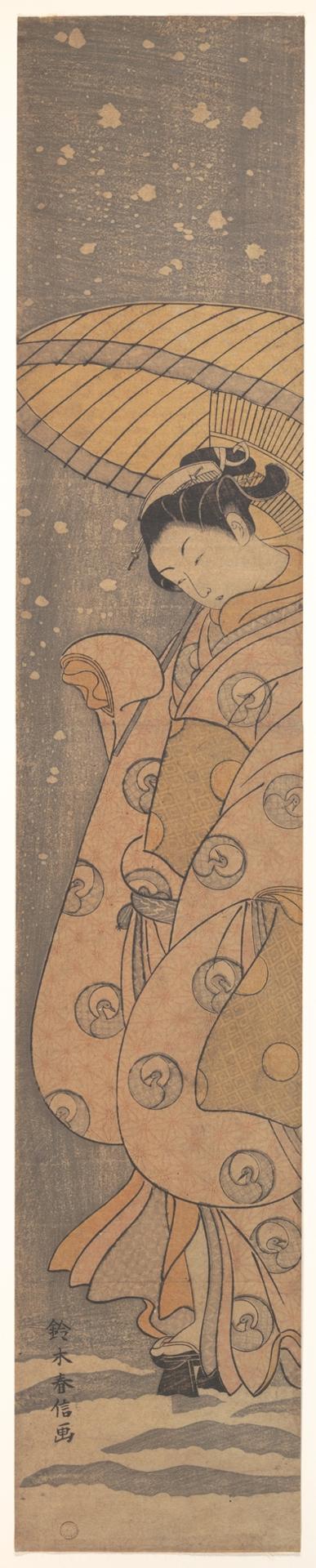
Beauty under an Umbrella in the Snow
Original title: Beauty under an Umbrella in the Snow
kurzbeschreibung
Suzuki Harunobu made this colour woodblock print around 1770, showing a young woman standing in the snow beneath a large umbrella. The tall, narrow format is a so-called pillar print, executed in ink and colour on paper and dated to the Edo period.
Description
The woman wears a long, patterned kimono and a hair ornament; she leans slightly to the left, her gaze lowered. A large yellowish umbrella arches over her, held up by a wooden frame. Snowflakes fall against the dark ground. Light entering from above picks out the contours of figure and umbrella, while the palette stays mostly muted, with accents of yellow and brown. Chinese characters appear in the lower part of the sheet.
Context
Harunobu is regarded as a pioneer of multicolour woodblock printing (nishiki-e), and through the 1760s and 1770s he devoted himself mainly to pictures of beautiful women (bijinga). Pillar prints of this kind served as decoration for the narrow posts in Japanese houses. The subject of a woman in the snow was popular in ukiyo-e and emphasised the tie to the seasons. The work was made in the late Edo period, a phase in which urban culture in Edo (present-day Tokyo) flourished.
Impact
The narrow arrangement and the towering umbrella give the sheet an elegant verticality. The meeting of warm yellow and brown tones with the cold snow calls up a quiet, contemplative mood. The woman's lowered posture feels intimate and restrained.
Technique
The sheet is a woodblock print (pillar print) in ink and colour on paper. Harunobu used multicolour printing (nishiki-e), which allowed fine gradations of tone and precise linework. At about 67.9 cm high and 12.7 cm wide, it follows the usual format for pillar prints.
AI-generated description text
Source: Metropolitan Museum of Art · Public Domain (CC0 1.0)