The Cry of the Stag
Original title: The Cry of the Stag
kurzbeschreibung
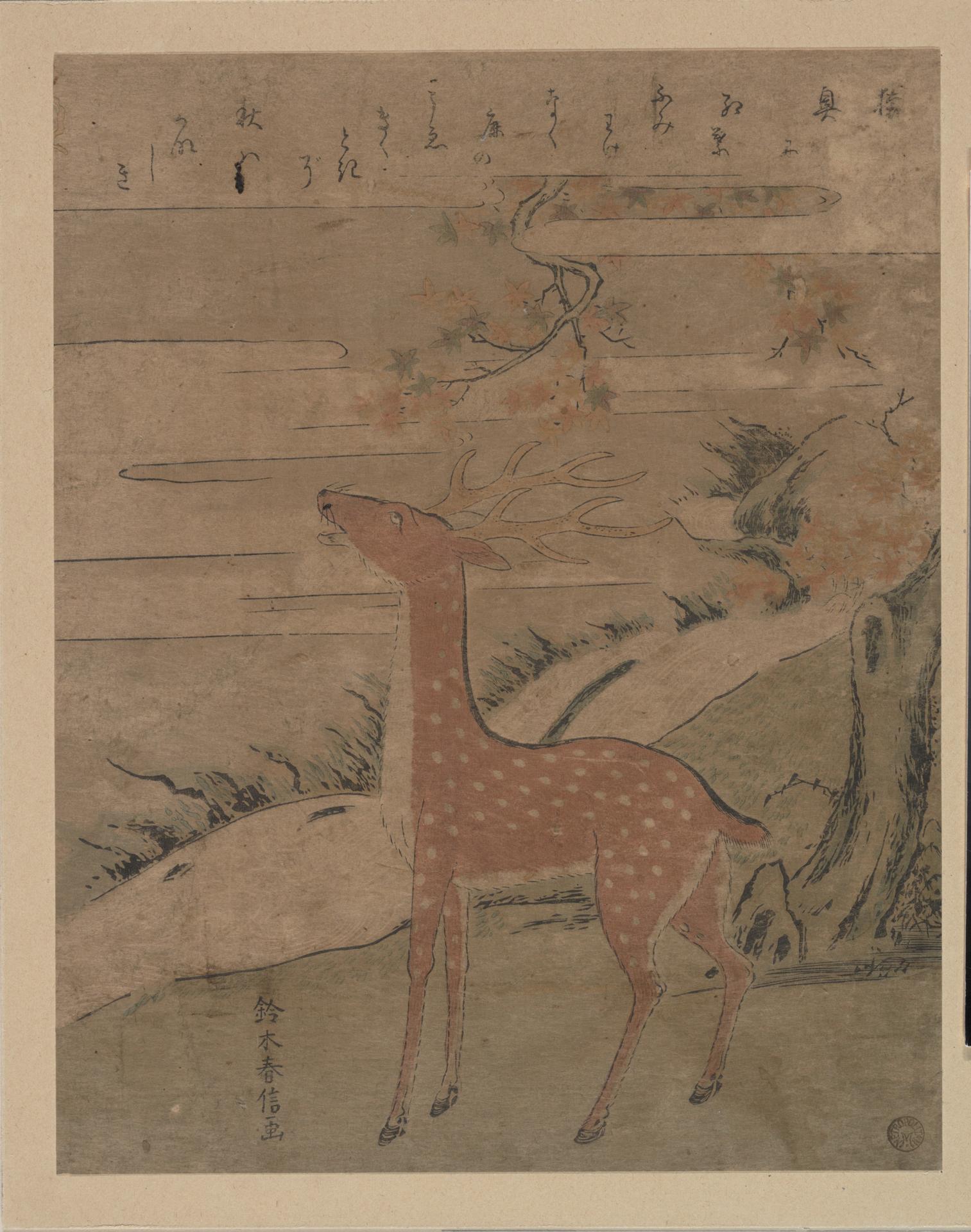
While many prints of the period show deer at rest, Suzuki Harunobu's 'The Call of the Stag' gives the animal a wide-open mouth. Made around 1760, the sheet is printed in ink and colour on paper and belongs to the Japanese colour woodblock tradition.
Description
A spotted stag with its mouth flung open commands the image. Trees and leaves frame the animal, creating a natural setting. Horizontal lines behind suggest sky or landscape. Chinese characters at the top likely give the title or a description. At the lower right stands the signature '鈴木春信'.
Context
Suzuki Harunobu, a leading master of Edo-period woodblock printing, is known for developing nishiki-e, the so-called brocade print. Around 1760 Japanese woodblock printing flourished, and multicolour prints became established. The deer motif may point to Japanese artistic tradition or to literary allusions common in ukiyo-e.
Impact
The stag's open mouth gives the image an immediate, almost dramatic tension. Clear lines and harmonious colouring create a quiet but expressive presence.
Technique
Ink and colour on paper, printed by woodblock, as is typical of Japanese ukiyo-e. Colours were applied over the woodblock print, preserving the technique's characteristic linear structure.
AI-generated description text
Source: Metropolitan Museum of Art · Public Domain (CC0 1.0)