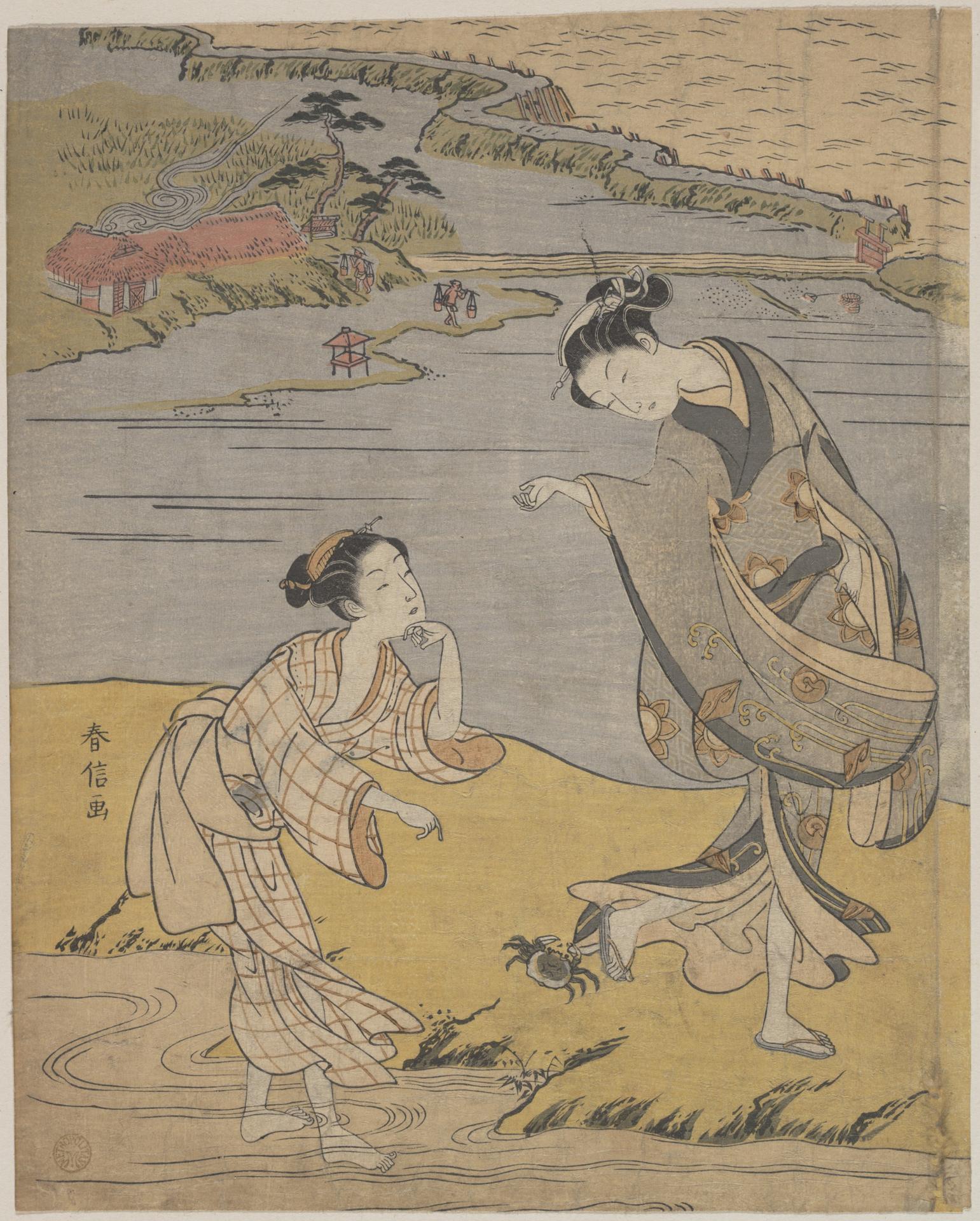
The Clinging Crab
Original title: The Clinging Crab
kurzbeschreibung
A crab stands in the sand between two figures on the shore. That motif gives this 1770 colour woodblock print by Suzuki Harunobu its title, Die festhaltende Krabbe (The Holding Crab). The two people face each other, absorbed in conversation. The ukiyo-e sheet is executed as a woodblock print in ink and colour on paper.
Description
On the left stands a person in traditional dress with a checked obi; on the right, a second figure wears an elaborately decorated kimono. The right figure hands something to the left, and both seem to be speaking. At their feet, in the middle of the sand, sits a small crab. Behind them open a river, trees, a pavilion and a small house. Greys, beiges and browns dominate the muted palette; the light falls evenly, without hard shadows.
Context
The sheet was made in the Edo period, a cultural high point in Japan. Harunobu is regarded as a pioneer of multicolour woodblock printing, nishiki-e, which spread from the 1760s. Everyday scenes and nature motifs suited the taste of the urban audience for whom ukiyo-e was intended. Whether the crab stands for luck or perseverance cannot be proven, but it is a plausible reading.
Impact
The closeness of the two figures gives the print something calm and private. Restrained colours and clear contours produce an unobtrusive elegance. As a small detail, the crab draws the eye and invites a closer look.
Technique
For each colour tone a separate woodblock is cut, and the colours are printed onto the paper one after another with ink. Precise lines and evenly filled colour areas distinguish nishiki-e, whose possibilities Harunobu did much to advance.
AI-generated description text
Source: Metropolitan Museum of Art · Public Domain (CC0 1.0)