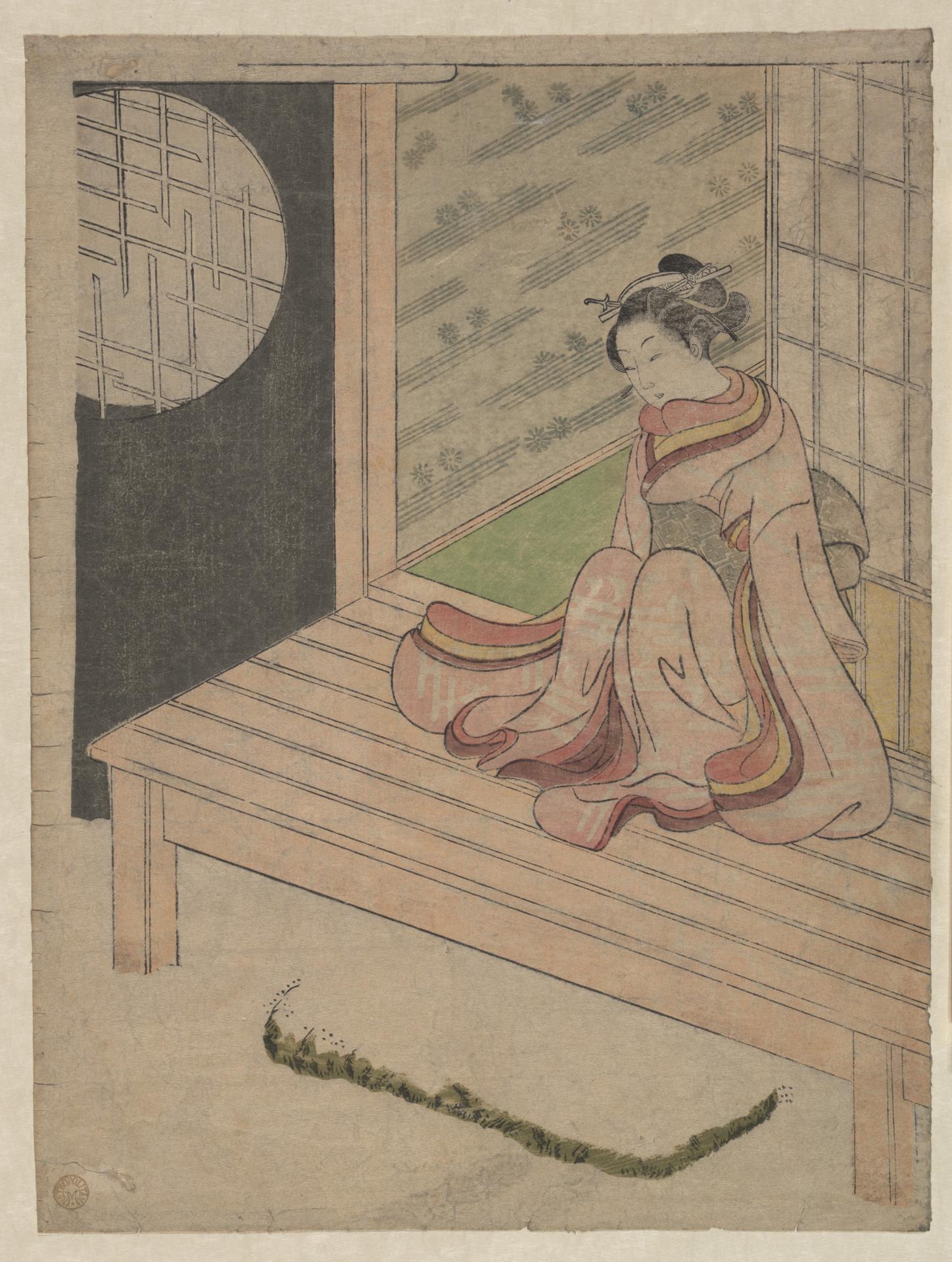
A Young Woman Seated upon the Engawa of a House
Original title: A Young Woman Seated upon the Engawa of a House
kurzbeschreibung
A young woman sits on the engawa of a Japanese house, captured in a color woodblock print by Suzuki Harunobu from around 1765. Her kimono shows a red and yellow pattern; the sheet is executed in ink and color on paper and belongs to the ukiyo-e genre.
Description
The seated figure occupies the low wooden bench at the center, her gaze lowered, her expression rather pensive, perhaps troubled. Over the long kimono with its red and yellow pattern, her upswept hair is adorned with accessories. Behind her, shoji with floral, leaf-like decoration close off the room; to the left a dark chamber opens, and from its window a slice of the moon emerges. A green carpet roll covers the floor, the palette remains mostly earthy with red and yellow accents, and the light falls softly and without direction from outside.
Context
Harunobu is one of the defining masters of ukiyo-e in eighteenth-century Japan and is considered a pioneer of multicolor printing, nishiki-e, which became established in the 1760s. The woman in a domestic setting matched the era's ideal of grace and seclusion. Above all, bijin-ga, pictures of beautiful women in familiar everyday scenes, form the core of his work.
Impact
The sheet feels calm and intimate; the woman's lowered posture leaves a quiet, slightly melancholy mood. Warm, private light emanates from the earthy tones and draws the viewer into the scene. The arrangement appears balanced through clear lines and an almost symmetrical order.
Technique
Ink and color on paper, printed in the ukiyo-e woodblock method. Multicolor printing allowed fine gradations, as seen in the reds of the kimono and the greens of the carpet. Clear contours and flatly applied colors correspond to the color woodblock print of the Edo period.
AI-generated description text
Source: Metropolitan Museum of Art · Public Domain (CC0 1.0)