Daikoku Dōagé
Original title: Daikoku Dōagé
kurzbeschreibung
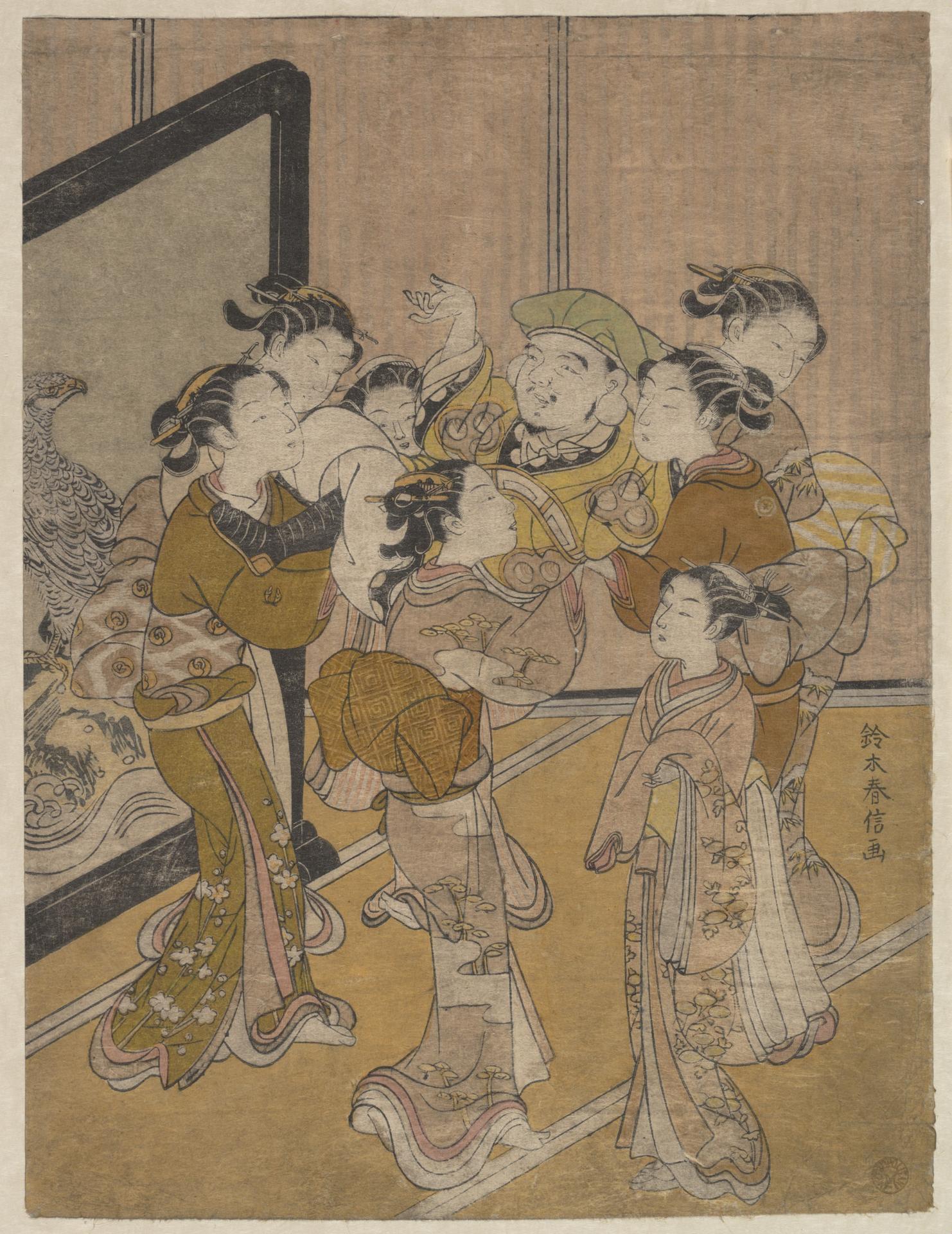
Daikoku, one of the Seven Lucky Gods, turns up amid a crowd of women: Suzuki Harunobu's print "Daikoku Dōagé" from 1766 lays out an indoor scene in which a man in yellow robes is surrounded on all sides, while an eagle perches on a platform behind him.
Description
Women in brightly patterned kimono stand around a central figure dressed in yellow and wearing a cap; their expressions shift between laughter and worry. An eagle on a platform closes off the rear of the picture. The figures are spread across the sheet in lively movement, and the arrangement feels open and relaxed. Warm tones — yellow, brown, pink — set the palette, and the light stays even, with no shadows.
Context
Harunobu ranks among the defining artists of the Edo period and helped push forward full-colour printing, known as nishiki-e. Around 1766 he favoured scenes from city life and popular culture. Tying the god Daikoku to a cheerful everyday situation points to the entertainment culture of the day.
Impact
The warm colouring and lively arrangement give the picture a cheerful, almost festive mood. The differing faces lend it narrative depth and invite the viewer to work out how the figures are interacting. Crisp outlines and the meticulous rendering of the clothing underline the print's aesthetic quality.
Technique
Ink and colour on paper, produced as a woodblock print. Harunobu worked in full-colour printing, in which a separate wooden block was used for each colour. Precise lines and evenly applied areas of colour testify to the craftsmanship of this printing method.
AI-generated description text
Source: Metropolitan Museum of Art · Public Domain (CC0 1.0)