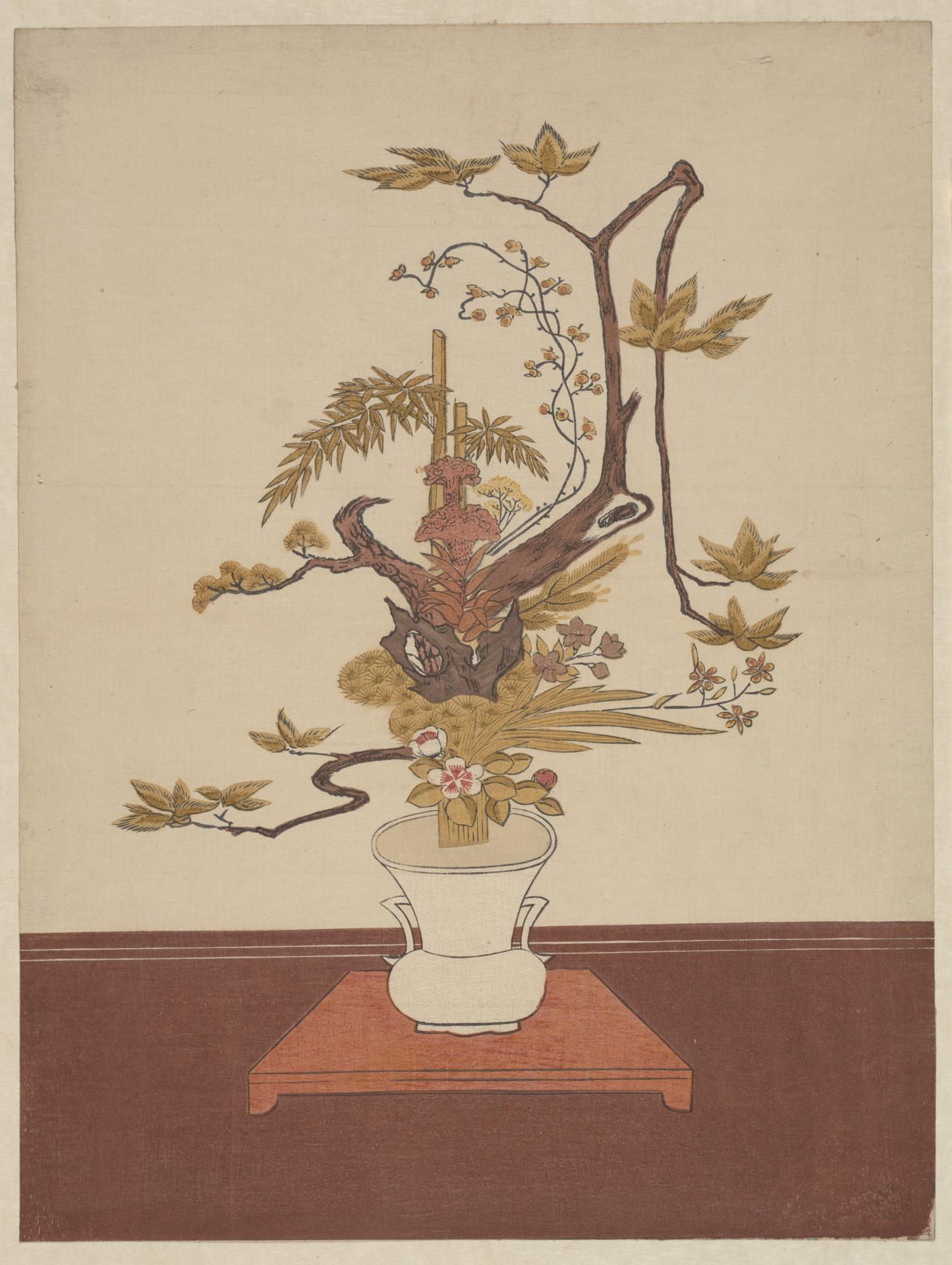
Ike Bana (Flower Arrangement) in the Ike-no-bo Style
Original title: Ike Bana (Flower Arrangement) in the Ike-no-bo Style
kurzbeschreibung
Suzuki Harunobu made this woodblock print probably in 1765. It presents a flower arrangement in the manner of the Ike-no-bo school: a stylized plant in a shallow basin resting on a stand, set against a restrained beige ground.
Description
A regularly structured plant stretches across the entire sheet. Its branches and leaves appear in gold, brown, and green, with small pink and white blossoms on some of them. The arrangement stands in a white, shallow basin on a red stand. Beige tones set the overall key of the print; evenly distributed light gives the colors a faint shimmer.
Context
Harunobu ranks among the foremost Japanese woodblock masters of the eighteenth century and is regarded as a pioneer of nishiki-e, the multicolor print. This sheet dates from around 1765, when that color woodcut became established in Edo, present-day Tokyo. An ikebana motif of this kind reflects the esteem for flower art among the educated urban public. Ike-no-bo is one of the oldest schools of Japanese flower arranging and emphasizes balanced lines.
Impact
The regular layout and restrained coloring feel calm and well balanced. Clear contours and even light lend the sheet a timeless elegance characteristic of Japanese woodblock printing.
Technique
The print is executed as a woodcut with ink and color on paper. In this process the design is cut into wooden blocks and then printed. Several layers of color laid over one another allow the fine transitions and the luminosity of the pigments.
AI-generated description text
Source: Metropolitan Museum of Art · Public Domain (CC0 1.0)