Parody of Minamoto no Tametomo
Original title: Parody of Minamoto no Tametomo
kurzbeschreibung
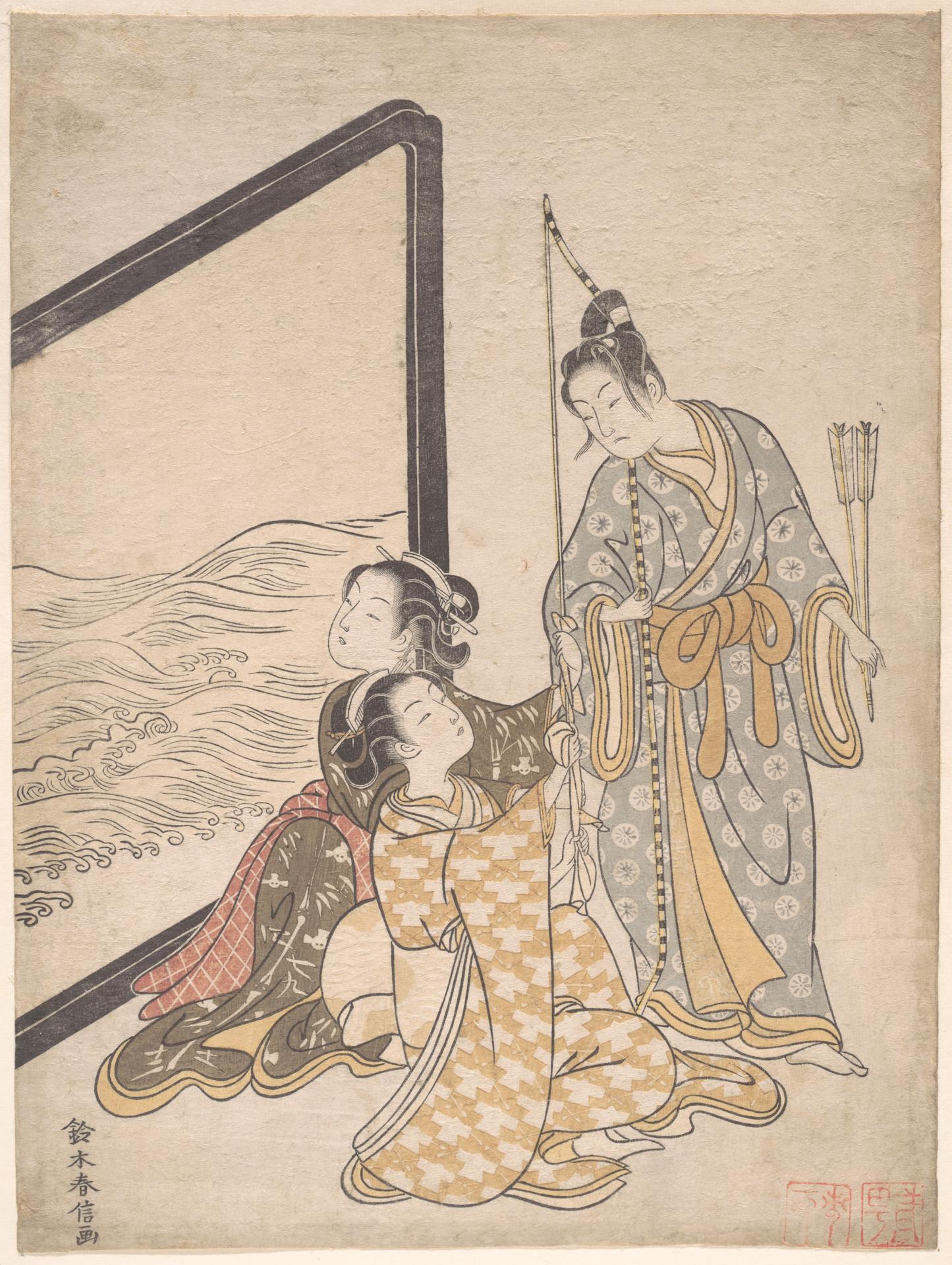
Suzuki Harunobu made this colour woodblock print in 1765, turning the famous hero Minamoto no Tametomo into comic material: three women and an armoured man appear together in one scene. It is a woodblock print in ink and colour on paper, in the medium format known as chūban.
Description
Three women in traditional dress dominate the foreground: two are seated on a bench, while the third kneels holding an arrowhead. Her garment displays a check pattern, and her hair is tied in a knot; the other two wear colourful kimonos and elaborate hairstyles. On the left a wave suggests a boat trip. On the bench stands a man in armour, an arrow on his back, looking toward the women. The figures are on the right, the wave motif on the left—a balanced arrangement in grey and beige, with red, blue and gold as accents.
Context
The print was made in 1765 in Edo, present-day Tokyo, during the Edo period. Harunobu is regarded as a pioneer of multicolour woodblock printing and is known for his elegant female figures. Parodies of historical heroes were very popular in ukiyo-e and served as light entertainment. This work counts among the early examples of full-colour printing, which was just then emerging.
Impact
Heroic pictorial tradition around Tametomo meets an everyday, almost intimate situation—creating an ironic break. The calm, balanced layout and delicate contours give the print a quiet elegance. Colour accents direct the gaze without disturbing the restrained overall effect.
Technique
The design was cut into woodblocks and transferred to paper with watercolours. Only the use of several blocks allowed the fine colour transitions and the precise patterns of the kimonos. Clear contours and flatly applied colours are entirely in keeping with ukiyo-e printing technique.
AI-generated description text
Source: Metropolitan Museum of Art · Public Domain (CC0 1.0)