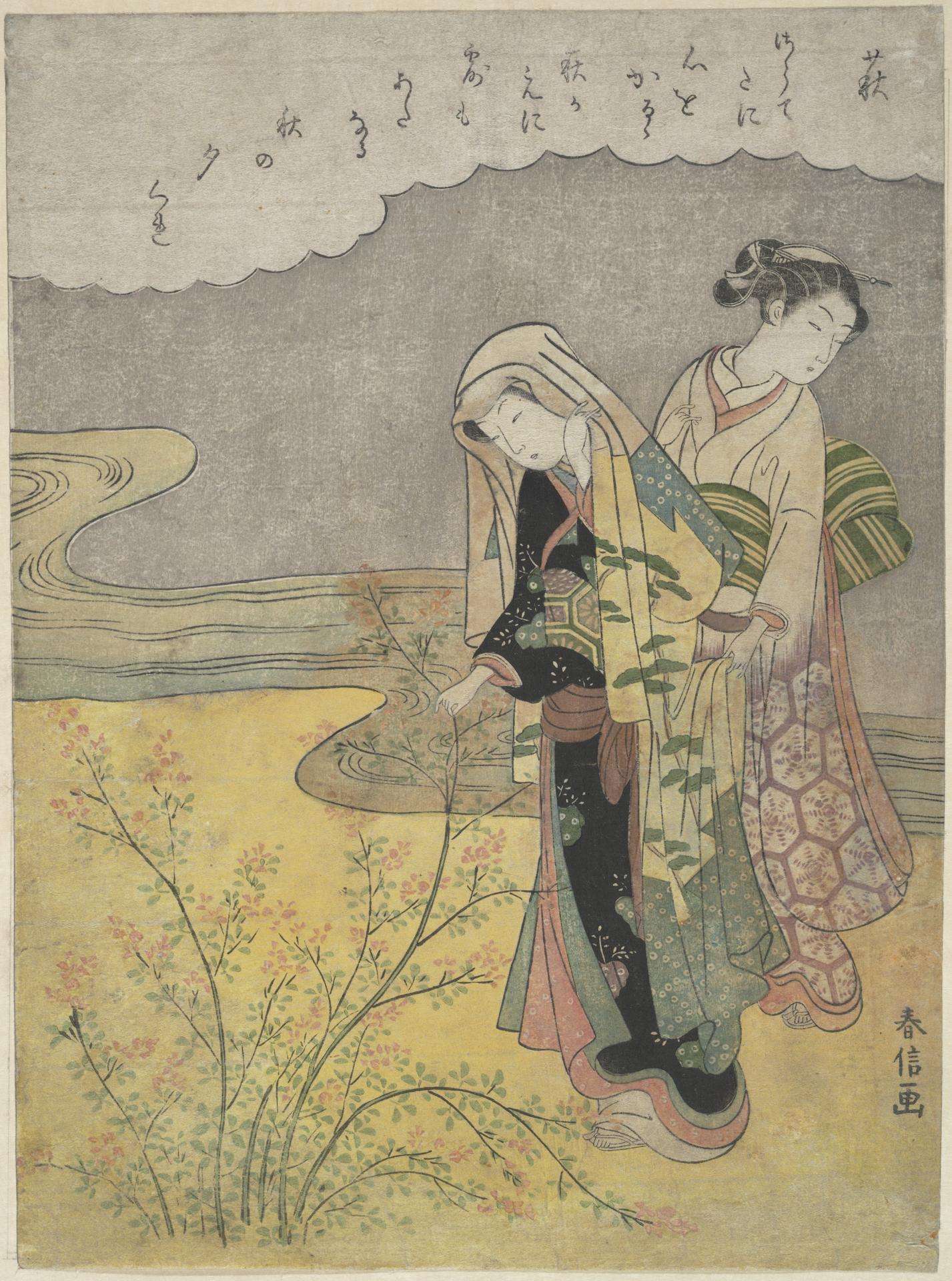
The Bush Clover (Hagi)
Original title: The Bush Clover (Hagi)
kurzbeschreibung
Two women in patterned robes stand in a landscape with a stream and trees. The print carries the title "Lespedeza (Hagi)" and comes from Suzuki Harunobu. Made around 1766, the colour woodblock is a chu-ban, a middle-sized sheet, printed in ink and colour on paper.
Description
In front, one woman holds a flower and lowers her eyes; a second stands off to the side behind her, also looking down. Both wear the elaborately patterned kimono of the Edo period. A stream and trees fill the rear of the sheet, and Chinese characters run across the top. Muted colours, crisp contours and clean lines define the image, which is lit evenly throughout.
Context
Suzuki Harunobu is regarded as a pioneer of multicolour woodblock printing, the nishiki-e that took hold in Edo during the 1760s. In Japanese art and literature the lespedeza counts among the traditional emblems of autumn. At the time this sheet was made, woodblock prints were increasingly produced for a broad urban public.
Impact
The women's quiet, inward-turned bearing and the subdued tones call up a still, elegiac mood. Delicate lines and a balanced layout give the sheet a decorative presence that also feels intimate.
Technique
Ink and colour on paper, printed from wooden blocks: the standard method of Japanese ukiyo-e. A separate block was used for each colour, which is what produces the sharp contours and clean lines.
AI-generated description text
Source: Metropolitan Museum of Art · Public Domain (CC0 1.0)