Osen of the Kagiya Teahouse
Original title: Osen of the Kagiya Teahouse
kurzbeschreibung
What separates this tall print from many comparable ukiyo-e sheets is its focus on a single woman presenting a bowl of tea discs, rather than on a crowded or narrative scene. Suzuki Harunobu made the work around 1769 as a woodblock print in ink and color on paper, dating it to the middle of the Edo period.
Description
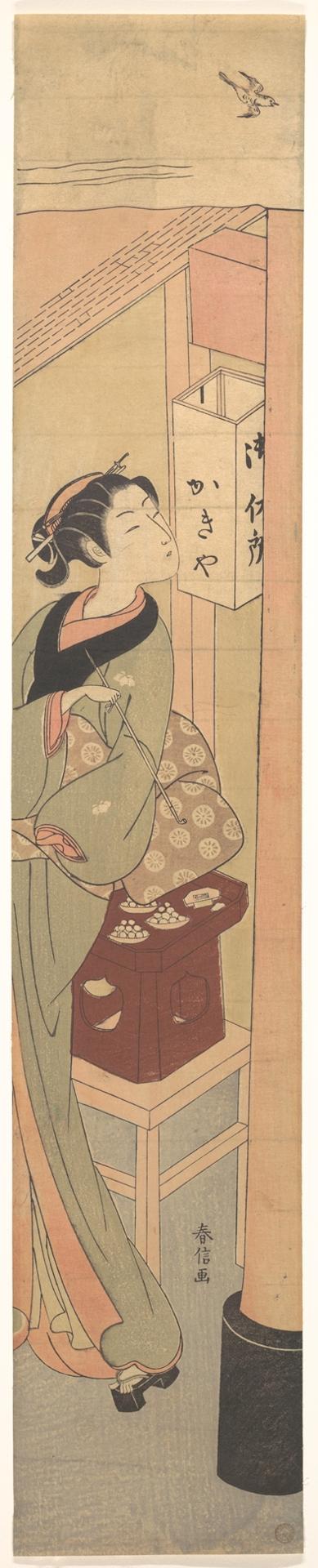
She wears a kimono patterned with circles and holds a bowl containing several small objects that recall tea discs. Her hair is dressed high and decorated with accessories. Part of a building with a roof and a pillar frames her, together with a sign bearing Japanese characters, and a small bird appears at the top. The palette stays pastel, dominated by pink, beige, and gray, while light falling from the front brings out the contours.
Context
The subject belongs to Harunobu's series 'Zashiki hakkei' (Eight Views of the Interior) from the 1760s. Osen, a well-known waitress at the Kagiya teahouse in Edo, was often commemorated in ukiyo-e prints. Harunobu is regarded as a pioneer of multicolor printing (nishiki-e), which emerged around 1765 and considerably widened the woodblock print's range of color. The narrow pillar-print format (hashira-e) was used to decorate columns in Japanese homes.
Impact
The tall, narrow layout brings the woman's elegant bearing and the quiet atmosphere of the interior to the fore. Pastel tones and clear lines convey a calm, almost idyllic mood characteristic of Harunobu's work.
Technique
Executed as a vertical woodblock print in ink and color on paper, the sheet belongs to the pillar-print type (hashira-e), a narrow format meant for mounting on columns. The printing relies on multicolor nishiki-e, which allows delicate gradations of color and precise lines.
AI-generated description text
Source: Metropolitan Museum of Art · Public Domain (CC0 1.0)