Sympathy
Original title: Sympathy
kurzbeschreibung
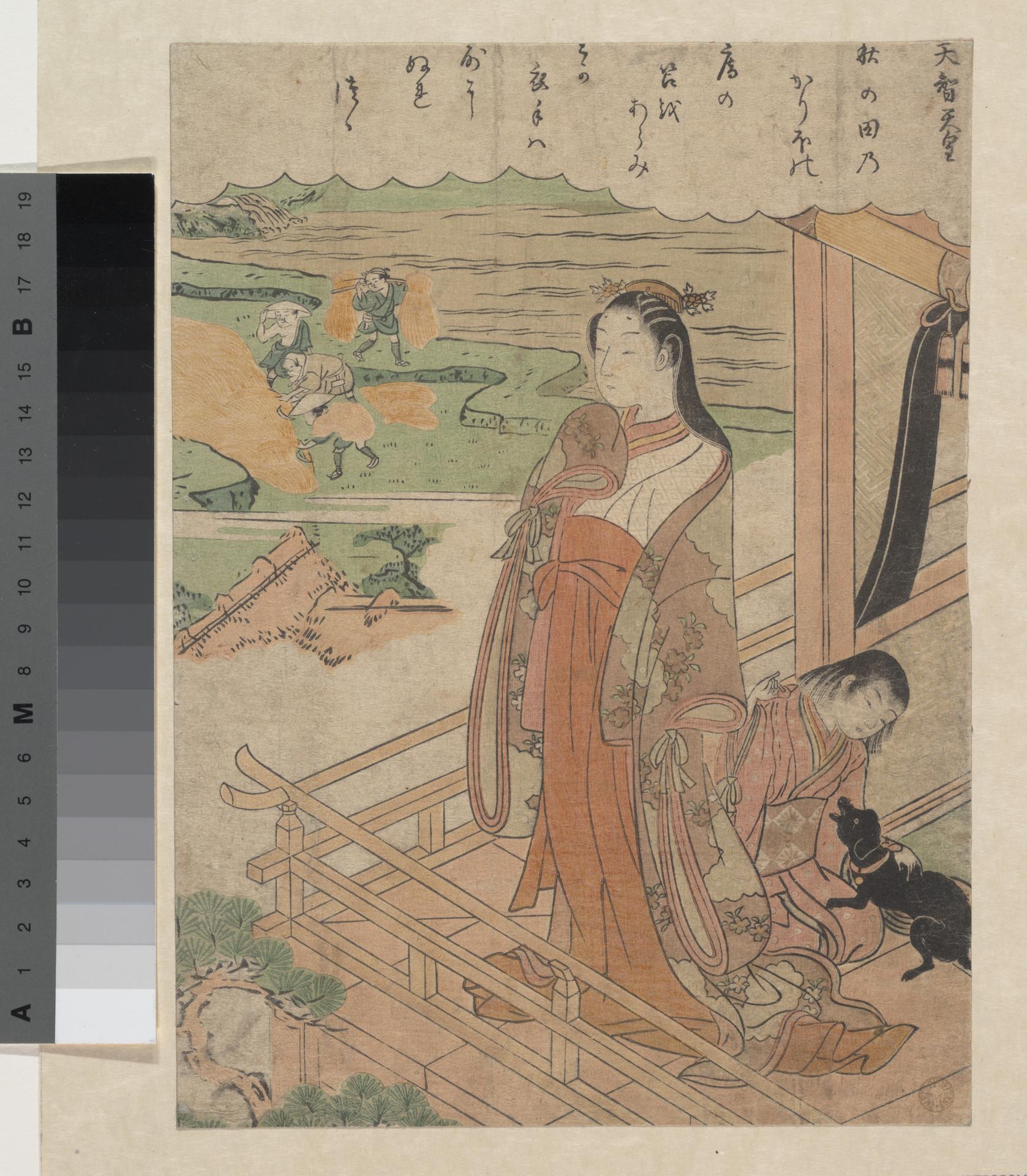
Made around 1768, Suzuki Harunobu's colour woodblock print "Sympathie" presents a woman in traditional dress standing on a platform, with a man kneeling beside her and a small animal at his side. Ink and colour on paper, the sheet belongs to the ukiyo-e tradition.
Description
A raised platform carries the standing woman in Japanese attire, while a man crouches nearby holding an animal. Behind them two farmers work a field, framed by trees and a water channel. Earth tones dominate the palette, with accents of blue and green. The layout stays clearly ordered, the outlines sharp and exact, the colours muted.
Context
Suzuki Harunobu ranks among the foremost ukiyo-e masters of eighteenth-century Japan. As a pioneer of multicolour printing (nishiki-e), which took shape from the mid-1760s, he left his mark on the printmaking of his day. This sheet dates from the Edo period, an era of cultural flourishing and urban pleasure culture. Harunobu often designed idealised female figures and scenes of everyday life.
Impact
The scene meets the viewer calmly and harmoniously, carried by its earthy tones and balanced arrangement. Bringing people and animal together and drawing the landscape into the picture creates a mood of quiet sympathy and closeness.
Technique
The image was produced as a woodblock print, with ink and colour applied to paper. Multicolour printing allowed several blocks to be used, yielding the delicate gradations and details. Crisp lines and precise execution distinguish Harunobu's working method.
AI-generated description text
Source: Metropolitan Museum of Art · Public Domain (CC0 1.0)