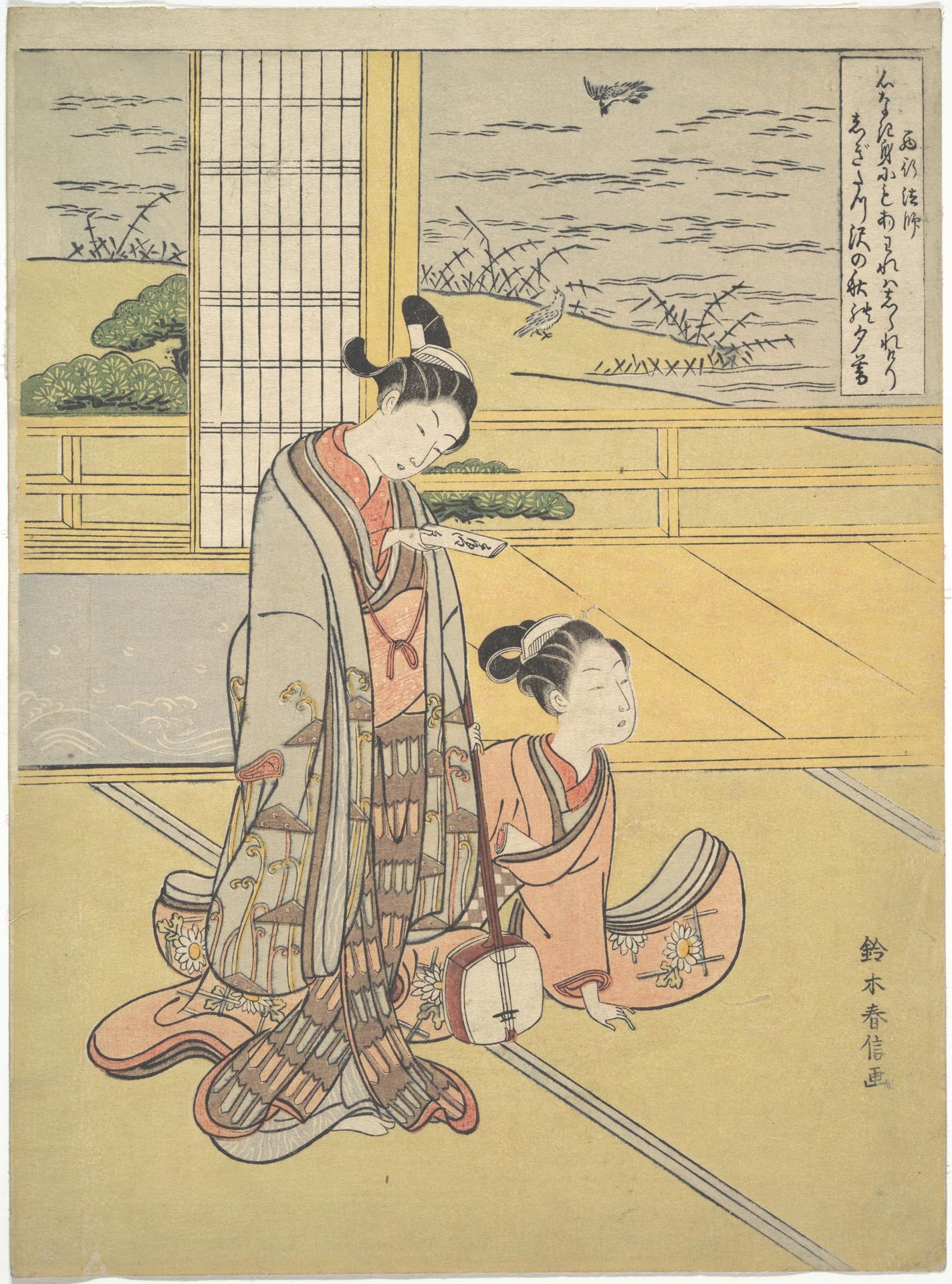
A Young Man and Woman with a Shamisen; Monk Saigyō
Original title: A Young Man and Woman with a Shamisen; Monk Saigyō, from a series alluding to the Three Evening Poems (Sanseki waka)
kurzbeschreibung
Suzuki Harunobu made this woodblock print around 1768. A young man and a young woman in traditional Japanese dress appear; she plucks a shamisen while he holds a sheet of paper. Executed in ink and color on paper, the print belongs to a series alluding to the three evening poems.
Description
Facing each other, the man and woman sit on a low bench. He holds a sheet of paper; she plays the shamisen. Their robes are decorated with floral patterns in warm pink and beige tones. A window opens onto a landscape with trees and birds, rendered in pastel blues and greens. The figures are placed symmetrically at the center, and the light seems evenly distributed.
Context
A major woodblock artist of the Edo period, Suzuki Harunobu is known for advancing multicolor printing (nishiki-e). The series refers to the 'Three Evening Poems' (Sanseki), a classical poetry collection in which the monk Saigyō is a central figure. Created at a time when woodblock prints were increasingly produced for an urban audience, the work reflects an interest in scenes of everyday life and literary allusions.
Impact
Clear lines and a delicate color palette create a calm, elegant atmosphere. The symmetrical arrangement of the figures and the even lighting give the image a harmonious balance. Through the quiet scene and fine detail, the viewer is drawn into the intimate stillness of the moment.
Technique
Ink and color are applied to paper; sharp contours and clearly separated areas of color characterize the eighteenth-century woodblock print. The format is a medium-sized block (chūban), measuring 28.4 x 21 cm.
AI-generated description text
Source: Metropolitan Museum of Art · Public Domain (CC0 1.0)