Waves on Moonlight
Original title: Waves on Moonlight
kurzbeschreibung
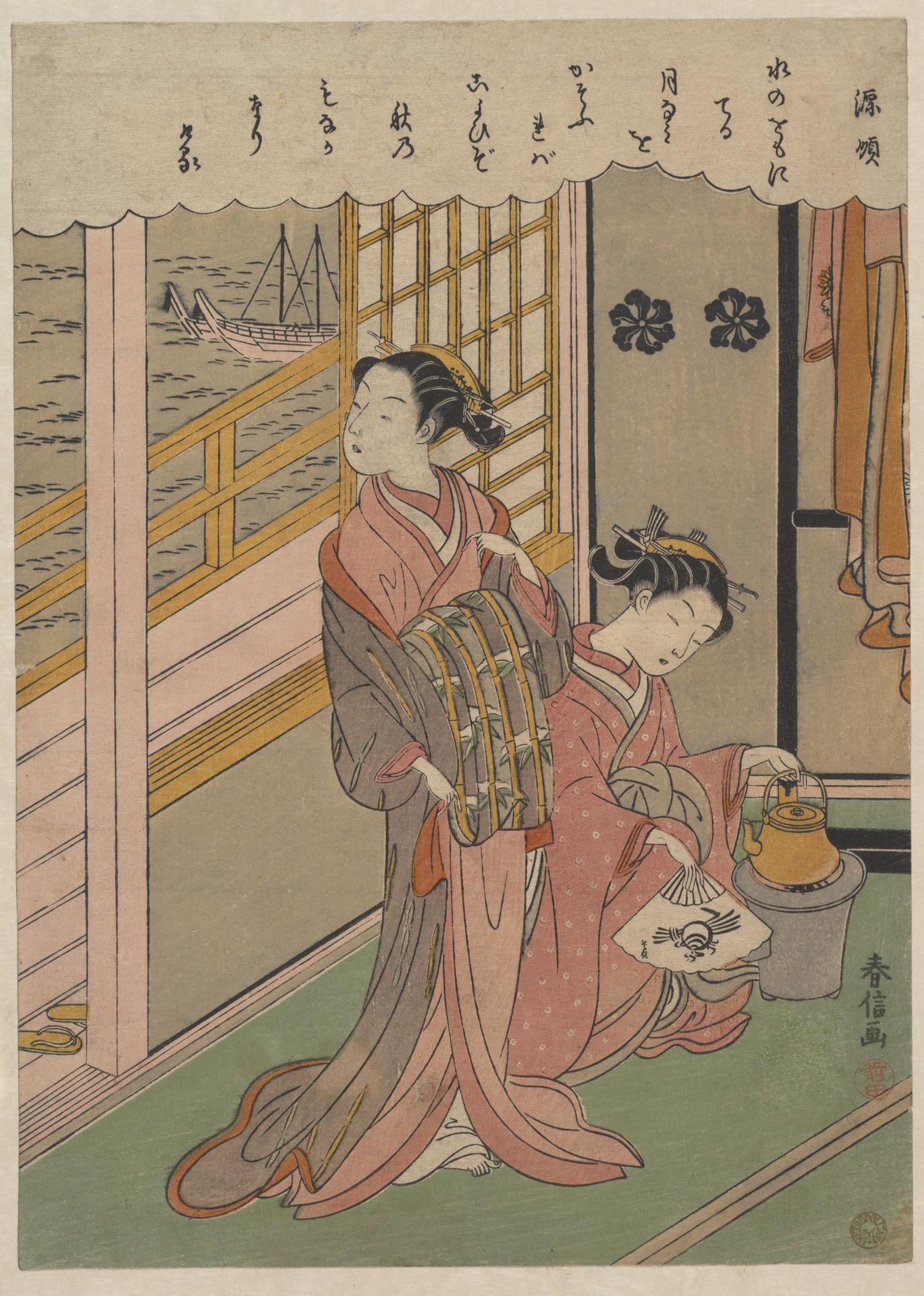
Suzuki Harunobu's colour woodblock print "Waves in Moonlight" dates from around 1768 and is one of those sheets that, instead of a purely interior scene, opens the view to the outside: two women in traditional Japanese dress appear in a room, and through an open door the eye is led out to the sea. The work is executed as a woodblock print with ink and colour on paper, measuring 27.9 × 20.3 cm.
Description
Unlike many contemporary bijin-ga, this print unites figure and landscape: one of the two women sits on the floor holding a tray with a teapot and a plate, while the other stands to the side and looks through an open door with a latticed window out to the sea, where sailing boats can be made out. Bright, friendly light floods the room and falls through the windows. The palette remains pastel, with pronounced tones of pink, grey and white. The layout feels symmetrical, the figures in the foreground, the sea behind. Along the upper edge run Chinese characters that could serve as a title or description.
Context
Suzuki Harunobu ranks among the defining Japanese woodblock masters of the eighteenth century; in the 1760s he introduced multicolour printing (nishiki-e). The sheet comes from the Edo period, an era of cultural flourishing and urban pleasure culture. Harunobu devoted himself mainly to pictures of elegant women (bijin-ga), often in everyday or literary scenes. The women's gaze toward the sea might allude to a classical poem, though no certain evidence for this exists.
Impact
The pastel tones and the incoming light create a calm, intimate mood. Through the symmetrical arrangement and clear lines the image gains something orderly, almost idyllic. The contrast between interior and sea view invites quiet contemplation.
Technique
Ink and colour were printed on paper for this sheet; the method is woodblock printing. Sharp lines and clearly defined areas of colour accord with the tradition of the Japanese colour woodblock print. The pastel nuances were achieved through the use of several printing blocks—a process that Harunobu brought to perfection.
AI-generated description text
Source: Metropolitan Museum of Art · Public Domain (CC0 1.0)