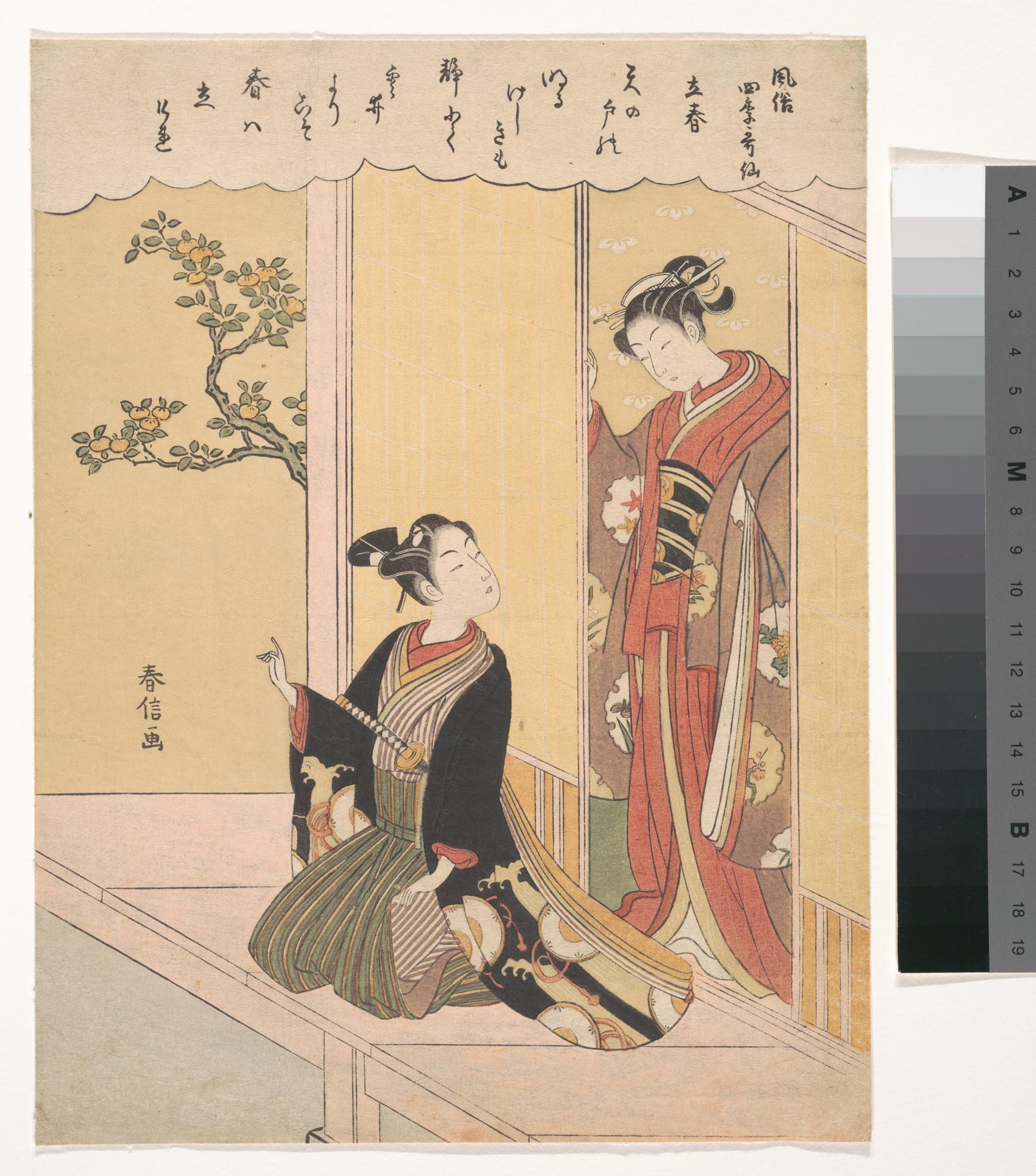
The First Day of Spring (Risshun), from the series Fashionable Poetic Immortals of the Four Seasons (Fūzoku shiki Kasen)
Original title: The First Day of Spring (Risshun), from the series Fashionable Poetic Immortals of the Four Seasons (Fūzoku shiki Kasen)
kurzbeschreibung
Suzuki Harunobu made this colour woodblock print around 1768 as part of the series Fūzoku shiki Kasen. Two women appear in an interior, printed in ink and colour on paper.
Description
Two women in traditional dress fill the picture: the one on the left sits on a bench and looks upward, while the one on the right stands and turns toward her. Their robes carry elaborate patterns in warm reds, yellows and browns, threaded with blue and green. Behind the figures rises a tree with fruit, most likely a mandarin orange. A wooden wall closes off the space, and the light falls evenly from the front.
Context
Harunobu is regarded as a pioneer of multicolour woodblock printing (nishiki-e) in the Edo period. The series ties inherited poetry to the fashion of its day. In this phase of his work the artist often turned to elegant scenes of women with poetic allusions. The first day of spring (risshun) refers to the Chinese calendar, which marks the turning of the seasons.
Impact
Clear lines and finely graded colours create a calm, balanced mood. The nearly symmetrical placing of the two figures gives the sheet a quiet equilibrium that invites the viewer to linger.
Technique
The image was printed as a woodblock in ink and colour on paper, with several blocks used for the different colours. Harunobu worked with delicate lines and flat areas of colour to render details such as patterns and the fall of folds precisely.
AI-generated description text
Source: Metropolitan Museum of Art · Public Domain (CC0 1.0)