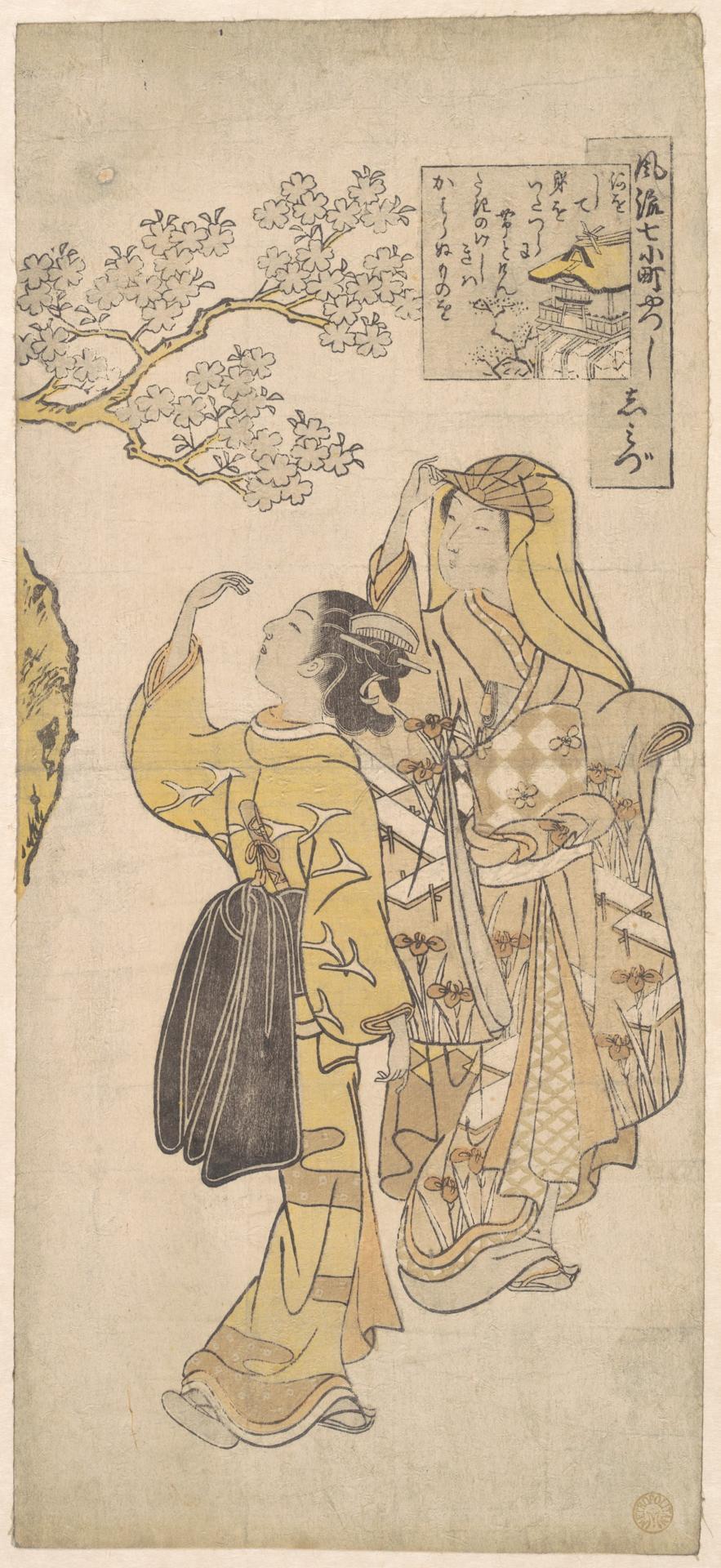
Shimizu Temple
Original title: Shimizu Temple
kurzbeschreibung
Two women stand beneath a flowering cherry tree, looking up at the blossoms; a small temple appears behind them. This print by Suzuki Harunobu, made around 1765, is a benizuri-e woodblock in the hosoban format.
Description
The figure on the left has raised her hand as if to touch the cherry blossoms; the one on the right holds a bouquet and gazes up at the flowers. Both wear kimonos with floral patterns, along with hair ornaments and small bags. A little roofed temple emerges behind them, surrounded by blossoms. In the upper right corner there is a small depiction of a temple with an inscription.
Context
Harunobu is regarded as a pioneer of nishiki-e (pictures of the western world) and from the 1760s produced multicolored woodblock prints. The Shimizu Temple in Kyoto is a well-known site, famous for its cherry blossoms. This print dates from the period when color woodblock printing was emerging and the benizuri-e technique, with its pink and green tones, was spreading.
Impact
A calm, contemplative mood emanates from the arrangement, carried by the delicate colors and the natural posture of the figures. The temple in the background links nature and architecture—a trait typical of Japanese aesthetics.
Technique
Woodblock print with ink and color on paper, executed in the benizuri-e technique with pink and green tones. The small hosoban format is characteristic of early Japanese color woodblock prints.
AI-generated description text
Source: Metropolitan Museum of Art · Public Domain (CC0 1.0)